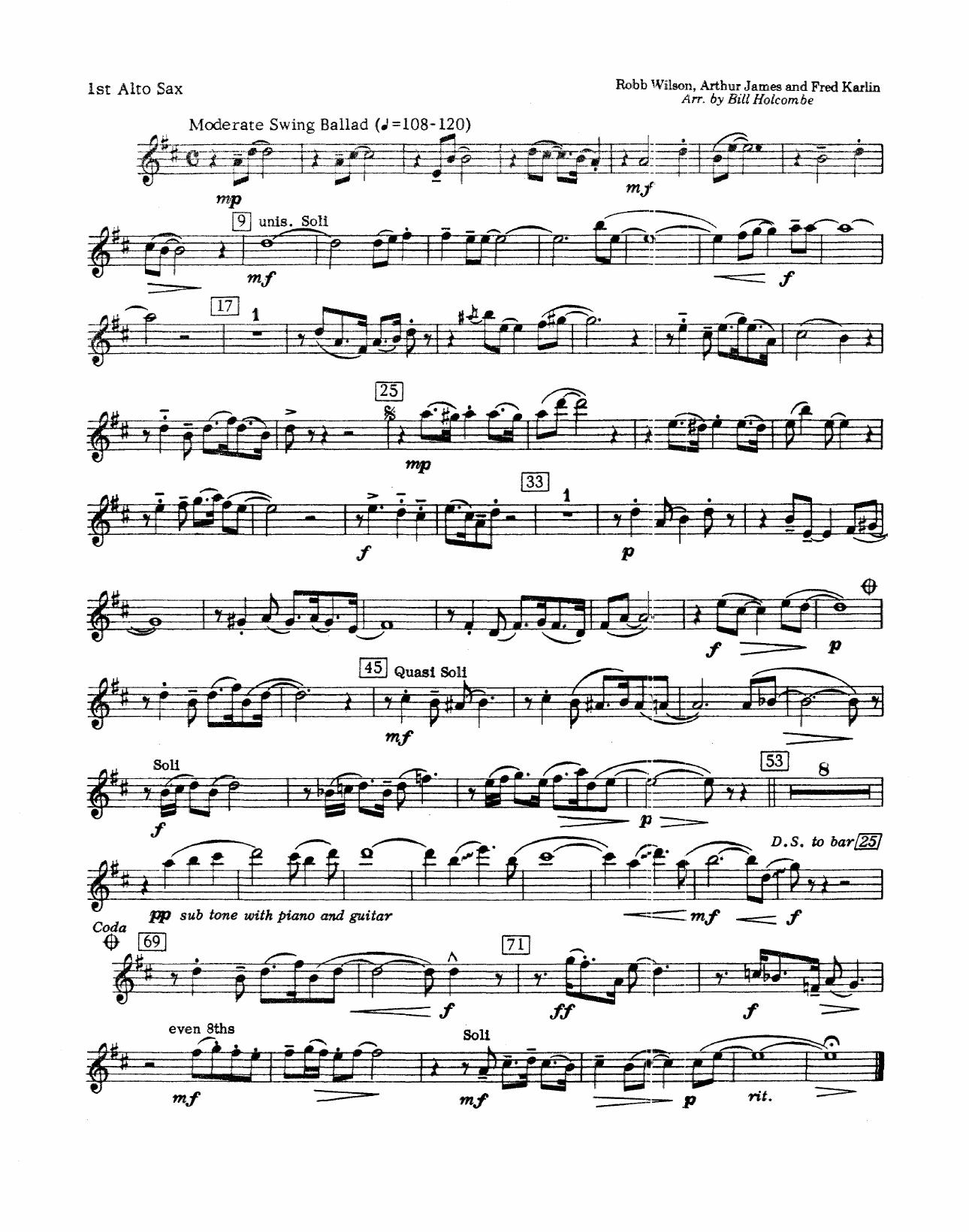
For All We Know (B.Holcombe)
Composed by Fred Karlin
Arranged by B.Holcombe
- Ensemble: Big Band
- Style: Jazz Standard
- Pages: 26
- Instruments (17): 1st Alto Sax, 2nd Alto Sax, 3rd Tenor Sax, 4th Tenor Sax, Baritone Sax, 1st Trumpet, 2nd Trumpet, 3rd Trumpet, 4th Trumpet, 1st Trombone, 2nd Trombone, 3rd Trombone, 4th (Bass) Trombone, Guitar, Bass, Drums, Piano
- Difficulty: medium
- Content: Individual Parts
- Format: PDF Download (Instant)
- Price: $24.99
"For All We Know," composed by Fred Karlin with lyrics by Robb Wilson and Arthur James, emerged as a poignant soft rock ballad for the 1970 film *Lovers and Other Strangers*. This Academy Award-winning song, though distinct from the 1934 jazz standard of the same title, quickly gained widespread recognition through the iconic 1971 recording by The Carpenters, which soared to the top of the charts and solidified its place in popular music history. Its enduring melody and reflective lyrics, exploring themes of enduring love and the passage of time, have made it a beloved piece, frequently covered across various genres and appreciated for its tender, introspective quality. B. Holcombe's big band arrangement transforms this classic into a lush, expressive jazz vehicle, ideally suited for a medium-slow ballad tempo in a comfortable, lyrical key. The musical character is one of heartfelt warmth and sophisticated elegance, designed to evoke a sense of nostalgic romance and gentle introspection. Holcombe masterfully reinterprets the original's emotional depth through the rich palette of the modern big band, maintaining the song's inherent beauty while infusing it with a distinctive jazz sensibility. The arrangement balances the song's pop origins with sophisticated harmonic language, creating a sound that is both accessible and musically rewarding. B. Holcombe, a prolific arranger and composer known for his extensive work with big bands and symphony orchestras, brings his signature blend of melodic clarity and harmonic richness to this piece. Drawing on his background as a woodwind doubler and his experience arranging for diverse ensembles, Holcombe's approach is characterized by intelligent voicings, particularly within the saxophone section, and carefully crafted brass textures that provide both warmth and subtle power. Expect smooth, interwoven lines, often featuring the saxophone section carrying the initial melodic statements, followed by full ensemble passages that swell with emotional resonance. While not a typical "shout chorus" arrangement, there are moments of collective power that build dynamically, culminating in a deeply satisfying ensemble sound. This arrangement features the melody primarily carried by the lead alto saxophone, often doubled or harmonized by other saxophones, creating a smooth, vocal-like quality. Opportunities for featured solos are thoughtfully integrated, typically for tenor saxophone or trumpet, allowing for expressive improvisation over the song's familiar chord changes. Technical challenges lie more in achieving a cohesive, blended ensemble sound, precise dynamics, and a unified emotional delivery rather than virtuosic individual passages. The rewarding aspect of performing this chart comes from its ability to connect with audiences through its timeless melody and the sheer beauty of the big band's collective expression. This arrangement is highly suitable for college and advanced high school jazz ensembles, as well as community and professional bands seeking a sophisticated and emotive ballad for their repertoire. It offers an excellent opportunity to develop ensemble blend, dynamic control, and expressive phrasing. This arrangement thrives on a medium-slow ballad tempo, typically around 60-72 beats per minute, emphasizing a relaxed, flowing feel rather than a strict metronomic pulse. Conductors should encourage musicians to focus on long, sustained phrases and a warm, blended tone, particularly within the saxophone section which frequently carries the melodic lead. Dynamics are crucial; subtle swells and diminuendos will enhance the emotional arc of the piece. Technical challenges include maintaining intonation in sustained chords, especially in the brass, and achieving a seamless transition between soli sections and full ensemble passages. Encourage brass players to use cup mutes where indicated for specific color, ensuring they blend rather than overpower. Rehearsal time should be dedicated to shaping phrases, listening across sections, and allowing soloists the space to develop their improvisational ideas expressively over the rich harmonic backdrop. Q: What instruments and parts are included in this arrangement? A: This big band arrangement is scored for 17 instruments, including Alto Saxophone 1, Alto Saxophone 2, Tenor Saxophone 3, Tenor Saxophone 4, Baritone Saxophone, four Trumpets, four Trombones, Piano, Bass, and Drums. A full conductor's score is also provided. Q: What is the difficulty level of this arrangement? A: This arrangement is rated as medium-advanced. It requires strong ensemble blend, good dynamic control, and mature phrasing from all sections, making it appropriate for college, advanced high school, community, and professional jazz ensembles. Q: What is the historical and musical context of "For All We Know" in this arrangement? A: This arrangement features the 1970 song "For All We Know," composed by Fred Karlin, which gained fame through The Carpenters' iconic recording. It is a tender ballad known for its expressive melody and romantic lyrical themes, distinct from the 1934 jazz standard of the same title. Q: What makes B. Holcombe's arrangement of "For All We Know" unique? A: B. Holcombe's arrangement is distinguished by its sophisticated voicings, particularly in the saxophone section, and its ability to translate the original song's emotional depth into a rich big band texture. It balances the song's pop origins with a refined jazz harmonic language, creating an elegant and expressive ballad. Q: What is the approximate performance duration and recommended tempo for this piece? A: The approximate performance duration is typically around 4-5 minutes, depending on the length of improvised solos. The recommended tempo is a medium-slow ballad, around 60-72 beats per minute, emphasizing a lyrical and flowing feel.
Questions and answers
- What is included in the For All We Know (B.Holcombe) PDF?
- The verified current file contains a conductor score and individual parts across 26 pages.
- How many instruments or parts are listed for For All We Know (B.Holcombe)?
- The verified instrumentation list contains 17 entries for this Big Band arrangement.
- Who is credited for For All We Know (B.Holcombe)?
- Composer: Fred Karlin. Arranger: B.Holcombe.
- What difficulty is listed for For All We Know (B.Holcombe)?
- The verified difficulty level is medium.
- What style is listed for For All We Know (B.Holcombe)?
- The catalog lists the style as Jazz Standard.
- Can I preview For All We Know (B.Holcombe) before buying?
- Yes. The product page provides a preview generated from the current PDF file.
- How is For All We Know (B.Holcombe) delivered?
- After successful payment, the digital PDF is made available for download. The displayed price is $24.99.
Musicians Also Search For
For All We Know B.Holcombe PDF • For All We Know B.Holcombe sheet music • For All We Know arranged by B.Holcombe • B.Holcombe big band charts • B.Holcombe jazz arrangements PDF • For All We Know Fred Karlin sheet music • For All We Know Fred Karlin big band arrangements • Fred Karlin big band charts • For All We Know big band arrangements • For All We Know big band PDF download • For All We Know jazz sheet music • big band sheet music download • For All We Know conductor score PDF • For All We Know individual parts download • For All We Know sheet music PDF • For All We Know Jazz Standard charts • Jazz Standard big band arrangements • buy For All We Know sheet music • download For All We Know PDF • For All We Know jazz charts • best B.Holcombe big band arrangements • Fred Karlin arranged by B.Holcombe • For All We Know printable sheet music • big band repertoire PDF