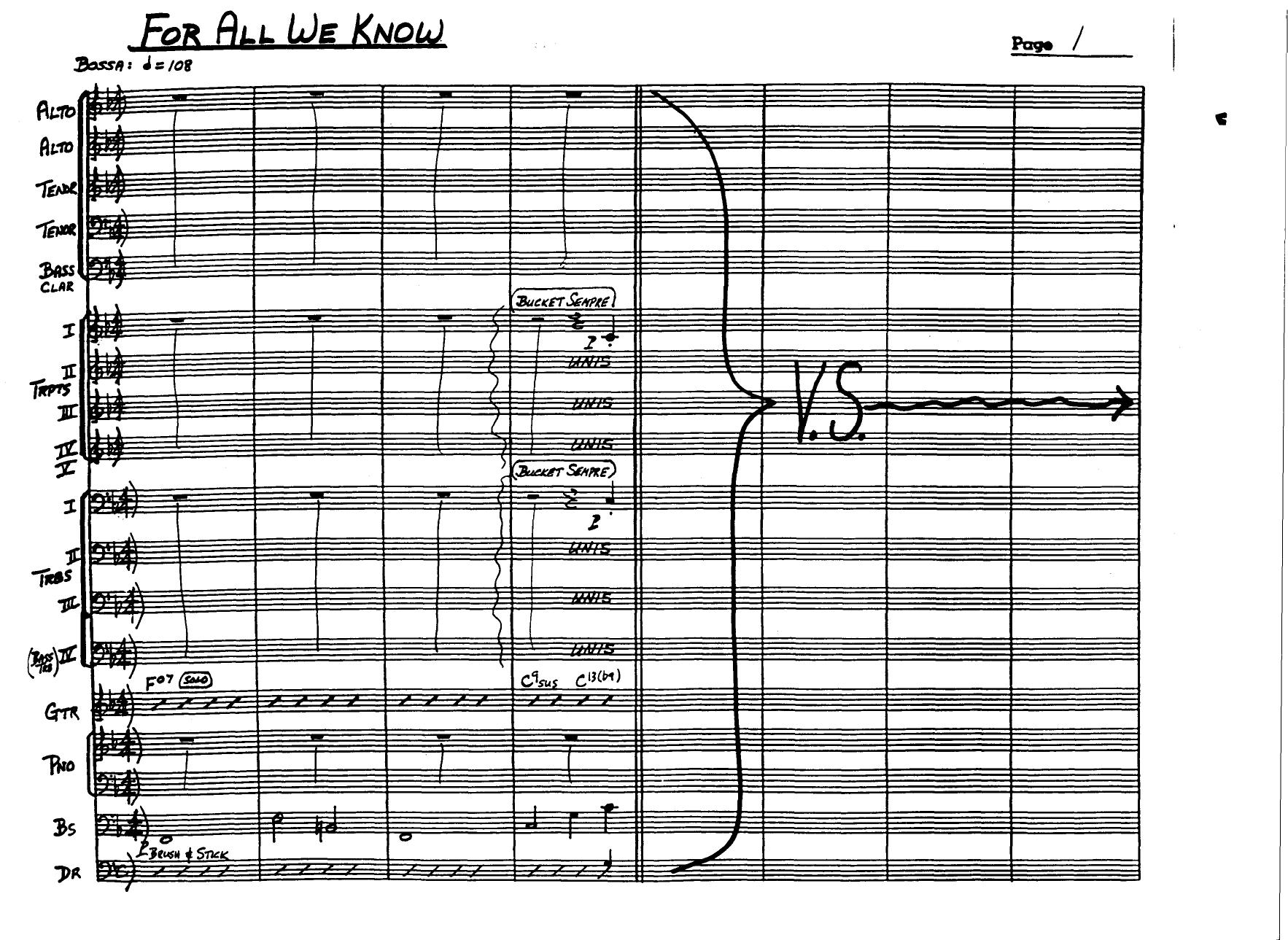
For All We Know (J.Clayton)
Composed by J. Fred Coots
Arranged by John Clayton
- Ensemble: Big Band
- Pages: 55
- Instruments (19): Alto Sax 1, Alto Sax 2, Tenor Sax 1, Tenor Sax 2, Bass Clarinet, Baritone Sax, Trumpet 1, Trumpet 2, Trumpet 3, Trumpet 4, Trumpet 5, Trombone 1, Trombone 2, Trombone 3, Bass Trombone 4, Guitar, Piano, Bass, Drums
- Difficulty: advanced
- Content: Individual Parts
- Format: PDF Download (Instant)
- Price: $24.99
Written by J. Fred Coots with lyrics by Sam M. Lewis, "For All We Know" entered the American Songbook in 1934 and quickly transcended its origins as a popular song to become a touchstone for jazz improvisers. Over the decades, definitive interpretations by vocalists like Billie Holiday and instrumental icons such as Bill Evans cemented its status as a vehicle for profound harmonic exploration and emotional vulnerability. Within the jazz idiom, the tune is revered for its haunting, descending melody and sophisticated underlying chord changes, which naturally invite lush, expansive reharmonizations. Master bassist, composer, and arranger John Clayton approaches this timeless standard as a tender, deeply expressive ballad centered around a luxuriant, rich harmonic palette. Unfolding at a slow, contemplative tempo, the arrangement establishes an atmosphere of intimate reflection before expanding into massive, cinematic climaxes. Clayton avoids predictable big band tropes, instead utilizing translucent woodwind voicings, subtle brass pedal points, and sophisticated chord extensions that evoke the sophisticated writing style associated with the Clayton-Hamilton Jazz Orchestra. The mood shifts fluidly from quiet introspection to soaring, passionate resonance, making it an emotional centerpiece for any concert program. The arrangement places a heavy emphasis on dynamic control, ensemble blend, and rubato phrasing, demanding absolute precision from all nineteen instruments. The saxophone section—featuring two altos, two tenors, and baritone—frequently acts as a unified choir, delivering gorgeous, interlocking solis that require immaculate intonation and breath support. While the full ensemble swells into rich, textured shout choruses, the arrangement leaves ample room for a featured soloist to navigate the changes with expressive freedom. The primary technical challenges lie not in fast fingerwork, but in the sustained breath control, balance, and emotional maturity required to maintain tension and release across the slow-moving harmonic landscape. Advanced collegiate, community, and professional big bands will find this chart to be an exceptionally rewarding addition to their repertoire. Because success with this arrangement relies entirely on a mature ensemble concept—including impeccable section blend, sophisticated rubato control, and refined dynamic gradation—it serves as a premier vehicle for showcasing an orchestra's collective musicianship. Directors seeking a sophisticated, emotionally resonant ballad that pushes an ensemble to listen deeply across sections will discover that John Clayton's treatment of "For All We Know" is a masterclass in modern big band arranging. Navigating John Clayton’s arrangement of "For All We Know" requires an extraordinary level of patience, active listening, and dynamic discipline from the entire ensemble. The conductor must establish a fluid, conversational sense of time rather than a rigid metronomic pulse, allowing the rubato-like phrasing to breathe naturally. Technically, the greatest challenge for the brass and reed sections is sustaining a warm, centered tone at ultra-soft dynamic levels (pianissimo to mezzo-piano) without losing pitch center. Reeds should focus on achieving a homogeneous choir sound during the intricate chord voicings, ensuring no single voice sticks out unless explicitly marked with the melody. For the rhythm section, the piano and guitar should voice chords sparsely, leaving plenty of space and avoiding clutter underneath the horns. The bassist plays a crucial foundational role, anchoring the rich harmonic shifts with a deep, resonant tone that supports Clayton’s signature chord extensions. Rehearsal should begin by having the sections isolate and practice their chord balances a cappella, paying close attention to internal tuning on the altered and extended dominants. Directors should emphasize that the emotional power of this chart stems from restraint; hold back the full force of the brass until the designated climactic moments to maximize their dramatic impact. Q: What instruments and parts are included in this big band arrangement? A: This 55-page publication includes a full conductor score and 19 standard big band instrumental parts, specifically configured for 5 saxophones (Alto 1, Alto 2, Tenor 1, Tenor 2, Baritone), 4 trumpets, 4 trombones, and a full 4-piece rhythm section (piano, bass, drums, guitar). Q: What is the difficulty level of this John Clayton chart? A: This arrangement is designated for advanced ensembles, typically suited for top-tier college, university, community, and professional big bands due to its heavy demands on intonation, dynamic control, and mature musical interpretation. Q: What is the style and historical background of this piece? A: It is a jazz ballad based on J. Fred Coots's 1934 standard, arranged in a contemporary, sophisticated orchestral style that draws on the rich tradition of the Clayton-Hamilton Jazz Orchestra. Q: What makes this specific arrangement by John Clayton unique? A: Clayton transforms a classic standard into a cinematic journey by utilizing translucent woodwind voicings, lush reharmonizations, and dynamic contrast that avoids predictable big band formulas in favor of deep emotional expression. Q: What is the expected performance duration and tempo feel? A: The piece is structured as a slow, expressive ballad performed with a rubato-influenced, free-flowing pulse, typically lasting between 4 to 6 minutes depending on the soloist's cadenza and the conductor's chosen tempo.
Questions and answers
- What is included in the For All We Know (J.Clayton) PDF?
- The verified current file contains a conductor score and individual parts across 55 pages.
- How many instruments or parts are listed for For All We Know (J.Clayton)?
- The verified instrumentation list contains 19 entries for this Big Band arrangement.
- Who is credited for For All We Know (J.Clayton)?
- Composer: J. Fred Coots. Arranger: John Clayton.
- What difficulty is listed for For All We Know (J.Clayton)?
- The verified difficulty level is advanced.
- Can I preview For All We Know (J.Clayton) before buying?
- Yes. The product page provides a preview generated from the current PDF file.
- How is For All We Know (J.Clayton) delivered?
- After successful payment, the digital PDF is made available for download. The displayed price is $24.99.
Musicians Also Search For
For All We Know John Clayton PDF • For All We Know John Clayton sheet music • For All We Know arranged by John Clayton • John Clayton big band charts • John Clayton jazz arrangements PDF • For All We Know J. Fred Coots sheet music • For All We Know J. Fred Coots big band arrangements • J. Fred Coots big band charts • For All We Know big band arrangements • For All We Know big band PDF download • For All We Know jazz sheet music • big band sheet music download • For All We Know conductor score PDF • For All We Know individual parts download • For All We Know sheet music PDF • buy For All We Know sheet music • download For All We Know PDF • For All We Know jazz charts • best John Clayton big band arrangements • J. Fred Coots arranged by John Clayton • For All We Know printable sheet music • big band repertoire PDF