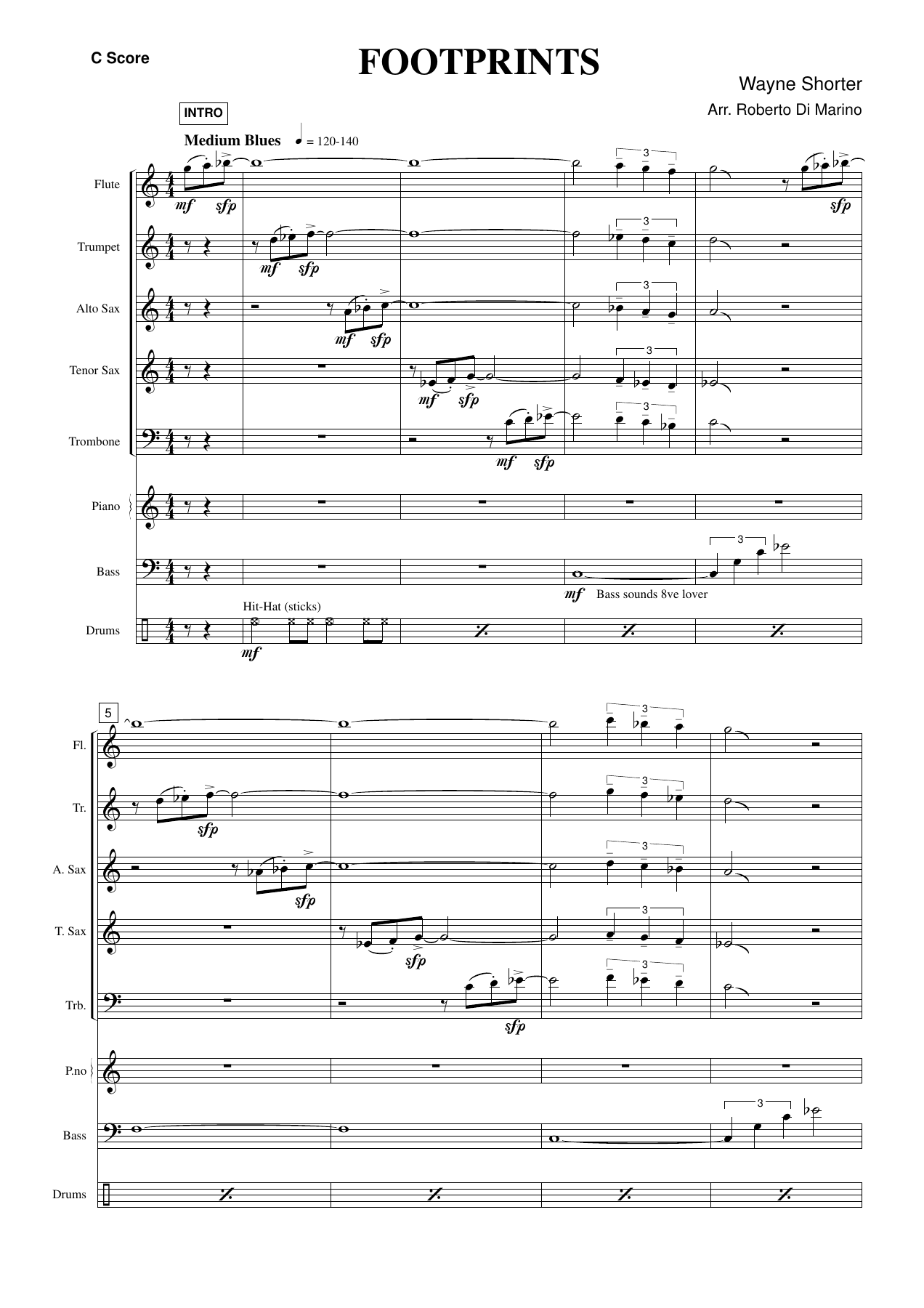
Footprints (W.Shorter) sheet music preview

Footprints (W.Shorter)

Composed by Wayne Shorter

Arranged by Roberto Di Marino

  • Ensemble: Small Ensemble
  • Style: Jazz Standard
  • Pages: 6
  • Instruments (8): Flute, Trumpet, Alto Sax, Tenor Sax, Trombone, Piano, Bass, Drums
  • Difficulty: easy
  • Content: Individual Parts
  • Format: PDF Download (Instant)
  • Price: $12.99

Wayne Shorter's iconic composition, "Footprints," emerged from the fertile ground of mid-1960s jazz, a period marked by profound innovation and the evolution of post-bop into modal and avant-garde expressions. Composed in 1966, the piece first appeared on Shorter's album *Adam's Apple*, though its commercial debut was on the Miles Davis Quintet's seminal album *Miles Smiles* in the same year, solidifying its place in the jazz canon. This era, often referred to as the "Second Great Quintet" period for Miles Davis, saw Shorter as a primary compositional voice, contributing pieces that pushed harmonic and rhythmic boundaries. "Footprints" quickly became a jazz standard due to its distinctive blend of a 12-bar C minor blues form with an unconventional, chromatically shifting turnaround and its innovative rhythmic structure. It masterfully navigates between a triple meter (often 6/8 or 6/4) and a 4/4 swing feel, famously exemplified by Tony Williams' drumming and Ron Carter's bassline on the *Miles Smiles* recording, which incorporated an Afro-Cuban "tresillo" rhythm. This rhythmic interplay, coupled with modal harmonies and a memorable melody, imbues the piece with a mysterious, introspective, yet deeply grooving character, evoking a sense of forward motion and timeless exploration. Roberto Di Marino's arrangement of "Footprints" thoughtfully interprets this jazz classic for a small ensemble, preserving its essential character while offering fresh perspectives. Di Marino, known for his meticulous and often sophisticated approach to jazz and classical arrangements, typically emphasizes clear voicings, harmonic richness, and idiomatic writing for each instrument. His work often balances reverence for the original material with subtle contemporary touches, making his arrangements both authentic and engaging. For "Footprints," expect an arrangement that highlights the piece's rhythmic complexities and harmonic nuances through carefully crafted ensemble passages and perhaps reharmonizations that expand upon Shorter's original modal framework without betraying its spirit. The arrangement likely features interwoven melodic lines and counterpoint, showcasing the ensemble's individual voices within a cohesive texture. Performance of this arrangement promises a rewarding experience for intermediate to advanced small jazz ensembles. The melody, initially presented by a lead voice, will likely be passed between instruments, demanding strong lyrical playing and blend. Expect featured solo sections, offering improvisational opportunities over the piece's unique C minor blues form with its signature altered turnaround. Technical challenges will include maintaining the precise rhythmic feel, particularly in navigating the shifts or superimpositions between triple and duple meters, and executing Di Marino's potentially intricate voicings and harmonic movements. The arrangement is suitable for college-level jazz combos, community jazz ensembles with proficient musicians, and even professional groups seeking a refined and engaging take on a beloved standard. Its six pages suggest a concise yet comprehensive treatment, allowing for focused rehearsal and impactful performance. Conductors and musicians approaching this arrangement should prioritize rhythmic precision and dynamic contour. The core challenge lies in articulating the subtle yet persistent rhythmic tension between the implied 6/8 feel of the melody and the underlying 4/4 pulse, especially in the bassline. Encourage the rhythm section to lock into a deep, unhurried groove that allows the melodic instruments to float above with expressive freedom. Pay close attention to Di Marino's voicings, ensuring balance and clarity, particularly in any soli sections where intricate harmonies are exposed. Soloists should be encouraged to explore the C Dorian mode and the chromatic possibilities inherent in the turnaround, drawing inspiration from the original recordings' exploratory spirit. Rehearsal time should be dedicated to isolating and perfecting the rhythmic interplay between bass and drums, as well as the ensemble's articulation of the head and any written-out ensemble figures. **Q: What instruments are included in this small ensemble arrangement?** A: While specific instrumentation can vary, a typical small ensemble arrangement by Roberto Di Marino for "Footprints" would likely include parts for a lead melodic instrument (e.g., flute or soprano saxophone), trumpet, alto saxophone, tenor saxophone, trombone, piano, bass, and drums. **Q: What is the difficulty level of this arrangement?** A: This arrangement is generally considered suitable for intermediate to advanced jazz ensembles, including college-level combos, proficient community groups, and professional small ensembles, due to its rhythmic complexities and harmonic demands. **Q: What is the musical style and historical context of "Footprints"?** A: "Footprints" is a jazz standard composed by Wayne Shorter in 1966, representing the post-bop and modal jazz era. It is characterized by its unique 12-bar C minor blues form with an altered turnaround and a distinctive rhythmic interplay between triple and duple meters. **Q: What makes Roberto Di Marino's arrangement of "Footprints" unique?** A: Roberto Di Marino's arrangements are known for their sophisticated voicings, harmonic richness, and meticulous attention to detail, often balancing reverence for the original material with subtle contemporary touches and idiomatic writing for each instrument. **Q: What is the typical performance duration or tempo for "Footprints"?** A: "Footprints" is typically performed at a medium tempo, often around 120-140 bpm, with a fluid, often alternating feel between 6/8 and 4/4, allowing for expressive melodic and improvisational development.

Questions and answers

What is included in the Footprints (W.Shorter) PDF?
The verified current file contains a conductor score across 6 pages.
How many instruments or parts are listed for Footprints (W.Shorter)?
The verified instrumentation list contains 8 entries for this Small Ensemble arrangement.
Who is credited for Footprints (W.Shorter)?
Composer: Wayne Shorter. Arranger: Roberto Di Marino.
What difficulty is listed for Footprints (W.Shorter)?
The verified difficulty level is easy.
What style is listed for Footprints (W.Shorter)?
The catalog lists the style as Jazz Standard.
Can I preview Footprints (W.Shorter) before buying?
Yes. The product page provides a preview generated from the current PDF file.
How is Footprints (W.Shorter) delivered?
After successful payment, the digital PDF is made available for download. The displayed price is $12.99.

Musicians Also Search For

Footprints Roberto Di Marino PDFFootprints Roberto Di Marino sheet musicFootprints arranged by Roberto Di MarinoRoberto Di Marino small ensemble chartsRoberto Di Marino jazz arrangements PDFFootprints Wayne Shorter sheet musicFootprints Wayne Shorter small ensemble arrangementsWayne Shorter small ensemble chartsFootprints small ensemble arrangementsFootprints small ensemble PDF downloadFootprints jazz sheet musicsmall ensemble sheet music downloadFootprints conductor score PDFFootprints sheet music PDFFootprints Jazz Standard chartsJazz Standard small ensemble arrangementsbuy Footprints sheet musicdownload Footprints PDFFootprints jazz chartsbest Roberto Di Marino small ensemble arrangementsWayne Shorter arranged by Roberto Di MarinoFootprints printable sheet musicsmall ensemble repertoire PDF

All arrangements by Roberto Di Marino All Wayne Shorter sheet music