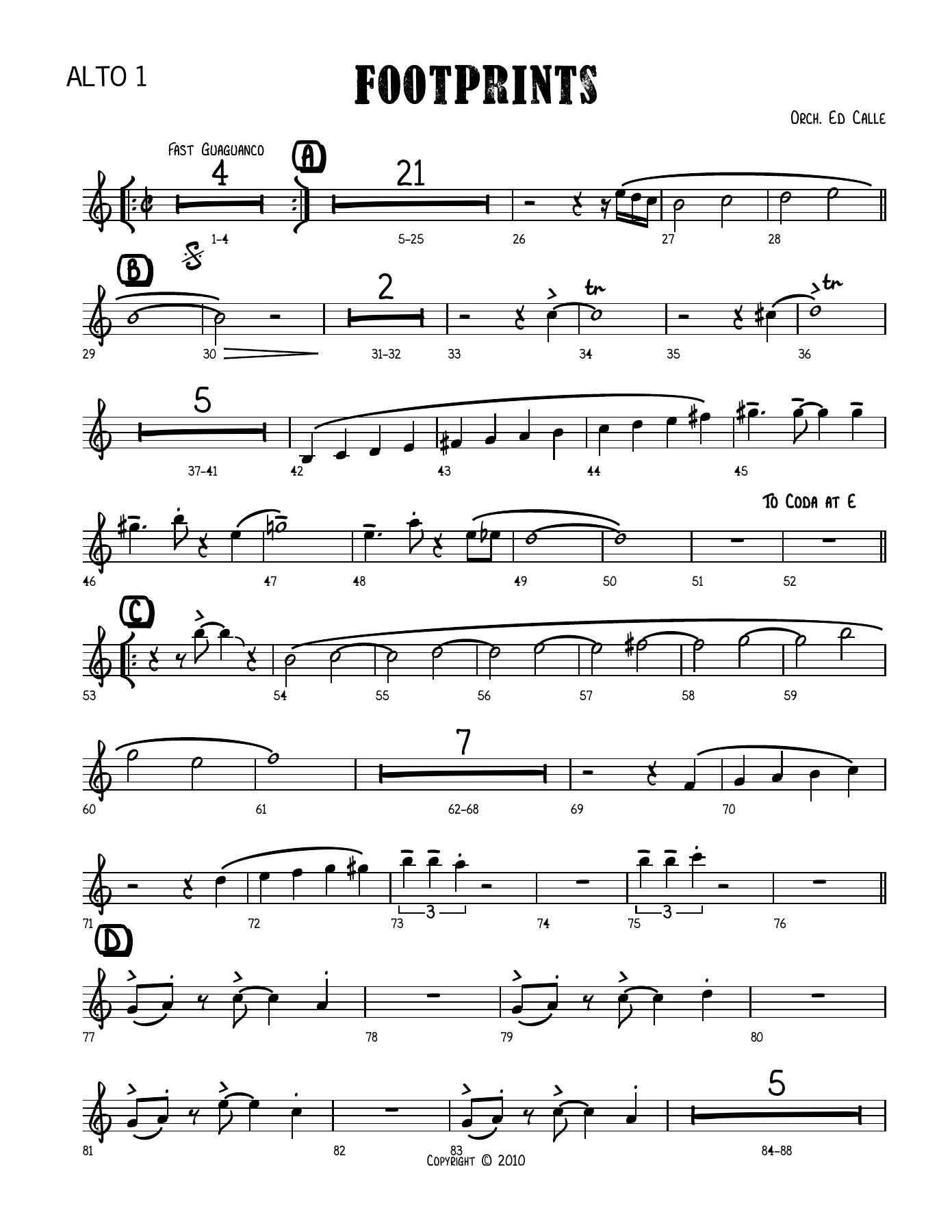
Footprints (Ed Calle)
Composed by Wayne Shorter
Arranged by Arturo Sandoval-Ed Calle
- Ensemble: Big Band
- Style: Jazz Standard
- Pages: 42
- Instruments (18): Alto 1, Alto 2, Tenor 1, Tenor 2, Bari. Sax., Trumpet 1, Trumpet 2, Trumpet 3, Trumpet 4, Trombone 1, Trombone 2, Trombone 3, Bass Trombone, Piano, Guitar, Bass Guitar, Drums, Flute
- Difficulty: medium
- Content: Individual Parts
- Format: PDF Download (Instant)
- Price: $24.99
Wayne Shorter's "Footprints," first appearing on his seminal 1966 Blue Note album *Adam's Apple* and later famously recorded by Miles Davis's Second Great Quintet on *Miles Smiles*, stands as an enduring cornerstone of modal and post-bop jazz. Its distinctive 6/4 time signature, haunting minor-key melody, and cyclical harmonic progression immediately set it apart, establishing it as a touchstone for improvisers and arrangers alike. The original recording, characterized by its enigmatic groove and Shorter's lyrical yet angular saxophone work, encapsulates the innovative spirit of the mid-1960s, pushing beyond conventional bebop structures into a more open, exploratory soundscape. This composition’s enduring popularity stems from its unique rhythmic feel and its capacity to inspire diverse interpretations, making it a true jazz standard. This particular big band arrangement, a collaboration between the legendary Arturo Sandoval and the virtuosic Ed Calle, reimagines "Footprints" with a vibrant, contemporary Latin-jazz flair. Departing from the original's more introspective modal feel, Sandoval and Calle infuse the piece with an infectious, medium-up Latin groove, likely a sophisticated bossa or samba hybrid, immediately shifting its character to one of energetic sophistication. The arrangement is anchored in a minor key, preserving the original's melodic integrity, but the harmonic language is expanded with rich, modern voicings that reflect both Sandoval's fiery trumpet legacy and Calle's expressive saxophone artistry. Expect a dynamic interplay between sections, with brass and saxophones engaging in intricate call-and-response figures and powerful unison lines. The arranger's approach is characterized by a masterful blend of orchestral color and rhythmic propulsion. The iconic melody is initially presented by the saxophone section, often in tight, harmonized voicings, before being passed to the brass, creating textural variety. Feature solos are prominently placed, offering ample opportunity for an alto saxophone soloist, a trumpet soloist, and potentially a tenor saxophone soloist to showcase their improvisational prowess over the driving Latin rhythm section. The arrangement builds through carefully constructed soli sections for both saxes and brass, culminating in an exhilarating shout chorus that showcases the full power and precision of the big band. Technical challenges include navigating complex rhythmic figures in the Latin groove, maintaining precise ensemble articulation, and executing the extended harmonic voicings with clarity and balance. The reward lies in performing a fresh, high-energy interpretation of a classic, providing both a challenging and deeply satisfying musical experience. This arrangement is ideally suited for advanced high school, collegiate, community, or professional big bands. Its demands in terms of rhythmic accuracy, ensemble blend, and improvisational skill require a mature and experienced ensemble. The intricate voicings and dynamic contrasts necessitate a band with strong section leaders and a conductor capable of shaping a nuanced and powerful performance. The Latin-jazz idiom, while accessible, requires a rhythm section adept at maintaining a consistent and authentic groove, making it an excellent vehicle for developing rhythmic precision and stylistic authenticity within a big band context. Conductors should emphasize a consistent, driving medium-up Latin groove from the rhythm section, ensuring the bass and drums lock in tightly to establish the foundation. Articulation is paramount; brass figures should be crisp and precise, while saxophone lines require a blend of legato phrasing and rhythmic bite. Pay close attention to the dynamic markings, as the arrangement utilizes significant contrasts to build tension and release. Soloists should be encouraged to embrace the Latin-jazz idiom, utilizing appropriate rhythmic and melodic vocabulary. Rehearsal time should be dedicated to balancing the dense harmonic voicings, particularly in the soli sections, to ensure clarity and impact. The 6/4 time signature, while consistent, may require initial rhythmic drilling to ensure all sections feel the pulse uniformly. Q: What instruments are included in this arrangement? A: This big band arrangement includes parts for 17 instruments: Alto Saxophone 1, Alto Saxophone 2, Tenor Saxophone 1, Tenor Saxophone 2, Baritone Saxophone, Trumpet 1, Trumpet 2, Trumpet 3, Trumpet 4, Trombone 1, Trombone 2, Trombone 3, Trombone 4, Piano, Bass, Drums, and Guitar. Q: What is the difficulty level of "Footprints (Ed Calle)"? A: This arrangement is considered advanced, suitable for collegiate, advanced high school, community, or professional big bands due to its complex rhythmic figures, extended harmonies, and demands on ensemble precision and improvisational skill. Q: How does this arrangement's style differ from the original Wayne Shorter composition? A: While retaining Wayne Shorter's original melody and harmonic foundation, this arrangement by Arturo Sandoval and Ed Calle transforms "Footprints" into a vibrant, medium-up Latin-jazz piece, departing from the original's more modal and introspective post-bop feel. Q: What makes this specific arrangement unique or distinctive? A: This arrangement is unique for its infusion of a sophisticated Latin groove, rich contemporary voicings, and the combined artistic signature of Arturo Sandoval and Ed Calle, offering a fresh, high-energy interpretation of a jazz standard with prominent solo features and powerful shout choruses. Q: What is the typical performance duration or tempo for this piece? A: "Footprints (Ed Calle)" is designed as a medium-up Latin-jazz piece. While exact duration can vary with improvisation, a typical performance would likely range from 6 to 8 minutes, depending on the length of the featured solos.
Questions and answers
- What is included in the Footprints (Ed Calle) PDF?
- The verified current file contains individual parts across 42 pages.
- How many instruments or parts are listed for Footprints (Ed Calle)?
- The verified instrumentation list contains 18 entries for this Big Band arrangement.
- Who is credited for Footprints (Ed Calle)?
- Composer: Wayne Shorter. Arranger: Arturo Sandoval-Ed Calle.
- What difficulty is listed for Footprints (Ed Calle)?
- The verified difficulty level is medium.
- What style is listed for Footprints (Ed Calle)?
- The catalog lists the style as Jazz Standard.
- Can I preview Footprints (Ed Calle) before buying?
- Yes. The product page provides a preview generated from the current PDF file.
- How is Footprints (Ed Calle) delivered?
- After successful payment, the digital PDF is made available for download. The displayed price is $24.99.
Musicians Also Search For
Footprints Arturo Sandoval-Ed Calle PDF • Footprints Arturo Sandoval-Ed Calle sheet music • Footprints arranged by Arturo Sandoval-Ed Calle • Arturo Sandoval-Ed Calle big band charts • Arturo Sandoval-Ed Calle jazz arrangements PDF • Footprints Wayne Shorter sheet music • Footprints Wayne Shorter big band arrangements • Wayne Shorter big band charts • Footprints big band arrangements • Footprints big band PDF download • Footprints jazz sheet music • big band sheet music download • Footprints individual parts download • Footprints sheet music PDF • Footprints Jazz Standard charts • Jazz Standard big band arrangements • buy Footprints sheet music • download Footprints PDF • Footprints jazz charts • best Arturo Sandoval-Ed Calle big band arrangements • Wayne Shorter arranged by Arturo Sandoval-Ed Calle • Footprints printable sheet music • big band repertoire PDF