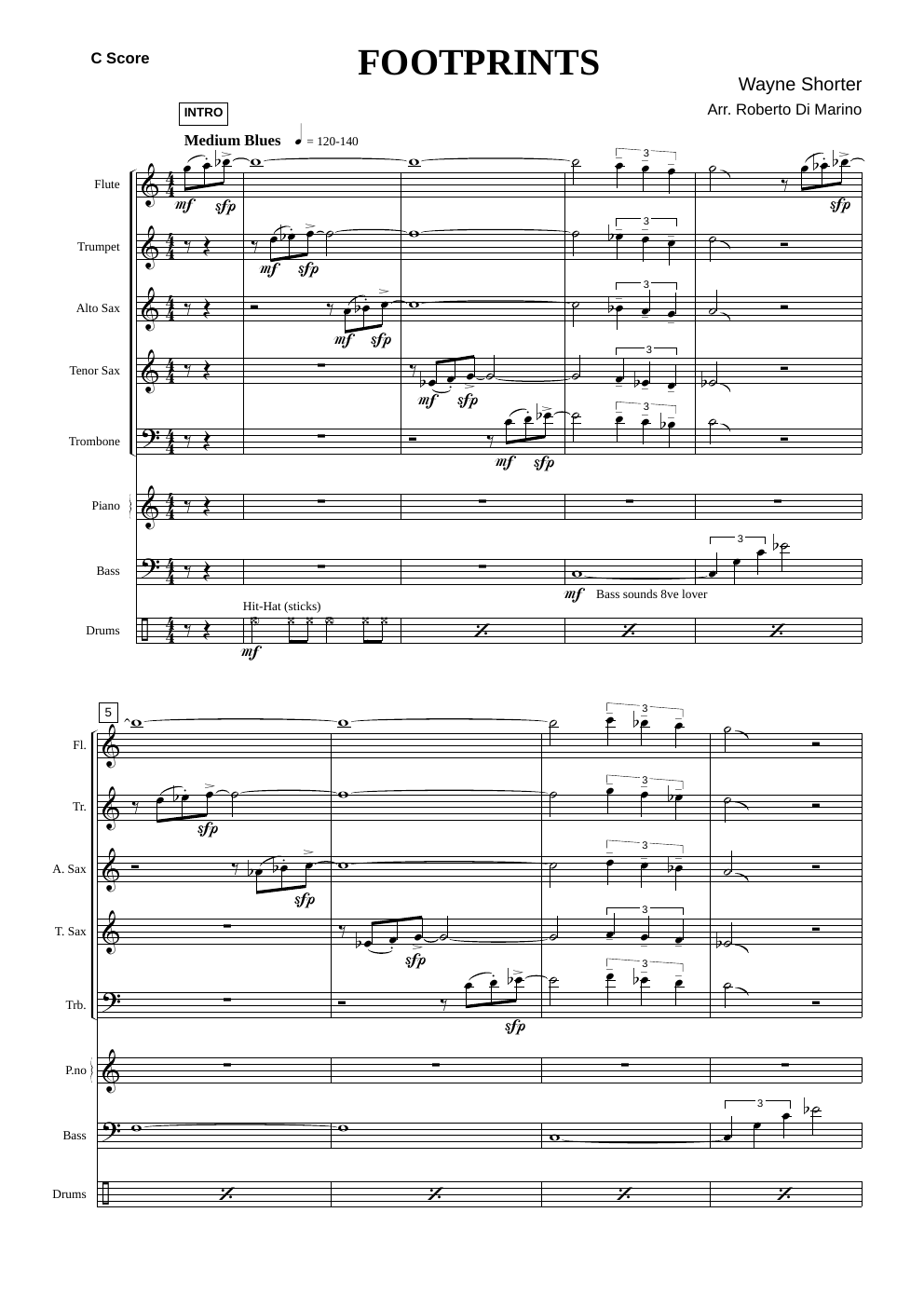
Footprints (Trumpet)
Composed by Wayne Shorter
Arranged by Trumpet
- Ensemble: Small Ensemble
- Style: Jazz Standard
- Pages: 6
- Difficulty: easy
- Content: Sheet Music
- Format: PDF Download (Instant)
- Price: $12.99
"Footprints," composed by the visionary saxophonist Wayne Shorter, stands as a cornerstone of the jazz repertoire, first appearing on his 1966 album *Adam's Apple*. While recorded for Shorter's album that year, its initial commercial release was on Miles Davis's seminal album *Miles Smiles*, also in 1966, solidifying its place in the pantheon of jazz standards. This era, characterized by the modal jazz explorations of Davis's Second Great Quintet, saw Shorter pushing the boundaries of post-bop with innovative melodic and harmonic concepts. "Footprints" is renowned for its distinctive bass line and modal harmonies, blending elements of post-bop and hard bop, making it a staple for jazz musicians worldwide. Its enduring appeal lies in its sophisticated harmonic framework, built upon a 12-bar C minor blues form, yet distinguished by an avant-garde turnaround and a unique rhythmic feel that often alternates between simple and compound meters, frequently notated in 6/4 or 6/8. The musical character of "Footprints" is immediately recognizable by its medium-tempo, often described as a hypnotic, flowing 6/8 or 6/4 groove that is not a traditional jazz waltz. The piece is primarily in C minor, specifically C Dorian, giving it a somewhat dark yet contemplative mood. The rhythmic interplay, particularly the bass line's characteristic figure (often referred to as tresillo in Afro-Cuban music), creates a subtle propulsion and an underlying tension that is both intellectually stimulating and deeply grooving. The harmony, while rooted in a minor blues, features an unexpected and challenging turnaround (F#m7b5, F7#11, Eaug7(#9), A7(#9) resolving to Cm7) that adds a mysterious and sophisticated flavor, inviting creative improvisation. This arrangement by Trumpet offers a fresh perspective on Shorter's classic, specifically tailored for a small ensemble. Trumpet, known for their meticulous attention to voicing and melodic clarity, approaches "Footprints" by highlighting the intricate contrapuntal possibilities within the original composition. The arrangement features the iconic melody primarily carried by the lead trumpet, often supported by rich, extended harmonies in the accompanying voices that underscore the C Dorian modality and the unique chromaticism of the turnaround. Expect carefully crafted soli sections that allow the ensemble to shine as a cohesive unit, demonstrating a deep understanding of the piece's harmonic and rhythmic nuances. Trumpet's signature technique of interweaving melodic fragments among the ensemble members ensures that each part is engaging and contributes to the overall texture, avoiding mere accompaniment. Performance of this arrangement is both challenging and highly rewarding. The lead trumpet carries the initial melody, requiring a strong command of tone and phrasing to articulate Shorter's memorable lines. Featured solo sections are provided, encouraging improvisers to explore the modal landscape and navigate the distinctive harmonic progression. Technical challenges include precise rhythmic execution in the 6/8 or 6/4 feel, particularly during the transitions between meters as famously demonstrated in the Miles Davis recording. The rewarding aspect lies in the ensemble's ability to lock into the groove, articulate the sophisticated voicings, and collectively interpret the piece's introspective yet energetic spirit. This arrangement is well-suited for college-level jazz ensembles, advanced community bands, and professional small groups seeking to perform a definitive jazz standard with a fresh, authoritative interpretation. Its detailed scoring provides ample opportunity for musical growth and a truly impactful performance. Approaching "Footprints" requires a keen sense of rhythmic precision and harmonic awareness. The primary technical challenge lies in maintaining the consistent 6/8 or 6/4 feel while navigating the subtle metric shifts inherent in the piece. Conductors should emphasize a relaxed, flowing pulse, encouraging musicians to internalize the "tresillo" rhythm in the bass line. Pay close attention to the nuanced voicings in the soli sections, ensuring balance and blend to allow the extended harmonies to speak clearly. Articulation should be crisp but not overly aggressive, reflecting the contemplative mood. Rehearsal tips include isolating the challenging turnaround (F#m7b5 – F7#11 – Eaug7(#9) – A7(#9) – Cm7) to ensure all players understand its chromatic movement and resolution. Encourage soloists to explore the C Dorian mode and its relationship to the underlying minor blues, while also being mindful of the harmonic rhythm. No special techniques like plunger mutes or doits are explicitly required, but expressive dynamics and thoughtful phrasing will greatly enhance the performance. Q: What instruments and parts are included in this arrangement? A: This arrangement is for a small jazz ensemble, specifically tailored for a trumpet-led group. It includes parts for lead trumpet, accompanying brass (e.g., additional trumpets, trombone), and a full rhythm section (piano, bass, drums, guitar). Q: What is the difficulty level of this arrangement? A: This arrangement is considered advanced intermediate to advanced. It requires solid instrumental technique, a strong understanding of jazz harmony, and experience with complex rhythmic feels, making it suitable for college, advanced community, or professional ensembles. Q: What is the musical style and historical context of "Footprints"? A: "Footprints" is a jazz standard composed by Wayne Shorter in 1966, representing the modal jazz and post-bop era. It is characterized by its unique 6/8 or 6/4 time signature, C minor (Dorian) tonality, and sophisticated harmonic progression, notably its distinctive turnaround. Q: What makes this specific arrangement of "Footprints" unique? A: This arrangement by Trumpet is unique for its focus on intricate trumpet voicings, carefully crafted soli sections, and a detailed approach to Shorter's original harmonic and rhythmic complexities. It provides a fresh, authoritative interpretation while remaining true to the spirit of the original. Q: What is the approximate performance duration or tempo for this arrangement? A: The arrangement is designed for a medium-tempo performance, typically around 120-140 beats per minute in a 6/8 or 6/4 feel. The total performance duration will vary depending on the length of improvised solos, but generally ranges from 5-8 minutes.
Musicians Also Search For
Footprints Trumpet PDF • Footprints Trumpet sheet music • Footprints arranged by Trumpet • Trumpet small ensemble charts • Trumpet jazz arrangements PDF • Footprints Wayne Shorter sheet music • Footprints Wayne Shorter small ensemble arrangement • Wayne Shorter small ensemble charts • Footprints small ensemble arrangement • Footprints small ensemble PDF download • Footprints jazz ensemble sheet music • small ensemble sheet music instant download • Footprints sheet music with parts • Footprints Jazz Standard chart • Jazz Standard small ensemble arrangements • buy Footprints sheet music online • download Footprints PDF • Footprints jazz chart • best Trumpet small ensemble arrangements • Wayne Shorter songs arranged by Trumpet • Footprints printable sheet music • small ensemble repertoire PDF