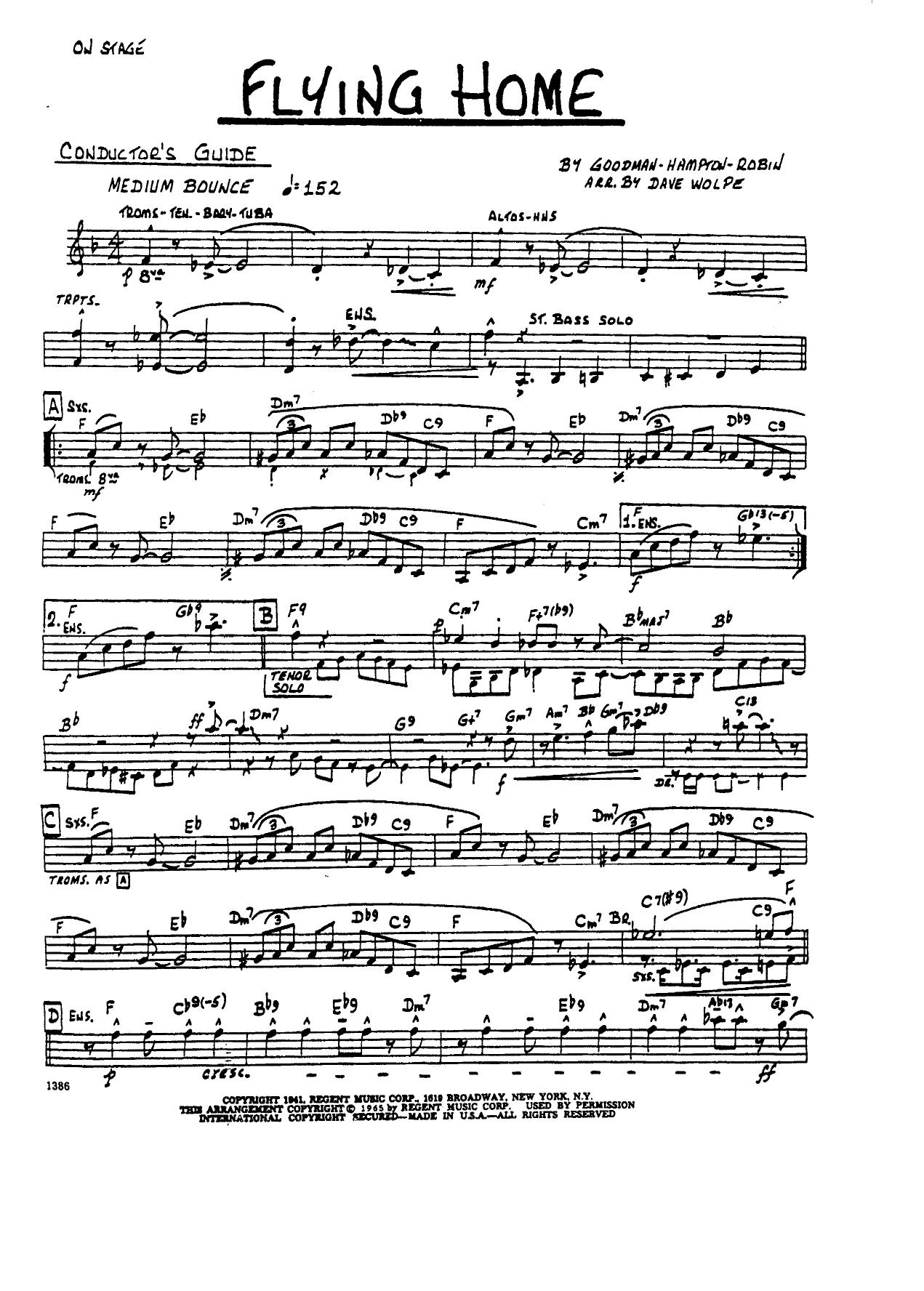
Flying Home (D.Wolpe) sheet music preview

Flying Home (D.Wolpe)

Composed by Benny Goodman

Arranged by Dave Wolpe

  • Ensemble: Big Band
  • Pages: 33
  • Instruments (18): Conductor's Guide, 1st Eb Alto Sax, 3rd Eb Alto Sax, 2nd Bb Tenor Sax, 4th Bb Tenor Sax, 5th Eb Baritone Sax, 1st Bb Trumpet, 2nd Bb Trumpet, 3rd Bb Trumpet, 4th Bb Trumpet, 1st Trombone, 2nd Trombone, 3rd Trombone, 4th Trombone, Guitar, Piano, String Bass, Drums
  • Difficulty: medium
  • Content: Individual Parts
  • Format: PDF Download (Instant)
  • Price: $24.99

Composed by the legendary "King of Swing" Benny Goodman along with electric guitar pioneer Charlie Christian and Lionel Hampton, "Flying Home" stands as one of the definitive anthems of the swing era. First recorded by the Benny Goodman Sextet in 1939 and subsequently expanded into a powerhouse big band arrangement in 1941, the tune became Goodman's closing theme and a defining vehicle for the explosive, honking tenor saxophone style of Illinois Jacquet. Representing the high-water mark of late-1930s and 1940s jazz, the composition bridges small-group Goodman swing with the high-octane energy that foreshadowed rhythm and blues, making it an electrifying crowd-pleaser that encapsulates the irrepressible optimism and driving momentum of wartime America. Master arranger Dave Wolpe breathes new life into this classic idiom, crafting a chart that pulses with an infectious, high-energy medium-up swing feel. Set in a bright, driving tempo around quarter note equals 200 BPM, the arrangement opens with the unmistakable, galloping vamp that instantly hooks the listener. Wolpe captures the jubilant, celebratory mood of the original while injecting modern big band sheen through crisp, interlocking brass counterlines and aggressive sax solis. The emotional arc moves from a lean, rhythmic intensity in the opening choruses to a roaring, full-ensemble shout chorus that utilizes classic Goodman-era call-and-response figures between the trumpets and saxophones, driving the band toward a high-octane, unforgettable climax. Wolpe’s arrangement is meticulously engineered to showcase a tight big band section while highlighting featured soloists. The melody is initially carried by the reed section with punctuated brass backing, maintaining a relentless forward drive through syncopated swing eighth notes. Solo space is provided for tenor saxophone and trumpet, allowing capable improvisers to stretch out over standard blues-informed changes reminiscent of the original recordings. Technically, the chart demands precise articulation, particularly in the saxophone section where fast, interlocking scalar passages and bebop-infused lines require clean fingerwork. The brass sections must execute crisp dynamic contrasts, ranging from sultry, muted backgrounds to blazing, open-bell ensemble peaks that demand endurance and upper-register security from the lead trumpet. Advanced high school, collegiate, and professional community big bands will find this arrangement an ideal centerpiece for concert programs, festival adjudications, and dance sets. While the technical demands require seasoned players—particularly regarding swing style consistency and section blending—the accessible harmonic language ensures that ensembles can quickly move past reading notes to locking in the authentic, blues-drenched groove. Performing this chart offers an invaluable masterclass in historical big band phrasing, teaching students how to balance horizontal linear momentum with vertical harmonic punch while celebrating one of the cornerstone masterworks of twentieth-century American music. Achieving an authentic performance of this chart requires meticulous attention to the traditional swing eighth-note subdivision. Avoid a square, even eighth-note feel; instead, ensure all unaccented eighth notes are slightly bounced and legato-tongued, with heavier weight given to beats two and four. The tempo should remain relentless, so the rhythm section must lock in a steady, unhurried pulse without rushing the peaks of the phrases. The brass section should utilize cup mutes or harmon mutes where indicated in the background figures to avoid covering the featured soloists. Trumpet players must manage their endurance carefully, as the chart builds progressively toward a high-register shout chorus. Saxophones need to focus on seamless blend during unison soli sections, ensuring that fast scalar runs are cleanly articulated rather than slurred indiscriminately. Directors should rehearse the dynamic shifts separately, ensuring that soft background figures remain truly subordinate to the melodic focal points before unleashing the full power of the ensemble in the final choruses. Q: What instrumentation and parts are included in this arrangement? A: This chart is scored for a standard 16-instrument big band, including Alto Saxophone 1 & 2, Tenor Saxophone 1 & 2, Baritone Saxophone, 4 Trumpets, 4 Trombones, Piano, Guitar, Bass, and Drum Set. Q: What is the difficulty level of this Dave Wolpe arrangement? A: It is rated as advanced intermediate to advanced, making it best suited for high school top-tier jazz ensembles, college bands, and professional community big bands with strong section leaders. Q: What style and historical era does "Flying Home" represent? A: It represents the classic swing era of the late 1930s and 1940s, originally made famous by Benny Goodman and associated with the high-energy Kansas City jazz and big band dance traditions. Q: What makes this specific arrangement by Dave Wolpe unique? A: Wolpe modernizes the classic Goodman/Jacquet framework with punchy, contemporary big band voicings and dynamic sectional contrasts while preserving the raw, driving energy of the original swing anthem. Q: What is the performance duration and recommended tempo? A: The arrangement runs approximately 3 to 4 minutes and is designed to be played at a bright, driving medium-up swing tempo of around quarter note equals 200 BPM.

Questions and answers

What is included in the Flying Home (D.Wolpe) PDF?
The verified current file contains a conductor score and individual parts across 33 pages.
How many instruments or parts are listed for Flying Home (D.Wolpe)?
The verified instrumentation list contains 18 entries for this Big Band arrangement.
Who is credited for Flying Home (D.Wolpe)?
Composer: Benny Goodman. Arranger: Dave Wolpe.
What difficulty is listed for Flying Home (D.Wolpe)?
The verified difficulty level is medium.
Can I preview Flying Home (D.Wolpe) before buying?
Yes. The product page provides a preview generated from the current PDF file.
How is Flying Home (D.Wolpe) delivered?
After successful payment, the digital PDF is made available for download. The displayed price is $24.99.

Musicians Also Search For

Flying Home Dave Wolpe PDFFlying Home Dave Wolpe sheet musicFlying Home arranged by Dave WolpeDave Wolpe big band chartsDave Wolpe jazz arrangements PDFFlying Home Benny Goodman sheet musicFlying Home Benny Goodman big band arrangementsBenny Goodman big band chartsFlying Home big band arrangementsFlying Home big band PDF downloadFlying Home jazz sheet musicbig band sheet music downloadFlying Home conductor score PDFFlying Home individual parts downloadFlying Home sheet music PDFbuy Flying Home sheet musicdownload Flying Home PDFFlying Home jazz chartsbest Dave Wolpe big band arrangementsBenny Goodman arranged by Dave WolpeFlying Home printable sheet musicbig band repertoire PDF

All arrangements by Dave Wolpe All Benny Goodman sheet music