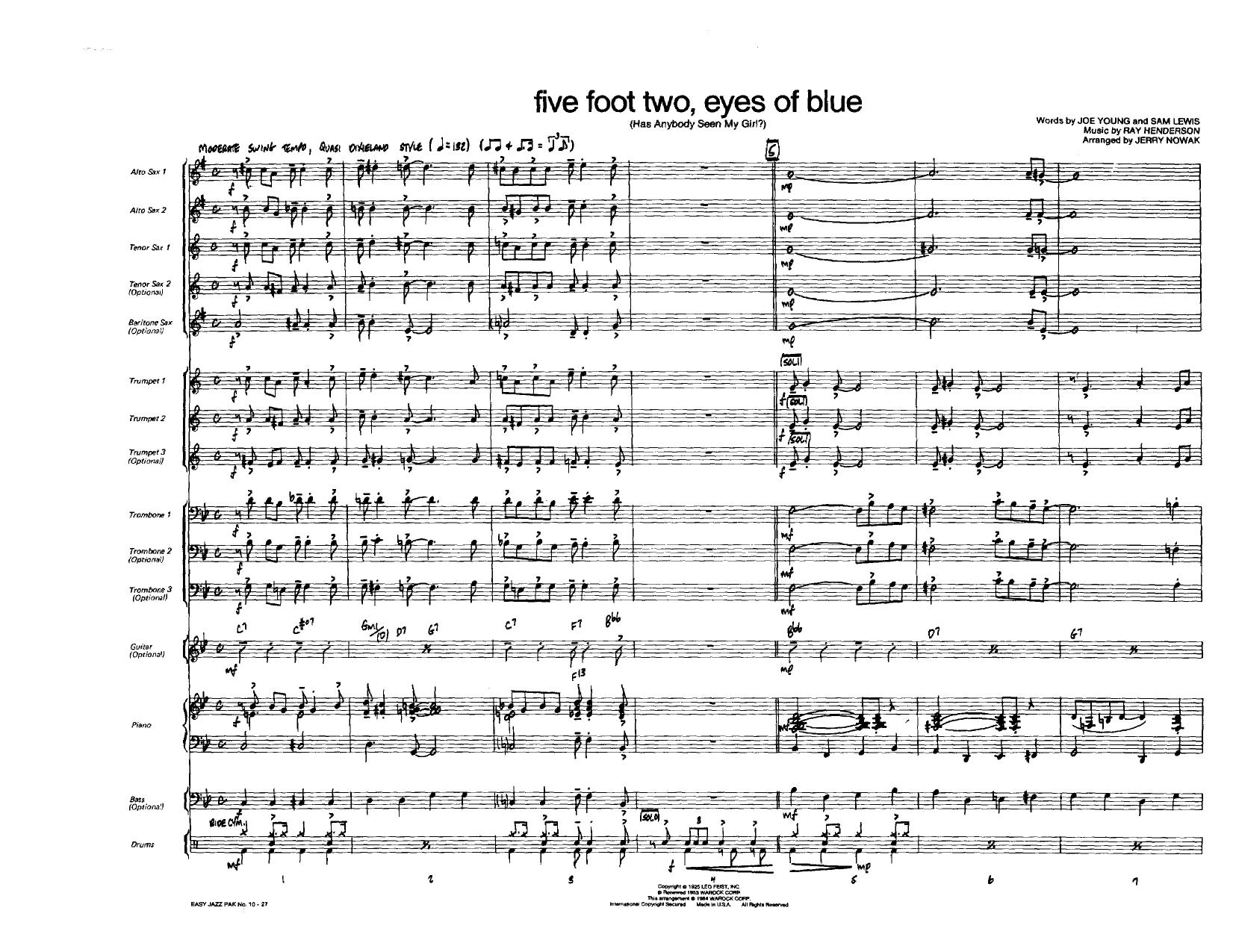
Five Foot Two, Eyes Of Blue (J.Nowak)
Composed by Ray Henderson
Arranged by Jerry Nowak
- Ensemble: Big Band
- Pages: 44
- Instruments (17): 1st Eb Alto Saxophone, 2nd Eb Alto Saxophone, 1st Bb Tenor Saxophone, 2nd Bb Tenor Saxophone, Eb Baritone Saxophone, 1st Bb Trumpet, 2nd Bb Trumpet, 3rd Bb Trumpet, 4th Trumpet, 1st Trombone, 2nd Trombone, 3rd Trombone, 4th Trombone, Piano, Guitar, Bass, Drums
- Difficulty: medium
- Content: Individual Parts
- Format: PDF Download (Instant)
- Price: $24.99
Ray Henderson’s timeless 1925 Tin Pan Alley classic, with lyrics by Sam M. Lewis and Joe Young, stands as one of the quintessential novelty tunes of the Roaring Twenties. Originally popularized during the jazz age and later immortalized by artists like Artie Shaw and more recently revived in various stylistic contexts, "Five Foot Two, Eyes Of Blue" represents the infectious, high-spirited energy of early American popular song. Translated brilliantly into the modern jazz idiom, this enduring standard bridges the gap between traditional ragtime-era optimism and swing-era sophistication, making it an indispensable crowd-pleaser that instantly connects with audiences of all generations through its irrepressible bounce and instantly recognizable melody. Jerry Nowak’s masterwork for standard big band breathes fresh life into the vintage composition by anchoring it in a bright, driving medium-swing groove. The arrangement opens with a playful, teasing introduction before launching into a vibrant four-four swing feel that radiates cheerful confidence and nostalgic charm. Throughout the chart, Nowak utilizes clever dynamic contrasts, crisp articulation demands, and infectious rhythmic syncopations that evoke the bustling atmosphere of a 1930s dance hall while maintaining a clean, contemporary harmonic clarity. The overall mood is buoyant and celebratory, driven by sparkling brass accents and a relentless, toes-tapping momentum that never flags. Drawing on his legendary reputation as a master educational arranger, Nowak structures the chart to balance accessibility with rich, rewarding ensemble interplay. The melody is introduced cleanly by the saxophone section before being handed off to full-ensemble tutti blocks that feature classic swing-era call-and-response figures between the brass and reeds. A standout shouting chorus builds the dramatic tension organically, showcasing tight harmonized voicings and well-placed dynamic swells that culminate in a thrilling, high-energy finish. Solos are thoughtfully integrated into the framework, allowing featured improvisers space to stretch out over standard changes while the rhythm section locks into an unyielding pocket. Advanced middle school, high school, and community jazz ensembles will find this 44-page publication to be an exceptional vehicle for developing stylistic authenticity, section blend, and swing articulation. While the technical demands remain approachable for developing players—avoiding extreme ranges or overly dense modern dissonances—the chart requires meticulous attention to articulation, particularly regarding short, crisp staccatos and buoyant eighth-note feels. Directors will appreciate how effectively the arrangement rewards careful sectional rehearsing, transforming a familiar historical tune into a polished, high-impact showcase for festival performance or concert programming. Success with Jerry Nowak’s chart hinges entirely on mastering an authentic, buoyant medium-swing eighth-note feel. Avoid a rigid, mechanical interpretation; instead, encourage the ensemble to lean into the triplet-based swing subdivisions with a relaxed yet driving pulse. The rhythm section is the engine room here—the drummer should maintain a light, feathered bass drum pulse with crisp ride cymbal definition, while the hi-hat strictly closes on beats two and four. Articulation is paramount: horn players must execute marked accents and staccatos with precision to capture the playful, teasing character of the 1920s melody. Pay close attention to dynamic markings during the shout chorus, ensuring the brass does not overpower the moving lines in the lower saxophones and trombones. Rehearsal should begin slowly, isolating the interplay between the rhythm section and the horn section's syncopated hits before bringing the tempo up to performance speed. Q: What instruments and parts are included in this publication? A: This standard 17-instrument big band arrangement includes parts for 2 alto saxophones, 2 tenor saxophones, 1 baritone saxophone, 4 trumpets, 4 trombones, piano, guitar, bass, and drums, spanning a total of 44 pages. Q: What is the difficulty level of this arrangement? A: This chart is graded as medium-easy to medium, making it exceptionally well-suited for high school jazz bands, advanced middle school groups, and community big bands looking for a crowd-pleasing standard. Q: What is the historical style and background of this piece? A: Originally composed by Ray Henderson in 1925 during the height of the Jazz Age, this arrangement reinterprets the classic Tin Pan Alley novelty song through a vibrant, mid-century swing big-band lens. Q: What makes Jerry Nowak's treatment unique compared to other versions? A: Nowak expertly balances educational playability with sophisticated big band writing, utilizing clever call-and-response figures, sparkling brass accents, and a carefully structured shout chorus that modernizes the vintage melody. Q: What is the approximate performance duration and tempo feel? A: The arrangement is set at a bright, energetic medium-swing tempo (around 132 to 140 BPM) and typically runs for approximately 3 minutes, making it ideal for festival performance or concert programming.
Questions and answers
- What is included in the Five Foot Two, Eyes Of Blue (J.Nowak) PDF?
- The verified current file contains a conductor score and individual parts across 44 pages.
- How many instruments or parts are listed for Five Foot Two, Eyes Of Blue (J.Nowak)?
- The verified instrumentation list contains 17 entries for this Big Band arrangement.
- Who is credited for Five Foot Two, Eyes Of Blue (J.Nowak)?
- Composer: Ray Henderson. Arranger: Jerry Nowak.
- What difficulty is listed for Five Foot Two, Eyes Of Blue (J.Nowak)?
- The verified difficulty level is medium.
- Can I preview Five Foot Two, Eyes Of Blue (J.Nowak) before buying?
- Yes. The product page provides a preview generated from the current PDF file.
- How is Five Foot Two, Eyes Of Blue (J.Nowak) delivered?
- After successful payment, the digital PDF is made available for download. The displayed price is $24.99.
Musicians Also Search For
Five Foot Two, Eyes Of Blue Jerry Nowak PDF • Five Foot Two, Eyes Of Blue Jerry Nowak sheet music • Five Foot Two, Eyes Of Blue arranged by Jerry Nowak • Jerry Nowak big band charts • Jerry Nowak jazz arrangements PDF • Five Foot Two, Eyes Of Blue Ray Henderson sheet music • Five Foot Two, Eyes Of Blue Ray Henderson big band arrangements • Ray Henderson big band charts • Five Foot Two, Eyes Of Blue big band arrangements • Five Foot Two, Eyes Of Blue big band PDF download • Five Foot Two, Eyes Of Blue jazz sheet music • big band sheet music download • Five Foot Two, Eyes Of Blue conductor score PDF • Five Foot Two, Eyes Of Blue individual parts download • Five Foot Two, Eyes Of Blue sheet music PDF • buy Five Foot Two, Eyes Of Blue sheet music • download Five Foot Two, Eyes Of Blue PDF • Five Foot Two, Eyes Of Blue jazz charts • best Jerry Nowak big band arrangements • Ray Henderson arranged by Jerry Nowak • Five Foot Two, Eyes Of Blue printable sheet music • big band repertoire PDF