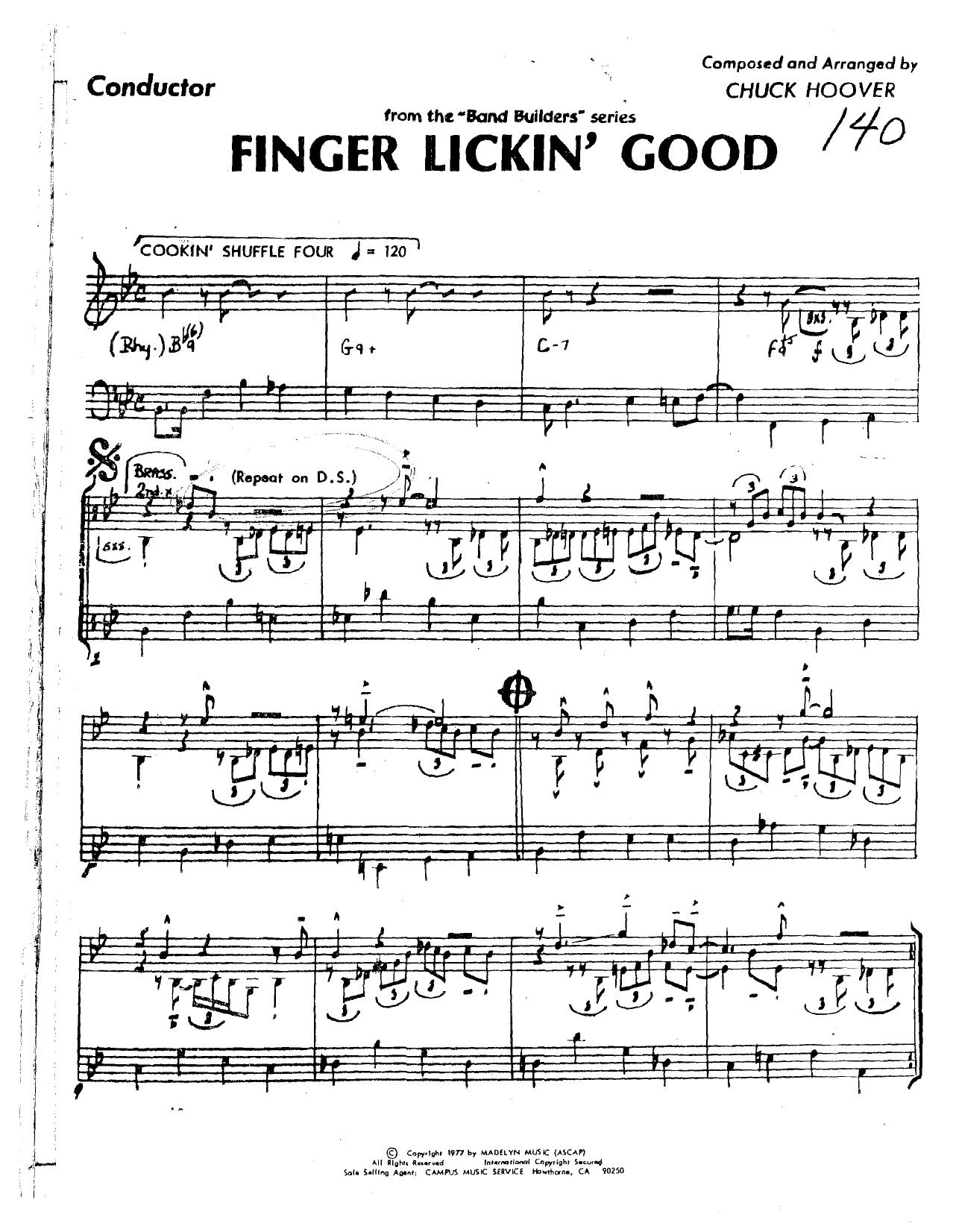
Finger Lickin' Good (C.Hoover)
Composed by C. Hoover
Arranged by C.Hoover
- Ensemble: Big Band
- Pages: 39
- Instruments (19): Conductor, 1st Alto Sax, 2nd Alto Sax, 1st Tenor Sax, Tenor Sax Solo, 2nd Tenor Sax, Bari Sax, 1st Trumpet, 2nd Trumpet, 3rd Trumpet, 4th Trumpet, 1st Trombone, 2nd Trombone, 3rd Trombone, 4th Trombone, Piano, Fender Bass, Guitar, Drums
- Difficulty: medium
- Content: Individual Parts
- Format: PDF Download (Instant)
- Price: $24.99
Rooted in the rich, earthy soil of traditional blues and early jazz vernacular, "Finger Lickin' Good" channels the infectious, foot-stomping energy of mid-century midwestern dance halls and urban jazz clubs. While the thematic origins trace back to anonymous rural blues motifs passed down through generations of American vernacular music, this contemporary big band setting revitalizes the material through a sophisticated lens. It honors the swagger of Kansas City swing and the tight, punchy horn styling of the post-bop era, transforming a humble folk-blues foundation into a powerhouse showcase for modern 17-piece jazz orchestras. Driven by a relentless, medium-tempo swing groove in 4/4 time, the arrangement radiates an unapologetic, blues-drenched confidence. The harmonic palette stretches beyond standard three-chord blues changes, incorporating subtle chromatic mediants, blues-scale alterations, and rich extended voicings—such as dominant 9#11s and minor 13ths—that give the brass and reed sections a modern, sophisticated bite. The mood oscillates between playful, swaggering refrains and high-octane outbursts of collective energy, evoking the smoky atmosphere of a late-night jam session where the groove dictates the entire room's pulse. Arranger C.Hoover stamps this chart with a distinct structural clarity, balancing dense, interlocking ensemble solis with wide-open spaces for rhythmic interplay. The arrangement features a tightly woven saxophone soli that showcases section unison work before expanding into rich, four-part block voicings. A powerhouse shout chorus near the climax builds tension through syncopated cross-rhythms and dynamic contrast, pushing the full ensemble from a low-register murmur to a roaring, brass-heavy climax. Hoover’s scoring ensures that even during dense polyphonic passages, the primary countermelodies remain transparent, allowing the underlying harmonic motion to breathe. Melodic duties are shared democratically across the ensemble, though the lead alto saxophone and first trumpet carry the primary thematic weight during exposition. Open solo sections are provided with flexible backing background figures, tailored to feature a confident tenor saxophonist or blues-oriented brass player. Technically rewarding rather than punishingly complex, the chart demands precise articulation, a unified section swing feel, and careful dynamic control, particularly in managing the balance between the rhythm section and the blazing brass unisons. Advanced high school ensembles with strong section leaders, as well as collegiate and professional community big bands, will find this arrangement an ideal centerpiece for festival programs or club sets. It strikes a rare balance: accessible enough for developing players to grasp the fundamental vocabulary of swing articulation, yet sophisticated enough to challenge seasoned jazz musicians looking to inject authentic blues grit and modern harmonic flavor into their performance repertoire. Success with "Finger Lickin' Good" hinges entirely on the rhythm section establishing an authoritative, relaxed medium-swing groove right from the downbeat. The recommended tempo is around 116–124 BPM; rushing this chart destroys the heavy, greasy pocket required to make the blues-inflected lines speak properly. Conductors should ensure the bass player articulates a crisp, acoustic-style walking bass line that locks tightly with the ride cymbal pattern. Brass players should make ample use of traditional stylistic ornaments—such as subtle plunger effects, controlled falls, and half-valve smears—especially during the background figures behind the soloists. Articulation is paramount: eighth notes must be swung naturally with tongue-slurred accents on the upbeats, avoiding both overly stiff classical phrasing and exaggerated bebop triplet stretching. During the climactic shout chorus, monitor the dynamic balance carefully; the trombones and baritone saxophone must project their low-register counterlines without obscuring the lead trumpet's high-register melody. Rehearsals should isolate the intricate saxophone soli at letter B, practicing it slowly with a metronome clicking on beats two and four before bringing it up to performance tempo. Q: What instruments and parts are included in this arrangement? A: This complete 17-instrument big band chart includes standard instrumentation: Alto Saxophone 1 & 2, Tenor Saxophone 1 & 2, Baritone Saxophone, Trumpets 1 through 4, Trombones 1 through 4, Piano, Guitar, Bass, Drums, and a full 39-page conductor score. Q: What is the difficulty level of this arrangement? A: It is graded as advanced intermediate to advanced, making it exceptionally well-suited for top-tier high school bands, collegiate jazz ensembles, and professional community big bands looking for a solid stylistic challenge. Q: What is the historical context and musical style of the piece? A: The arrangement is set in a medium-swing jazz style, drawing heavily from traditional blues forms and the energetic, swinging traditions of mid-century big band jazz popularized in Kansas City and urban club scenes. Q: What makes C.Hoover's arrangement unique? A: It stands out through its clever integration of traditional blues vocabulary with modern extended harmonies, featuring meticulously crafted saxophone solis, dynamic counterpoint, and a high-energy shout chorus that revitalizes the source material. Q: What is the performance duration and recommended tempo? A: The arrangement plays out over approximately 4 to 5 minutes at a recommended medium-swing tempo of 116 to 124 beats per minute, providing an ideal length for festival adjudication or concert programming.
Questions and answers
- What is included in the Finger Lickin' Good (C.Hoover) PDF?
- The verified current file contains a conductor score and individual parts across 39 pages.
- How many instruments or parts are listed for Finger Lickin' Good (C.Hoover)?
- The verified instrumentation list contains 19 entries for this Big Band arrangement.
- Who is credited for Finger Lickin' Good (C.Hoover)?
- Composer: C. Hoover. Arranger: C.Hoover.
- What difficulty is listed for Finger Lickin' Good (C.Hoover)?
- The verified difficulty level is medium.
- Can I preview Finger Lickin' Good (C.Hoover) before buying?
- Yes. The product page provides a preview generated from the current PDF file.
- How is Finger Lickin' Good (C.Hoover) delivered?
- After successful payment, the digital PDF is made available for download. The displayed price is $24.99.
Musicians Also Search For
Finger Lickin' Good C.Hoover PDF • Finger Lickin' Good C.Hoover sheet music • Finger Lickin' Good arranged by C.Hoover • C.Hoover big band charts • C.Hoover jazz arrangements PDF • Finger Lickin' Good C. Hoover sheet music • Finger Lickin' Good C. Hoover big band arrangements • C. Hoover big band charts • Finger Lickin' Good big band arrangements • Finger Lickin' Good big band PDF download • Finger Lickin' Good jazz sheet music • big band sheet music download • Finger Lickin' Good conductor score PDF • Finger Lickin' Good individual parts download • Finger Lickin' Good sheet music PDF • buy Finger Lickin' Good sheet music • download Finger Lickin' Good PDF • Finger Lickin' Good jazz charts • best C.Hoover big band arrangements • C. Hoover arranged by C.Hoover • Finger Lickin' Good printable sheet music • big band repertoire PDF