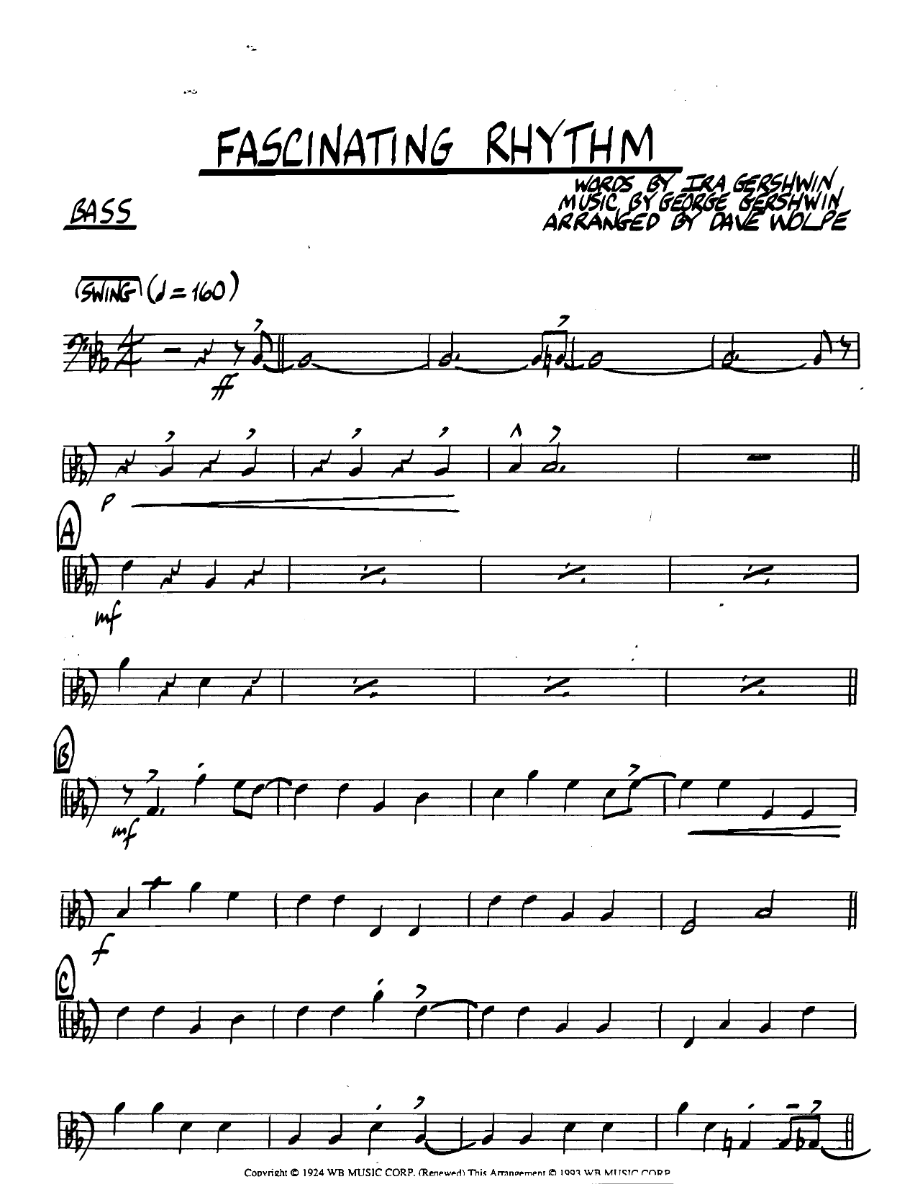
Fascinating Rhythm (D.Wolpe) sheet music preview

Fascinating Rhythm (D.Wolpe)

Composed by George Gershwin

Arranged by Dave Wolpe

  • Ensemble: Small Ensemble
  • Style: Jazz Standard
  • Pages: 11
  • Instruments (3): Bass, Piano, Drums
  • Difficulty: easy
  • Content: Individual Parts
  • Format: PDF Download (Instant)
  • Price: $19.99

George Gershwin's iconic "Fascinating Rhythm," with lyrics by his brother Ira, burst onto the scene in 1924 as part of the Broadway musical *Lady, Be Good!*. This piece quickly became an anthem of the Jazz Age, embodying the era's vibrant energy and modern syncopation. Introduced by Cliff Edwards and the legendary Fred and Adele Astaire, who also recorded it with George Gershwin on piano in 1926, the song's innovative rhythmic complexity was lauded by critics and composers alike, with Aaron Copland describing it as "rhythmically not only the most fascinating but the most original jazz song yet composed". Its enduring appeal lies in its synthesis of Black jazz rhythms with Tin Pan Alley melodies, effectively bridging popular song forms and emerging jazz idioms, solidifying its place as a quintessential jazz standard. Dave Wolpe's arrangement of "Fascinating Rhythm" captures the infectious spirit of the original while infusing it with his signature small ensemble flair. This rendition leans into a bright, medium-up swing feel, maintaining the driving pulse that defines the piece. The arrangement is characterized by its energetic tempo and the playful, off-beat phrasing that makes the tune so distinctive. It evokes a mood of sophisticated exuberance, perfect for showcasing a band's precision and dynamic range. The key is expertly chosen to allow for both harmonic richness and instrumental clarity, providing a vibrant canvas for the ensemble to shine. Wolpe, a master arranger known for his accessible yet sophisticated charts, approaches this standard with a keen understanding of both its historical context and contemporary performance needs. His arrangements often feature strong ensemble writing, clear melodic statements, and well-crafted solo sections. In this small ensemble setting, expect artful voicings that provide a full sound despite fewer players, and perhaps a dynamic interplay between different instrumental groupings. While specific details on voicings or modulations are not provided, Wolpe's reputation suggests harmonically interesting passages that support the melody without overpowering it, and potentially a clever reharmonization that adds a fresh perspective to Gershwin's classic. Performance of this arrangement is both challenging and highly rewarding. The melody, with its characteristic syncopation, is likely passed between various sections, offering each instrument a moment in the spotlight. While the arrangement details do not specify soloists, Wolpe's charts frequently include featured solo opportunities for instruments like trumpet, tenor saxophone, or piano, allowing for improvisation over the standard chord changes. Technical challenges will include maintaining the precise rhythmic integrity, navigating potential meter changes, and executing dynamic contrasts effectively. The reward lies in delivering a polished, high-energy performance of a timeless classic that resonates with audiences. This arrangement is suitable for college, community, and advanced high school jazz ensembles, offering a robust learning experience and a captivating performance piece. This arrangement of "Fascinating Rhythm" thrives on rhythmic precision and a consistent, driving medium-up swing feel. Conductors should emphasize a clear subdivision of the beat to ensure all players lock into the intricate syncopations, particularly in the main melody and any soli sections. Pay close attention to dynamic markings, as Wolpe often uses subtle shifts to build excitement and shape phrases. Rehearsal should focus on crisp articulation, especially in brass and saxophone lines, to highlight the playful, "pitter-patter" nature of the rhythm. While specific techniques like plunger mutes or falls are not explicitly noted, encourage musicians to add stylistic embellishments appropriate for the jazz standard idiom, such as subtle scoops or falls on sustained notes, particularly in the brass. Soloists should be encouraged to study the original melody and harmonic progression (often in F major or Eb major) to inform their improvisations, embracing the tune's inherent rhythmic drive. The chart includes potential meter changes and key changes, which will require careful attention during rehearsal to ensure smooth transitions and accurate pitch. **Q: What instruments are included in this small ensemble arrangement?** A: This 11-page small ensemble arrangement typically includes parts for a standard jazz rhythm section (piano, bass, drums) and a selection of horns, often encompassing alto saxophone, tenor saxophone, trumpet, and trombone, designed for flexible instrumentation. **Q: What is the difficulty level of this arrangement?** A: Dave Wolpe's arrangement of "Fascinating Rhythm" is graded as a 4, indicating a medium-advanced to difficult level, suitable for experienced high school, college, or community jazz ensembles. **Q: What is the musical style and historical context of "Fascinating Rhythm"?** A: "Fascinating Rhythm" is a quintessential jazz standard composed by George Gershwin in 1924 for the Broadway musical *Lady, Be Good!*, embodying the energetic and syncopated spirit of the Jazz Age. **Q: What makes Dave Wolpe's arrangement unique?** A: Dave Wolpe's arrangement is known for its energetic medium-up swing feel, sophisticated yet accessible voicings for a small ensemble, and potential for featured solos, all while preserving the iconic rhythmic character of Gershwin's original. **Q: What is the typical performance duration or tempo for this arrangement?** A: While specific duration can vary with improvisation, this arrangement is designed for a bright, medium-up swing tempo, typically around 180 BPM, making for an engaging and lively performance.

Questions and answers

What is included in the Fascinating Rhythm (D.Wolpe) PDF?
The verified current file contains individual parts across 11 pages.
How many instruments or parts are listed for Fascinating Rhythm (D.Wolpe)?
The verified instrumentation list contains 3 entries for this Small Ensemble arrangement.
Who is credited for Fascinating Rhythm (D.Wolpe)?
Composer: George Gershwin. Arranger: Dave Wolpe.
What difficulty is listed for Fascinating Rhythm (D.Wolpe)?
The verified difficulty level is easy.
What style is listed for Fascinating Rhythm (D.Wolpe)?
The catalog lists the style as Jazz Standard.
Can I preview Fascinating Rhythm (D.Wolpe) before buying?
Yes. The product page provides a preview generated from the current PDF file.
How is Fascinating Rhythm (D.Wolpe) delivered?
After successful payment, the digital PDF is made available for download. The displayed price is $19.99.

Musicians Also Search For

Fascinating Rhythm Dave Wolpe PDFFascinating Rhythm Dave Wolpe sheet musicFascinating Rhythm arranged by Dave WolpeDave Wolpe small ensemble chartsDave Wolpe jazz arrangements PDFFascinating Rhythm George Gershwin sheet musicFascinating Rhythm George Gershwin small ensemble arrangementsGeorge Gershwin small ensemble chartsFascinating Rhythm small ensemble arrangementsFascinating Rhythm small ensemble PDF downloadFascinating Rhythm jazz sheet musicsmall ensemble sheet music downloadFascinating Rhythm individual parts downloadFascinating Rhythm sheet music PDFFascinating Rhythm Jazz Standard chartsJazz Standard small ensemble arrangementsbuy Fascinating Rhythm sheet musicdownload Fascinating Rhythm PDFFascinating Rhythm jazz chartsbest Dave Wolpe small ensemble arrangementsGeorge Gershwin arranged by Dave WolpeFascinating Rhythm printable sheet musicsmall ensemble repertoire PDF

All arrangements by Dave Wolpe All George Gershwin sheet music