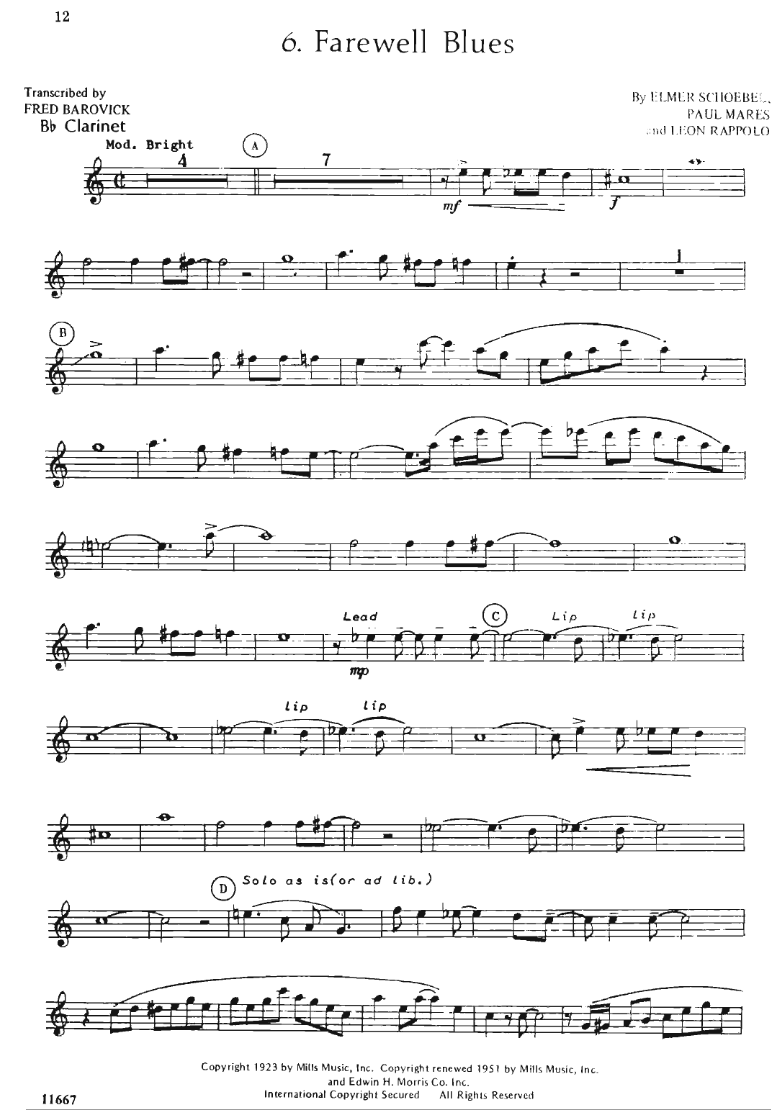
Farewell Blues (F.Barovick) sheet music preview

Farewell Blues (F.Barovick)

Composed by Elmer Schoebel, Paul Mares, and Leon Rappolo

Arranged by Fred Barovick

  • Ensemble: Small Ensemble
  • Style: Jazz Standard
  • Pages: 28
  • Difficulty: easy
  • Content: Sheet Music
  • Format: PDF Download (Instant)
  • Price: $12.99

"Farewell Blues," a true cornerstone of early jazz, was composed in 1922 by the collaborative talents of Elmer Schoebel, Paul Mares, and Leon Rappolo. First recorded by the seminal New Orleans Rhythm Kings (under the moniker Friars Society Orchestra), this piece rapidly became a standard, emblematic of the burgeoning Dixieland and early swing eras. Its enduring popularity is evidenced by countless recordings from jazz luminaries such as Fletcher Henderson, Cab Calloway, Benny Goodman, and even later interpretations by bluegrass artists like Lester Flatt and Earl Scruggs, highlighting its foundational melodic and harmonic appeal across genres. The tune's simple yet rewarding 16-bar AABA chord progression, often rooted in a I-V7-I structure, provides a fertile ground for improvisation and ensemble interplay, making it a favorite for both performers and audiences alike. Fred Barovick's arrangement of "Farewell Blues" for small ensemble captures the authentic spirit of this jazz standard while presenting it with a fresh, accessible clarity. Barovick, known for his meticulous transcriptions and arrangements for groups like The Dukes of Dixieland, approaches this piece with an expert understanding of traditional jazz voicings and rhythmic drive. His signature technique involves crafting arrangements that honor the original intent of the composition while providing thoughtful structures for modern small ensembles. This particular rendition maintains the medium-swing feel inherent to the piece, typically set in a bright, energetic tempo that evokes the joyous, often improvisational, character of early jazz. The arrangement is likely in a key conducive to brass and woodwinds, such as F major, allowing for comfortable execution and a vibrant sound. Musically, this arrangement emphasizes the lively interplay characteristic of small-group jazz. The melody, often initially presented by a lead horn, is then passed between instruments, featuring both unison sections and harmonized soli passages that showcase Barovick’s adept voicings. Expect featured solo sections, offering improvisational opportunities over the classic blues-infused changes. Technical challenges will primarily revolve around maintaining a tight, cohesive ensemble sound, accurate articulations typical of the style, and navigating the rhythmic precision required for a swinging performance. The reward lies in the infectious energy generated by a well-executed rendition, allowing musicians to connect with a pivotal piece of jazz history and engage in spirited musical conversation. This arrangement is ideally suited for college and community jazz ensembles, as well as advanced high school groups with a solid grasp of jazz fundamentals and improvisation. Its small ensemble format fosters individual responsibility and interaction, making it an excellent vehicle for developing ensemble communication and improvisational skills. The clear notation and thoughtful structure provide a strong framework, enabling groups to delve into the nuances of early jazz performance without being overwhelmed by overly complex charts. It offers a rich educational experience, allowing musicians to explore the historical context and performance practices of a true jazz classic. Conductors should aim for a bright, medium-swing tempo, typically around ♩=160-180, ensuring a buoyant and forward-moving feel without rushing. Emphasize crisp, short articulations in the brass and a light, driving quarter-note pulse from the rhythm section to establish the authentic Dixieland character. Key technical challenges include maintaining precise rhythmic unison during soli sections and ensuring clear melodic lines are articulated, especially when passed between instruments. Encourage soloists to embrace the blues scale and arpeggiated dominant 7th chords typical of the era, focusing on melodic coherence over virtuosic display. Rehearsal should prioritize listening across the ensemble, balancing the lead melody with supportive counter-melodies and rhythmic accompaniment. Pay close attention to dynamics to create shape and excitement throughout the form, reserving the loudest moments for shout choruses. Q: What instruments are included in this arrangement? A: This small ensemble arrangement typically includes parts for lead melody instruments (e.g., trumpet, clarinet, tenor saxophone), a rhythm section (piano, bass, drums), and potentially a trombone or an additional horn, allowing for flexible instrumentation within a small group setting. Q: What is the difficulty level of this arrangement? A: This arrangement is rated as intermediate. It is suitable for college and community jazz ensembles, and advanced high school groups, requiring solid instrumental technique and a foundational understanding of jazz improvisation. Q: What is the musical style and historical context of "Farewell Blues"? A: "Farewell Blues" is a classic jazz standard from 1922, representing the Dixieland and early swing eras. It embodies the energetic, improvisational spirit of traditional jazz, characterized by its infectious medium-swing feel and blues-infused harmonies. Q: What makes Fred Barovick's arrangement unique? A: Fred Barovick's arrangement is distinguished by its authentic voicings and clear structure, designed to capture the original spirit of the piece for small ensembles. His approach balances historical accuracy with playability, featuring well-crafted soli sections and ample space for improvisation. Q: What is the typical performance duration and tempo for this piece? A: A typical performance of this arrangement would last approximately 3-5 minutes, depending on the number and length of improvised solos. It is best performed at a bright, medium-swing tempo, generally in the range of ♩=160-180.

Musicians Also Search For

Farewell Blues Fred Barovick PDFFarewell Blues Fred Barovick sheet musicFarewell Blues arranged by Fred BarovickFred Barovick small ensemble chartsFred Barovick jazz arrangements PDFFarewell Blues Elmer Schoebel, Paul Mares, and Leon Rappolo sheet musicFarewell Blues Elmer Schoebel, Paul Mares, and Leon Rappolo small ensemble arrangementElmer Schoebel, Paul Mares, and Leon Rappolo small ensemble chartsFarewell Blues small ensemble arrangementFarewell Blues small ensemble PDF downloadFarewell Blues jazz ensemble sheet musicsmall ensemble sheet music instant downloadFarewell Blues sheet music with partsFarewell Blues Jazz Standard chartJazz Standard small ensemble arrangementsbuy Farewell Blues sheet music onlinedownload Farewell Blues PDFFarewell Blues jazz chartbest Fred Barovick small ensemble arrangementsElmer Schoebel, Paul Mares, and Leon Rappolo songs arranged by Fred BarovickFarewell Blues printable sheet musicsmall ensemble repertoire PDF

All arrangements by Fred Barovick All Elmer Schoebel, Paul Mares, and Leon Rappolo sheet music