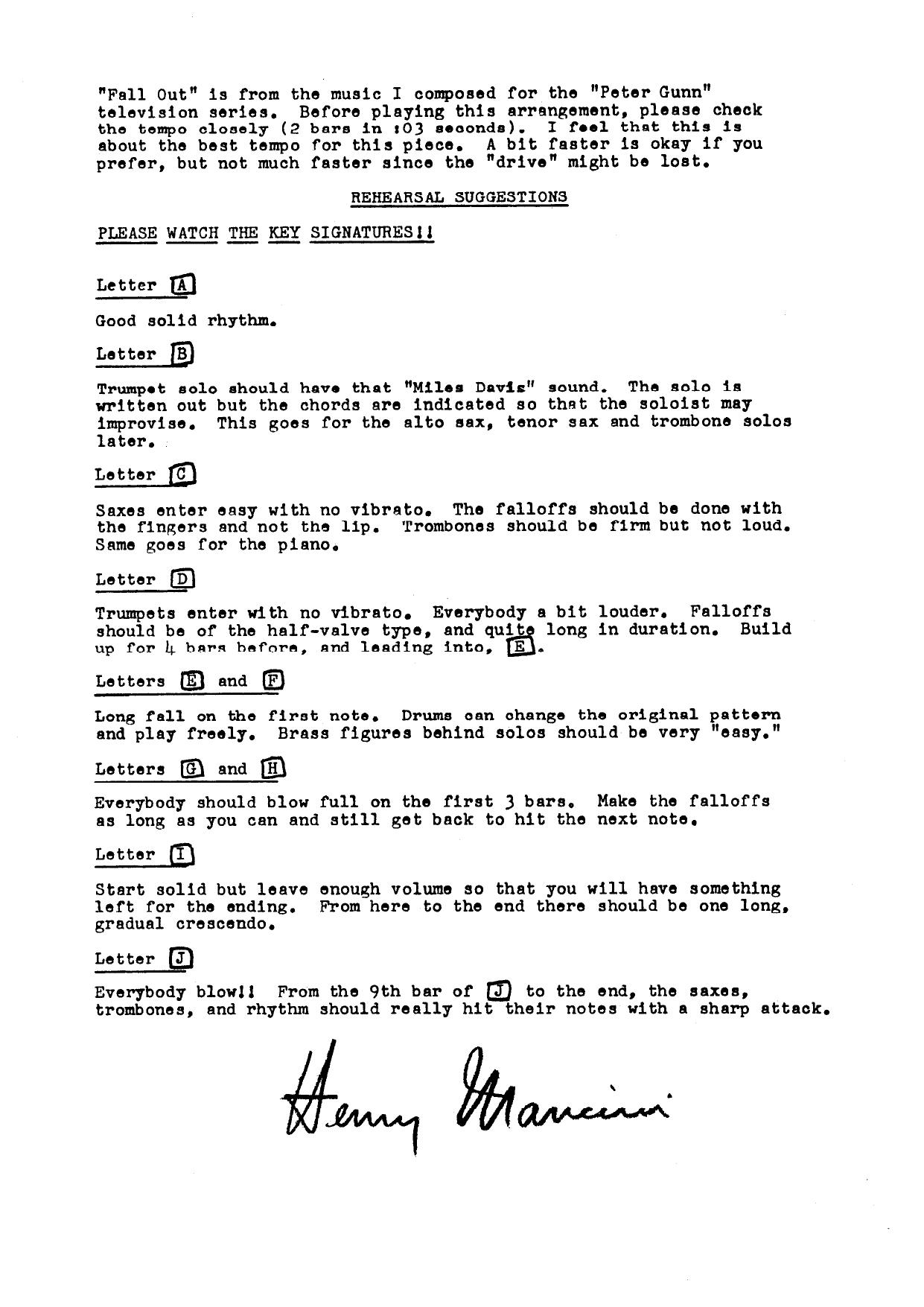
Fall Out (H.Mancini)
Composed by Henry Mancini
Arranged by H.Mancini
- Ensemble: Big Band
- Style: Jazz Standard
- Pages: 39
- Instruments (18): Conductor, Alto Sax I, Alto Sax II, Tenor Sax I, Tenor Sax II, Baritone Sax, Trumpet I, Trumpet II, Trumpet III, Trumpet IV, Trombone I, Trombone II, Trombone III, Trombone IV, Piano, Guitar, Bass, Drums
- Difficulty: medium
- Content: Individual Parts
- Format: PDF Download (Instant)
- Price: $24.99
Henry Mancini's "Fall Out" stands as a captivating example of mid-20th-century jazz, a period defined by sophisticated harmonic palettes and innovative big band scoring. While Mancini is perhaps most widely celebrated for his iconic film scores like *The Pink Panther* and *Breakfast at Tiffany's*, his contributions to the jazz idiom are equally significant, showcasing his mastery of orchestration and melodic invention. "Fall Out" emerged from this fertile era, embodying the cool, refined aesthetic that characterized much of the West Coast jazz scene and the evolving sound of big bands in the late 1950s and early 1960s. It's a piece that, while not as ubiquitous as some of his film themes, offers a deep dive into Mancini's prowess as a composer of original jazz material, demonstrating a nuanced understanding of ensemble dynamics and instrumental color. This particular arrangement of "Fall Out" by H.Mancini himself captures a sophisticated, medium-slow swing feel in 4/4 time, often leaning into a relaxed, almost nonchalant groove that belies its underlying complexity. The mood is one of cool confidence and understated elegance, evoking the smoky atmosphere of a classic jazz club. Harmonically, the piece is rich with extended chords, subtle dissonances, and smooth voice leading, typical of Mancini's refined approach. The energy builds organically, transitioning from introspective moments to more expansive, full-ensemble statements without ever sacrificing its inherent coolness. The primary key centers around a minor tonality, lending a slightly melancholic yet undeniably alluring character to the overall sound. H.Mancini's arranging approach for "Fall Out" is characterized by his signature blend of lush voicings and meticulous attention to detail. The arrangement features intricate saxophone soli passages that weave together with seamless precision, often employing close harmony and unexpected voice leading that gives the section a distinct, unified sound. Brass sections are utilized with both power and restraint; trombones often provide a warm, foundational cushion, while trumpets punctuate with controlled, often muted, melodic figures. There are moments of classic call-and-response between sections, but always with a sophisticated twist. While a traditional shout chorus provides a climactic moment, it's crafted with Mancini's characteristic harmonic depth rather than relying solely on raw power, ensuring the piece maintains its elegant demeanor throughout. The melody of "Fall Out" is initially carried by the saxophone section, often with a lead alto voice, establishing the piece's cool, lyrical theme. Featured solos are strategically placed, typically for tenor saxophone and trumpet, allowing for improvisational expression over the piece's rich harmonic changes. Technical challenges include precise articulation in the fast-moving soli sections, maintaining a consistent, relaxed swing feel at a medium-slow tempo, and navigating the extended harmonies with accurate intonation. The rewarding aspects lie in the sheer musicality of the writing, the opportunity for expressive soloing, and the satisfaction of executing Mancini's sophisticated ensemble textures. This arrangement is ideally suited for college-level jazz ensembles, advanced community big bands, and professional groups looking for a challenging yet highly rewarding piece that showcases musicality and ensemble precision over sheer volume. "Fall Out" demands a disciplined yet relaxed approach to its medium-slow swing feel. Conductors should emphasize a consistent, unhurried pulse, ensuring the rhythm section lays down a solid, grooving foundation without rushing. Key technical challenges include the intricate saxophone soli passages, which require meticulous attention to blend, balance, and precise articulation to achieve Mancini's intended smooth, unified sound. Brass players, particularly trumpets, should focus on controlled dynamics and intonation, especially when employing plunger mutes for specific effects, ensuring clean attacks and releases. Rehearsal time should be dedicated to dissecting the harmonic voicings in the ensemble sections, allowing musicians to internalize the subtle dissonances and resolutions. Encourage soloists to embrace the cool, lyrical nature of the piece, focusing on melodic development within the established harmonic framework. Q: What instruments and parts are included in this arrangement of "Fall Out"? A: This big band arrangement includes parts for 17 instruments: Alto Saxophone 1, Alto Saxophone 2, Tenor Saxophone 1, Tenor Saxophone 2, Baritone Saxophone, Trumpet 1, Trumpet 2, Trumpet 3, Trumpet 4, Trombone 1, Trombone 2, Trombone 3, Bass Trombone, Piano, Bass, Drums, and Guitar, along with a full conductor score. Q: What is the difficulty level of this arrangement? A: This arrangement is considered advanced intermediate to advanced, suitable for college-level jazz ensembles, advanced community big bands, and professional groups due to its intricate voicings, harmonic complexity, and demands for precise ensemble playing and expressive soloing. Q: What musical style and historical context does "Fall Out" represent? A: "Fall Out" is a jazz standard composed by Henry Mancini, representing the sophisticated big band jazz style of the late 1950s and early 1960s, characterized by cool jazz influences, lush harmonies, and meticulous orchestration. Q: What makes H.Mancini's arrangement of "Fall Out" unique? A: This arrangement is unique for its authentic reflection of Henry Mancini's personal arranging style, featuring his signature sophisticated voicings, intricate saxophone soli sections, nuanced brass writing, and a focus on melodic and harmonic depth over overt power, all within a cool, medium-slow swing feel. Q: What is the typical performance duration and tempo for this piece? A: The typical performance duration for "Fall Out" is approximately 4-5 minutes, performed at a medium-slow swing tempo, emphasizing a relaxed and grooving feel.
Questions and answers
- What is included in the Fall Out (H.Mancini) PDF?
- The verified current file contains a conductor score and individual parts across 39 pages.
- How many instruments or parts are listed for Fall Out (H.Mancini)?
- The verified instrumentation list contains 18 entries for this Big Band arrangement.
- Who is credited for Fall Out (H.Mancini)?
- Composer: Henry Mancini. Arranger: H.Mancini.
- What difficulty is listed for Fall Out (H.Mancini)?
- The verified difficulty level is medium.
- What style is listed for Fall Out (H.Mancini)?
- The catalog lists the style as Jazz Standard.
- Can I preview Fall Out (H.Mancini) before buying?
- Yes. The product page provides a preview generated from the current PDF file.
- How is Fall Out (H.Mancini) delivered?
- After successful payment, the digital PDF is made available for download. The displayed price is $24.99.
Musicians Also Search For
Fall Out H.Mancini PDF • Fall Out H.Mancini sheet music • Fall Out arranged by H.Mancini • H.Mancini big band charts • H.Mancini jazz arrangements PDF • Fall Out Henry Mancini sheet music • Fall Out Henry Mancini big band arrangements • Henry Mancini big band charts • Fall Out big band arrangements • Fall Out big band PDF download • Fall Out jazz sheet music • big band sheet music download • Fall Out conductor score PDF • Fall Out individual parts download • Fall Out sheet music PDF • Fall Out Jazz Standard charts • Jazz Standard big band arrangements • buy Fall Out sheet music • download Fall Out PDF • Fall Out jazz charts • best H.Mancini big band arrangements • Henry Mancini arranged by H.Mancini • Fall Out printable sheet music • big band repertoire PDF