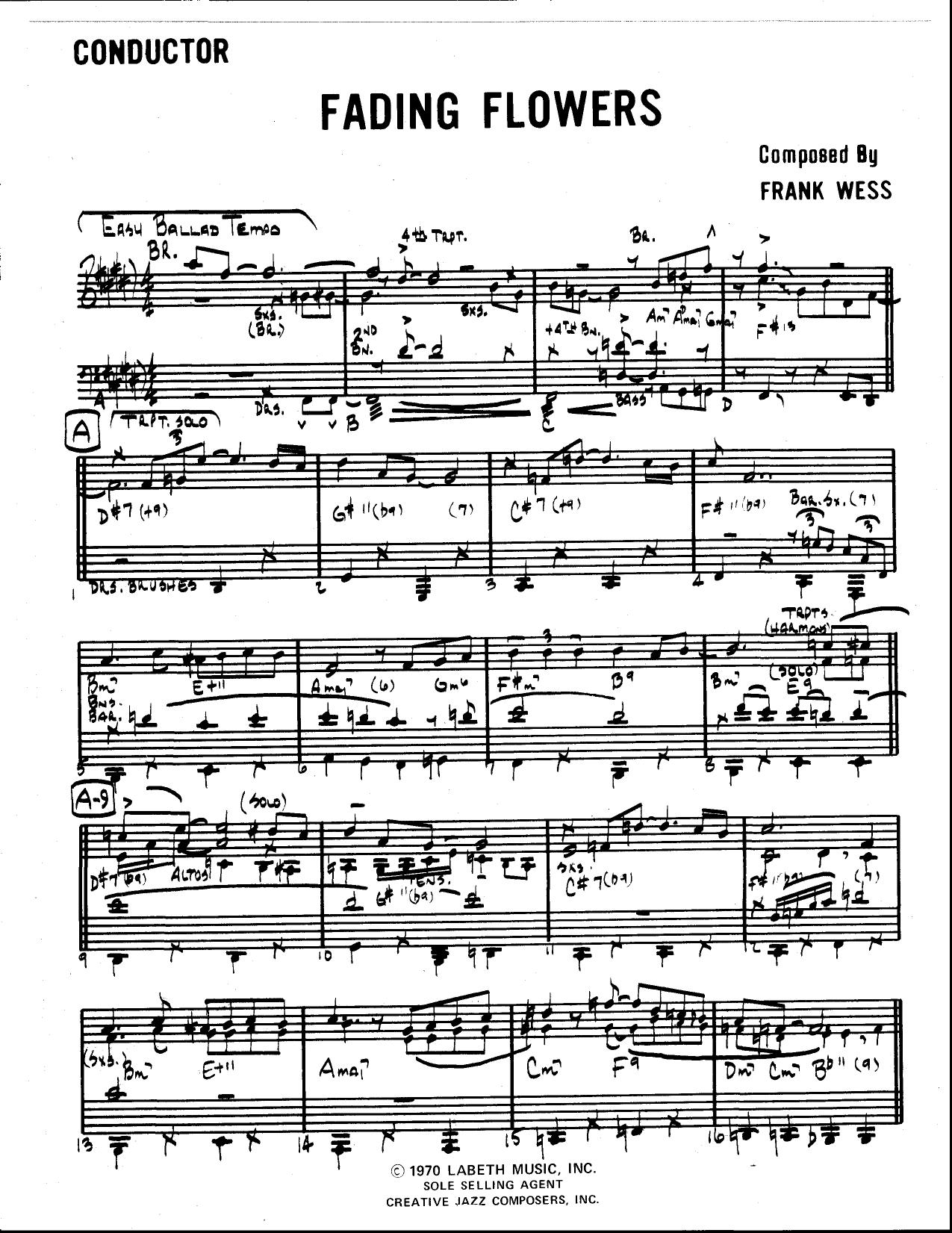
Fading Flowers (F.Wess-CJC)
Composed by Frank Wess
Arranged by F.Wess-CJC
- Ensemble: Big Band
- Style: Jazz Standard
- Pages: 37
- Instruments (19): Conductor, 1st Alto Sax, 2nd Alto Sax, 1st Tenor Sax, 2nd Tenor Sax, 5th Baritone Sax, Solo Trumpet, 1st Trumpet, 2nd Trumpet, 3rd Trumpet, 4th Trumpet, 1st Trombone, 2nd Trombone, 3rd Trombone, 4th Trombone, Bass, Drums, Piano, Guitar
- Difficulty: advanced
- Content: Individual Parts
- Format: PDF Download (Instant)
- Price: $24.99
"Fading Flowers (F.Wess-CJC)" stands as a compelling big band arrangement of a lesser-known gem from the illustrious career of Frank Wess, a pivotal figure in the Count Basie Orchestra and a master of both tenor saxophone and flute. While not as widely recorded as some jazz standards, the original composition by Wess embodies the sophisticated, swinging aesthetic of the late 1950s and early 1960s, a period marked by the refinement of big band jazz and the emergence of more intricate harmonic and melodic ideas within a swinging framework. Wess's compositions often showcased his lyrical sensibility and deep understanding of the big band idiom, making "Fading Flowers" a testament to his compositional prowess and a piece ripe for rediscovery. It evokes a mood of contemplative elegance, a medium-slow swing feel that allows for expressive melodic development and rich harmonic textures, distinguishing it from more overtly energetic or melancholic ballads. This particular arrangement by F.Wess-CJC elevates the original material with a distinctive and authoritative voice, characteristic of an arranger deeply steeped in the tradition yet unafraid to explore contemporary harmonic colors. The piece is set in a medium-slow swing tempo, typically around 88-96 BPM, in the key of C minor, which lends itself to a melancholic yet hopeful atmosphere. The arranger's approach is marked by sophisticated voicings that blend the saxophone section with brass, creating lush, sustained chords that underpin the primary melodic statements. Expect intricate soli sections for the saxophones, showcasing tight ensemble playing and precise articulation, punctuated by brass interjections that build dynamic tension. F.Wess-CJC masterfully employs extended harmonies and subtle reharmonizations, adding depth and a modern sheen without sacrificing the original's melodic integrity or swing feel. The arrangement features the melody initially carried by the lead alto saxophone, offering a lyrical and expressive opening statement, before being passed to a harmonized saxophone section. There are ample opportunities for featured solos, typically for tenor saxophone and trumpet, allowing soloists to explore the rich harmonic landscape provided by the rhythm section. Technical challenges include precise blend and intonation within the saxophone soli passages, dynamic control across the full ensemble, and the execution of subtle rhythmic nuances inherent in a medium-slow swing. The brass sections will need to articulate cleanly and with controlled power, particularly during the shout choruses which build to a powerful, yet never overpowering, climax. Performing "Fading Flowers" is rewarding for its ability to convey profound emotion through sophisticated ensemble writing and its capacity to truly showcase a band's musical maturity and expressive capabilities. This arrangement is ideally suited for advanced high school, collegiate, community, and professional big bands. Its demands for nuanced phrasing, sophisticated harmonic understanding, and precise ensemble execution make it an excellent vehicle for developing musicality and technical proficiency. The depth of the writing ensures that even professional ensembles will find ample interpretive challenges and opportunities for expressive performance, making it a valuable addition to any serious big band's repertoire. "Fading Flowers (F.Wess-CJC)" requires a meticulous approach to blend and balance, particularly within the saxophone soli sections where precise intonation and unified phrasing are paramount. Aim for a medium-slow swing tempo, approximately 88-96 BPM, ensuring the rhythm section establishes a relaxed yet propulsive groove from the outset; avoid rushing the eighth notes. Conductor and musicians should pay close attention to the dynamic markings, which are crucial for shaping the emotional arc of the piece, ranging from delicate pianissimo passages to controlled, full-ensemble forte sections. Special techniques include subtle brass falls and controlled vibrato in sustained wind chords. Rehearsal time should be dedicated to isolating the intricate inner voices of the saxophone soli, ensuring each line is heard clearly yet contributes to the overall harmonic texture. Emphasize the lyrical quality of the melody, allowing soloists and lead players to truly sing through their instruments. Q: What instruments and parts are included in this arrangement? A: This arrangement is scored for a standard 18-piece big band, including Alto Saxophone 1, Alto Saxophone 2, Tenor Saxophone 1, Tenor Saxophone 2, Baritone Saxophone, Trumpet 1, Trumpet 2, Trumpet 3, Trumpet 4, Trombone 1, Trombone 2, Trombone 3, Bass Trombone, Piano, Bass, Drums, and Guitar. The full conductor score is also included. Q: What is the difficulty level of "Fading Flowers (F.Wess-CJC)"? A: This arrangement is considered advanced, suitable for collegiate, community, and professional big bands. It demands strong technical proficiency, sophisticated harmonic understanding, and a high level of ensemble blend and musicality. Q: What is the musical style and historical context of this piece? A: "Fading Flowers" is a jazz standard composed by Frank Wess, embodying the sophisticated, lyrical big band jazz style of the late 1950s and early 1960s. It features a medium-slow swing feel with rich harmonies. Q: What makes this arrangement by F.Wess-CJC unique? A: F.Wess-CJC's arrangement is distinguished by its sophisticated voicings, intricate saxophone soli passages, subtle reharmonizations, and dynamic shout choruses, all while preserving the original composition's lyrical integrity and swing feel. Q: What is the typical performance duration or tempo for this arrangement? A: The typical performance duration is approximately 5-6 minutes, depending on the length of improvised solos. The recommended tempo is a medium-slow swing, ranging from 88 to 96 beats per minute.
Questions and answers
- What is included in the Fading Flowers (F.Wess-CJC) PDF?
- The verified current file contains a conductor score and individual parts across 37 pages.
- How many instruments or parts are listed for Fading Flowers (F.Wess-CJC)?
- The verified instrumentation list contains 19 entries for this Big Band arrangement.
- Who is credited for Fading Flowers (F.Wess-CJC)?
- Composer: Frank Wess. Arranger: F.Wess-CJC.
- What difficulty is listed for Fading Flowers (F.Wess-CJC)?
- The verified difficulty level is advanced.
- What style is listed for Fading Flowers (F.Wess-CJC)?
- The catalog lists the style as Jazz Standard.
- Can I preview Fading Flowers (F.Wess-CJC) before buying?
- Yes. The product page provides a preview generated from the current PDF file.
- How is Fading Flowers (F.Wess-CJC) delivered?
- After successful payment, the digital PDF is made available for download. The displayed price is $24.99.
Musicians Also Search For
Fading Flowers F.Wess-CJC PDF • Fading Flowers F.Wess-CJC sheet music • Fading Flowers arranged by F.Wess-CJC • F.Wess-CJC big band charts • F.Wess-CJC jazz arrangements PDF • Fading Flowers Frank Wess sheet music • Fading Flowers Frank Wess big band arrangements • Frank Wess big band charts • Fading Flowers big band arrangements • Fading Flowers big band PDF download • Fading Flowers jazz sheet music • big band sheet music download • Fading Flowers conductor score PDF • Fading Flowers individual parts download • Fading Flowers sheet music PDF • Fading Flowers Jazz Standard charts • Jazz Standard big band arrangements • buy Fading Flowers sheet music • download Fading Flowers PDF • Fading Flowers jazz charts • best F.Wess-CJC big band arrangements • Frank Wess arranged by F.Wess-CJC • Fading Flowers printable sheet music • big band repertoire PDF