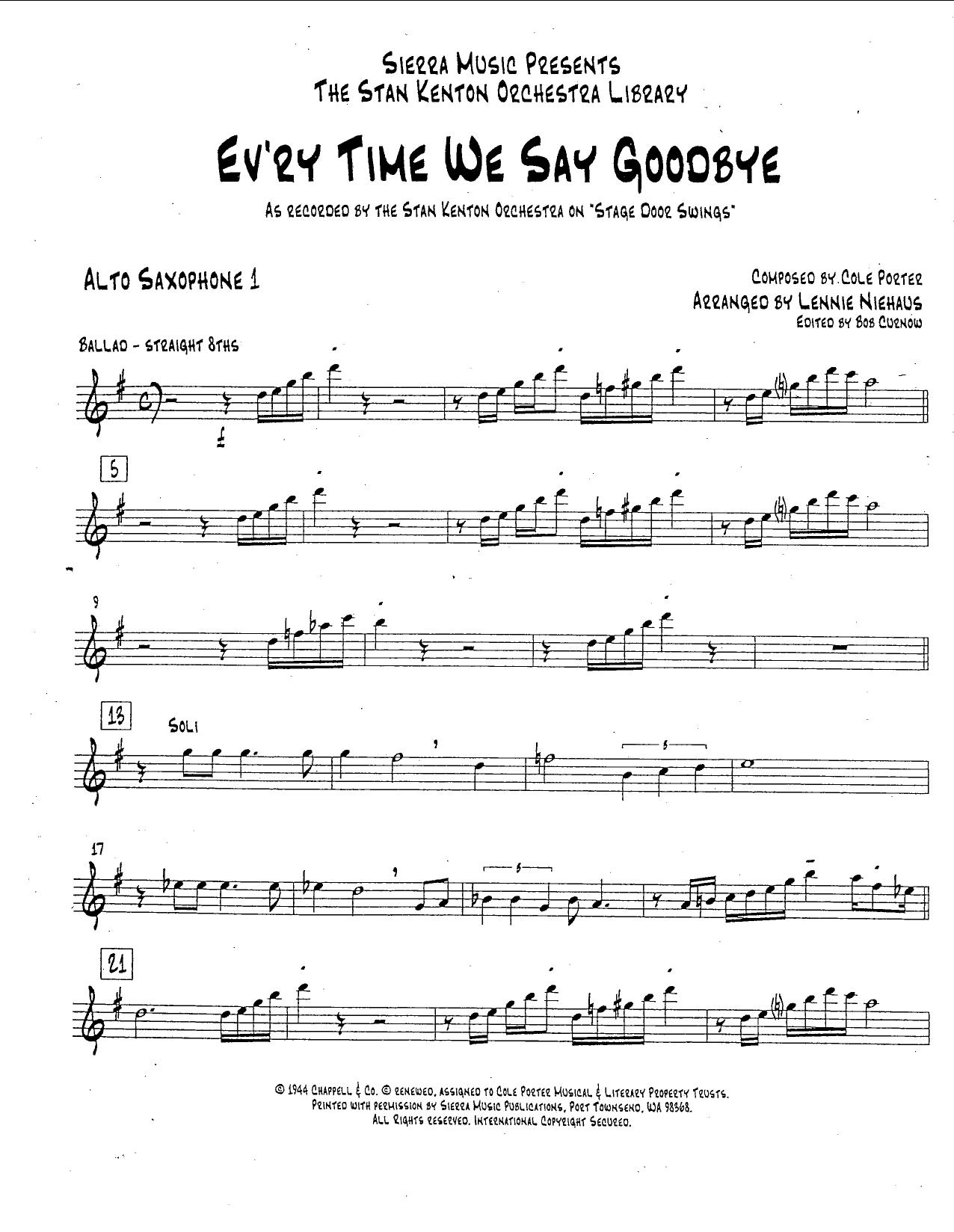
Ev'ry Time We Say Goodbye (L. Niehaus)
Composed by Cole Porter
Arranged by Lennie Niehaus
- Ensemble: Big Band
- Pages: 38
- Instruments (19): Alto Saxophone 1, Alto Saxophone 2, Tenor Saxophone 1, Tenor Saxophone 2, Baritone Saxophone, Trumpet 1, Trumpet 2, Trumpet 3, Trumpet 4 (Solo), Trumpet 5, Trombone 1, Trombone 2, Trombone 3, Bass Trombone 4, Bass Trombone 5, Guitar, Piano, Acoustic Bass, Drums
- Difficulty: medium
- Content: Individual Parts
- Format: PDF Download (Instant)
- Price: $24.99
Cole Porter’s timeless 1944 masterpiece "Ev’ry Time We Say Goodbye" stands as one of the most sophisticated contributions to the Great American Songbook, revered for its ingenious harmonic shifts from minor to major and its bittersweet, melancholic lyricism. Originally introduced in the Broadway revue *Seven Lively Arts* and subsequently immortalized by jazz legends ranging from Charlie Parker and John Coltrane to Ella Fitzgerald, the composition presents a unique structural challenge due to its unusual modulations and rich emotional subtext. It represents the pinnacle of mid-century sophisticated popular song craft, seamlessly bridging the gap between Broadway theater and modern jazz harmonic exploration. Lennie Niehaus approaches this classic standard with the characteristic West Coast cool jazz restraint, elegant counterpoint, and immaculate linear writing that defined his legendary career as both a Stan Kenton alto saxophonist and a prolific film composer. Rather than relying on bombastic shout choruses or high-register pyrotechnics, Niehaus frames the melody in a lush, harmonically rich canvas. The arrangement unfolds as a sublime ballad or a deeply expressive slow-tempo reflection, utilizing open, airy voicing structures in the saxophone and brass sections that evoke a contemplative, twilight mood. The subtle interplay between the woodwinds and the rhythm section creates an intimate, chamber-jazz atmosphere within a full big band format. The arrangement predominantly features the saxophone section carrying the initial thematic statements, taking full advantage of Niehaus’s intimate understanding of reed sonorities. Rich, four-part and five-part harmonizations give the ensemble a warm, velvety texture, while carefully integrated solo space allows a featured lead horn—typically alto saxophone or trumpet—to interpret Porter’s harmonic labyrinth with expressive rubato and lyrical phrasing. Technical demands center less on raw velocity and much more on intonation control, blend, breath support during long phrasing arcs, and the delicate execution of altered chord extensions at a subdued dynamic level. Advanced high school ensembles, collegiate jazz orchestras, and professional repertory bands will find this chart to be an exceptional vehicle for developing ensemble listening skills and mature musicality. Because it trades volume for subtlety, it forces musicians to master dynamic control and rhythmic unison across the section. Performing this arrangement rewards the ensemble with a masterclass in tension and release, offering audiences a poignant, sophisticated listening experience that honors one of jazz history's most heartbreakingly beautiful melodies. Conductors should approach this chart with a primary focus on horizontal linear motion and pristine intonation, as Niehaus’s sophisticated writing exposes any pitch discrepancies immediately. The tempo should remain a relaxed, flowing slow-to-medium ballad feel; resist the urge to drag, maintaining an internal pulse that keeps the eighth-note lines fluid and conversational. The saxophone section must prioritize a unified, classical-leaning blend on the rich chordal pads, ensuring that inner voices do not overpower the lead alto. Brass players should utilize warm, dark mutes or very gentle, covered open tones where indicated, avoiding any aggressive edge to their attack. Rehearsal time is best spent isolating the rhythm section and horns on the complex harmonic shifts, ensuring smooth voice-leading from minor keys into the brighter major resolutions. Balance is the ultimate hurdle; because the chart relies on delicate countermelodies tucked beneath the primary theme, balance must be meticulously monitored from the podium to let every moving voice breathe. Q: What instruments and parts are included in this big band arrangement? A: The 38-page score and parts set is scored for a standard 16-instrument big band instrumentation, featuring two alto saxophones, two tenor saxophones, a baritone saxophone, standard brass writing, and a full rhythm section. Q: What is the difficulty level of this Lennie Niehaus chart? A: This arrangement is graded as medium-advanced, making it ideal for skilled high school, collegiate, and professional jazz ensembles that excel at ballad playing and subtle harmonic reading. Q: What is the historical style and context of this arrangement? A: It reflects the sophisticated West Coast cool jazz aesthetic pioneered by arranger and saxophonist Lennie Niehaus, transforming Cole Porter's 1944 standard into an intimate, harmonically rich orchestral reflection. Q: What makes this specific Cole Porter arrangement unique? A: Unlike typical big band charts that rely on high-energy shout choruses, Niehaus utilizes transparent, airy voicings, intricate linear counterpoint, and lush saxophone solis to emphasize emotional depth over volume. Q: What is the performance duration and tempo feel of the piece? A: Designed as an expressive slow-to-medium ballad, the piece generally runs around 4 to 5 minutes depending on the rubato interpretation taken by the featured soloist and conductor.
Questions and answers
- What is included in the Ev'ry Time We Say Goodbye (L. Niehaus) PDF?
- The verified current file contains individual parts across 38 pages.
- How many instruments or parts are listed for Ev'ry Time We Say Goodbye (L. Niehaus)?
- The verified instrumentation list contains 19 entries for this Big Band arrangement.
- Who is credited for Ev'ry Time We Say Goodbye (L. Niehaus)?
- Composer: Cole Porter. Arranger: Lennie Niehaus.
- What difficulty is listed for Ev'ry Time We Say Goodbye (L. Niehaus)?
- The verified difficulty level is medium.
- Can I preview Ev'ry Time We Say Goodbye (L. Niehaus) before buying?
- Yes. The product page provides a preview generated from the current PDF file.
- How is Ev'ry Time We Say Goodbye (L. Niehaus) delivered?
- After successful payment, the digital PDF is made available for download. The displayed price is $24.99.
Musicians Also Search For
Ev'ry Time We Say Goodbye Lennie Niehaus PDF • Ev'ry Time We Say Goodbye Lennie Niehaus sheet music • Ev'ry Time We Say Goodbye arranged by Lennie Niehaus • Lennie Niehaus big band charts • Lennie Niehaus jazz arrangements PDF • Ev'ry Time We Say Goodbye Cole Porter sheet music • Ev'ry Time We Say Goodbye Cole Porter big band arrangements • Cole Porter big band charts • Ev'ry Time We Say Goodbye big band arrangements • Ev'ry Time We Say Goodbye big band PDF download • Ev'ry Time We Say Goodbye jazz sheet music • big band sheet music download • Ev'ry Time We Say Goodbye individual parts download • Ev'ry Time We Say Goodbye sheet music PDF • buy Ev'ry Time We Say Goodbye sheet music • download Ev'ry Time We Say Goodbye PDF • Ev'ry Time We Say Goodbye jazz charts • best Lennie Niehaus big band arrangements • Cole Porter arranged by Lennie Niehaus • Ev'ry Time We Say Goodbye printable sheet music • big band repertoire PDF