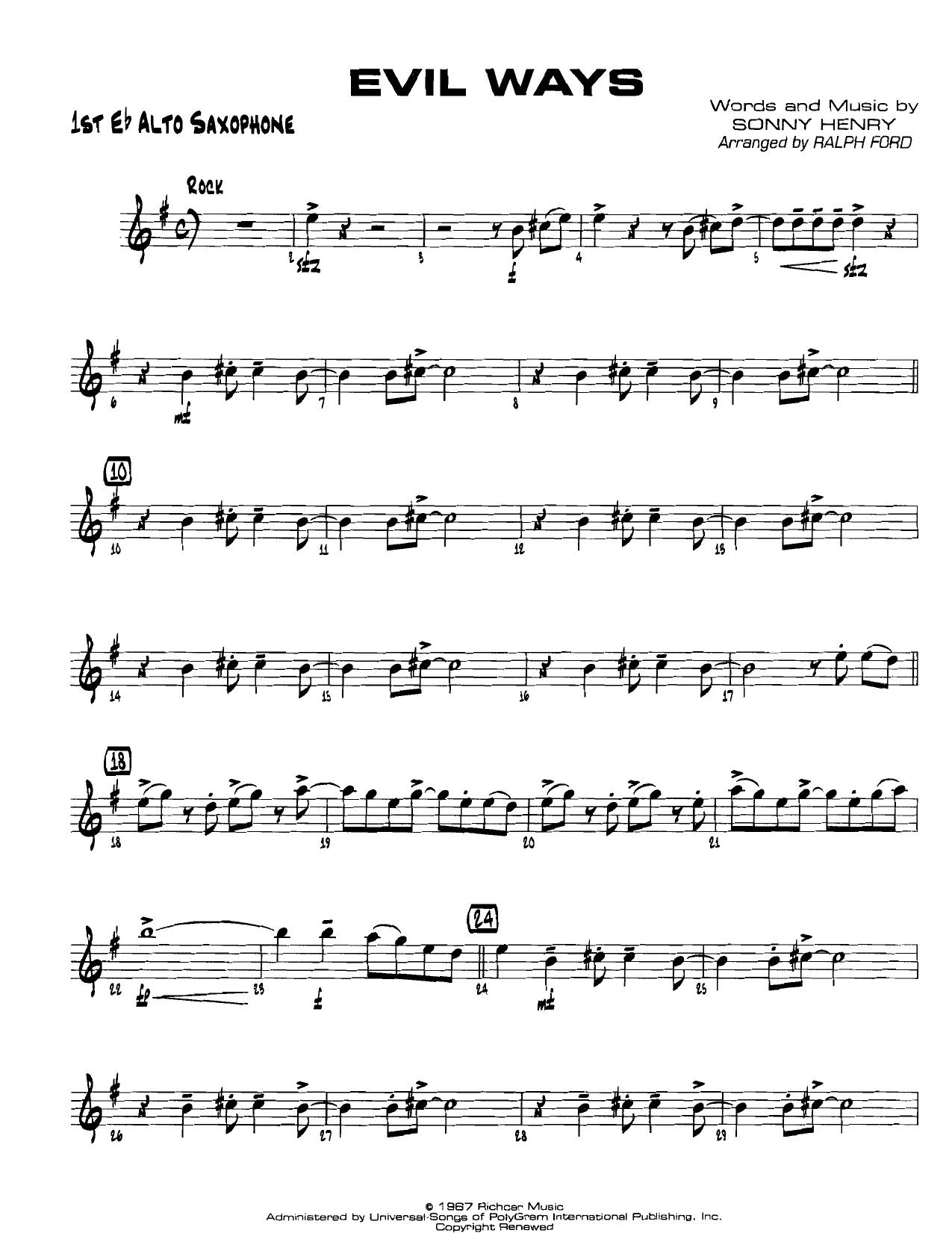
Evil Ways (R.Ford) sheet music preview

Evil Ways (R.Ford)

Composed by R.Ford

Arranged by R.Ford

  • Ensemble: Big Band
  • Style: Jazz Standard
  • Pages: 48
  • Instruments (20): 1st Eb Alto Saxophone, 2nd Eb Alto Saxophone, 1st Bb Tenor Saxophone, 2nd Bb Tenor Saxophone, Eb Baritone Saxophone, 1st Bb Trumpet, 2nd Bb Trumpet, 3rd Bb Trumpet, 1st Trombone, 2nd Trombone, 3rd Trombone, Tuba, Bass, Guitar, Aux. Percussion I (Maracas, Guiro), Aux. Percussion II (Congas), Drums, Horn in F (Dbls. 1st Trombone), C Flute, Piano
  • Difficulty: medium
  • Content: Individual Parts
  • Format: PDF Download (Instant)
  • Price: $24.99

"Evil Ways" is an iconic piece of the late 1960s, a vibrant testament to the fusion of Latin rhythms with rock and jazz sensibilities that defined an era. Originally composed by Sonny Henry, the track gained massive international fame through Santana's electrifying performance at Woodstock in 1969 and its subsequent release on their self-titled debut album. It quickly became a top-ten hit, solidifying Santana's place in music history and introducing a broad audience to the infectious Latin-rock groove that would become their signature. The piece is characterized by its driving percussion, distinctive guitar riffs, and a hypnotic, often modal, harmonic foundation, making it a perennial favorite and a true jazz standard in the broader sense of popular music that has crossed over into jazz repertoire. This big band arrangement by R.Ford masterfully captures the essence of the original while expanding its dynamic and textural possibilities for a full jazz ensemble. Ford's treatment maintains the infectious Latin-rock feel, primarily in a medium tempo, ensuring the signature rhythmic drive remains at the forefront. The arrangement is set in a key that is comfortable for the entire ensemble, allowing for rich, full-bodied voicings without undue technical strain. R.Ford, known for crafting accessible yet musically rewarding charts, employs clear and articulate ensemble writing, frequently utilizing unisons and well-balanced section soli passages that highlight the brass and saxophone sections. The mood is energetic and celebratory, evoking the vibrant spirit of its origins. The arrangement features the main melodic themes passed between various sections, including the saxophones and brass, creating a dynamic interplay. While the core melody is well-defined, there are ample opportunities for improvisation over the piece's characteristic vamp. R.Ford provides written solos for key instruments, often based on the accessible two-chord vamp, making it an excellent vehicle for developing improvisers to gain confidence. The chart includes a robust shout chorus that builds intensity, culminating in a powerful ensemble finish. Technical challenges are thoughtfully managed, focusing on rhythmic precision within the Latin groove and clean articulation rather than extreme ranges or complex harmonic substitutions. This arrangement is ideally suited for high school, community, and developing college jazz ensembles. R.Ford's expertise in scoring for this level ensures that the parts are well-written, with modest brass ranges and clearly notated rhythm section parts, providing a solid foundation for a successful performance. The rewarding aspect of performing this piece lies in its undeniable audience appeal, the opportunity for rhythmic cohesion, and the chance for soloists to shine within a supportive, grooving framework. It’s a chart that teaches ensemble tightness and rhythmic accuracy while delivering a high-energy, crowd-pleasing experience. Conductors should emphasize a precise and locked-in rhythmic feel from the rhythm section to establish the infectious Latin-rock groove. The tempo should be a steady medium, allowing the eighth notes to feel slightly swung but with a strong, forward momentum characteristic of Latin rock. Key technical challenges include maintaining rhythmic accuracy across all sections, particularly in the syncopated figures and ensemble hits. Brass players should focus on clean articulation and controlled dynamics, avoiding overblowing to preserve the blend. Saxophones should strive for a unified sound in soli sections, paying close attention to phrasing. No special techniques like plunger mutes or falls are explicitly required, but discretion can be used for stylistic embellishment in solo sections. Rehearsal time should be dedicated to isolating and drilling the rhythmic figures, ensuring the bass and drums are tightly interlocked, and practicing the ensemble soli passages for clarity and balance. Q: What instruments are included in this arrangement? A: This big band arrangement includes parts for 20 instruments: Alto Saxophone 1, Alto Saxophone 2, Tenor Saxophone 1, Tenor Saxophone 2, Baritone Saxophone, Trumpet 1, Trumpet 2, Trumpet 3, Trumpet 4, Trombone 1, Trombone 2, Trombone 3, Trombone 4, Guitar, Piano, Bass, Drums, and auxiliary percussion. It also includes a conductor score. Q: What is the difficulty level of this arrangement? A: This arrangement is considered accessible and suitable for high school, community, and developing college jazz ensembles. It is often graded as easy to medium-easy, making it ideal for bands looking for a rewarding yet manageable challenge. Q: What musical style and historical context does "Evil Ways" represent? A: "Evil Ways" is a jazz standard rooted in the Latin-rock fusion style of the late 1960s. It was popularized by Santana in 1969, embodying the energetic and groovy sound that blended rock with Afro-Cuban rhythms. Q: What makes R.Ford's arrangement of "Evil Ways" unique? A: R.Ford's arrangement is distinctive for its well-crafted ensemble writing, accessible voicings, and provision of written solos over an easy two-chord vamp, making it highly suitable for younger or developing jazz musicians. It retains the original's infectious Latin-rock groove while expanding it for a full big band. Q: What is the typical performance duration and tempo of this piece? A: The typical performance duration for this arrangement is approximately 3-4 minutes, depending on the length of improvised solos. It is designed to be performed at a medium Latin-rock tempo, emphasizing a steady and infectious groove.

Questions and answers

What is included in the Evil Ways (R.Ford) PDF?
The verified current file contains a conductor score and individual parts across 48 pages.
How many instruments or parts are listed for Evil Ways (R.Ford)?
The verified instrumentation list contains 20 entries for this Big Band arrangement.
Who is credited for Evil Ways (R.Ford)?
Composer: R.Ford. Arranger: R.Ford.
What difficulty is listed for Evil Ways (R.Ford)?
The verified difficulty level is medium.
What style is listed for Evil Ways (R.Ford)?
The catalog lists the style as Jazz Standard.
Can I preview Evil Ways (R.Ford) before buying?
Yes. The product page provides a preview generated from the current PDF file.
How is Evil Ways (R.Ford) delivered?
After successful payment, the digital PDF is made available for download. The displayed price is $24.99.

Musicians Also Search For

Evil Ways R.Ford PDFEvil Ways R.Ford sheet musicEvil Ways arranged by R.FordR.Ford big band chartsR.Ford jazz arrangements PDFEvil Ways R.Ford big band arrangementsEvil Ways big band arrangementsEvil Ways big band PDF downloadEvil Ways jazz sheet musicbig band sheet music downloadEvil Ways conductor score PDFEvil Ways individual parts downloadEvil Ways sheet music PDFEvil Ways Jazz Standard chartsJazz Standard big band arrangementsbuy Evil Ways sheet musicdownload Evil Ways PDFEvil Ways jazz chartsbest R.Ford big band arrangementsEvil Ways printable sheet musicbig band repertoire PDF

All arrangements by R.Ford All R.Ford sheet music