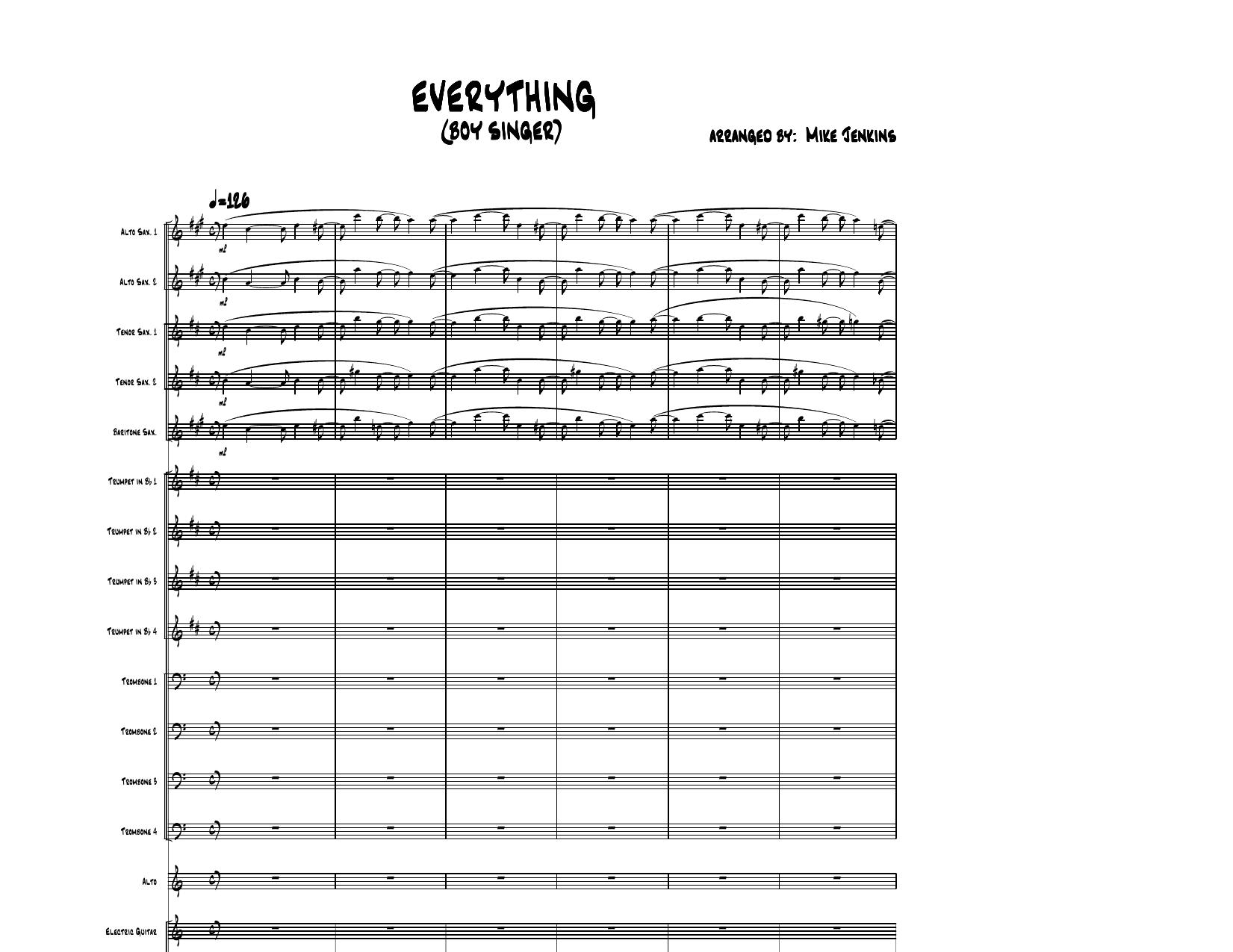
Everithing (M.Jenkins)
Composed by M. Jenkins
Arranged by Mike Jenkins
- Ensemble: Big Band Vocal
- Style: Pop
- Pages: 39
- Instruments (17): 1st Alto Sax, 1st Tenor Sax, 2nd Alto Sax, 2nd Tenor Sax, Bari Sax, Bass, Trombone 1, Trombone 2, Trombone 3, Trombone 4, Drums, Piano, Trumpet 1, Trumpet 2, Trumpet 3, Trumpet 4, Vocal
- Difficulty: medium
- Content: Individual Parts
- Format: PDF Download (Instant)
- Price: $24.99
Blending the polished accessibility of contemporary pop composition with the sophisticated harmonic palette of modern jazz orchestration, "Everithing" (composed by M. Jenkins) captures a vibrant cross-section of modern vocal jazz writing. Originally conceived as a catchy, groove-oriented pop track, this composition lends itself remarkably well to the big band format, echoing the high-energy vocal styling popularized by contemporary crossover artists who bridge the gap between Top 40 radio and traditional swing clubs. The intrinsic melodic hook of the original song provides a sturdy framework for an arrangement that seamlessly marries commercial appeal with intricate jazz counterpoint. Mike Jenkins structures this chart around a pulsing, infectious medium-up groove that sits comfortably in a driving 4/4 meter. The arrangement opens with an atmospheric, tension-building intro featuring sustained horn pads underneath a rhythmic piano and bass vamp, quickly giving way to a buoyant, forward-driving feel. As the arrangement unfolds through its various choruses, Jenkins employs rich, extended harmonies—utilizing sharp upper-structure triads and lush saxophone block voicings—to elevate the harmonic interest far beyond the original pop chord progression. The emotional trajectory shifts smoothly from playful and sophisticated verse sections to an explosive, brass-heavy shout chorus that demands crisp articulation and a unified ensemble attack. Vocalists will find plenty of room to stretch interpretively, as the chart is meticulously orchestrated to support the lead voice without ever getting muddy or overly dense. The woodwinds—comprising two altos, two tenors, and baritone sax—frequently carry interlocking counter-melodies and crisp soli lines that punctuate the vocal phrases. Meanwhile, the brass section functions dynamically, shifting from muted, textural background figures behind the verse to blazing, open-bell stabs during the climactic refrains. Jenkins introduces a clever modulation just prior to the final vocal chorus, injecting a burst of renewed energy that drives the ensemble straight to a high-impact, punchy ending. Advanced high school, collegiate, and professional big bands will discover an ideal balance of crowd-pleasing familiarity and legitimate musical challenge within these 39 pages. While the rhythm section must maintain an unwavering, driving pocket to anchor the pop-jazz groove, the horn sections will benefit greatly from working on dynamic control, intonation in tight upper-structure voicings, and stylistic unity. Complete with a comprehensive conductor score and a full 17-instrument big band instrumentation, this chart stands out as an exceptional centerpiece for any contemporary vocal jazz set, offering modern audiences a fresh sonic experience while giving working musicians plenty of depth to sink their teeth into. The primary technical challenge in performing Mike Jenkins' arrangement of "Everithing" lies in marrying a strict, driving pop-groove with a fluid, idiomatic jazz phrasing. The rhythm section must establish a rock-solid, unyielding pocket from the downbeat; the drummer should blend contemporary pop-funk subdivision with traditional jazz ride cymbal punctuation, avoiding any heavy dragging on the backbeats. For the horn sections, precision in articulation is paramount. Ensure that all eighth-note lines are swung moderately where indicated, but keep stutters and short accents razor-sharp to maintain the contemporary pop edge. During the background figures behind the vocal, brass players should utilize subtle cup or harmon mutes (where specified) to avoid stepping on the lyric delivery. Conductors should pay close attention to dynamic balance during the dense, extended-harmony saxophone solis, ensuring the inner voices do not get buried by the baritone sax or lead alto. Rehearsals should begin by isolating the rhythm section and vocal soloist together to lock in the groove before layering in the horn sections section by section. Focus heavily on breath support leading into the modulation, as maintaining intonation through the key change will define the success of the climactic shout chorus. Q: What instruments and parts are included in this big band arrangement? A: This arrangement is scored for a standard 17-instrument big band instrumentation, including 5 saxophones (1st Alto, 2nd Alto, 1st Tenor, 2nd Tenor, Bari Sax), 4 trumpets, 4 trombones, guitar, piano, bass, drum set, and the vocal lead part, alongside a comprehensive 39-page conductor score. Q: What is the difficulty level of this arrangement? A: This chart is graded as advanced-intermediate to advanced, making it best suited for college ensembles, high-level high school bands, and professional or community big bands with strong section players and a confident vocal soloist. Q: What is the musical style and historical context of "Everithing"? A: Composed by M. Jenkins, the piece originates as a contemporary pop song and is reimagined here in a sophisticated modern big band vocal jazz style that bridges mainstream radio appeal with intricate jazz harmony. Q: What makes Mike Jenkins' arrangement of this piece unique? A: Jenkins elevates the original pop composition through lush extended chord voicings, interlocking woodwind counter-melodies, a clever key modulation, and a high-impact shout chorus that breathes new life into the familiar melody. Q: What is the performance duration and recommended tempo for this chart? A: The arrangement runs approximately 3.5 to 4 minutes and is designed to be performed at a lively, driving medium-up tempo feel that keeps the energy high from start to finish.
Questions and answers
- What is included in the Everithing (M.Jenkins) PDF?
- The verified current file contains a conductor score and individual parts across 39 pages.
- How many instruments or parts are listed for Everithing (M.Jenkins)?
- The verified instrumentation list contains 17 entries for this Big Band Vocal arrangement.
- Who is credited for Everithing (M.Jenkins)?
- Composer: M. Jenkins. Arranger: Mike Jenkins.
- What difficulty is listed for Everithing (M.Jenkins)?
- The verified difficulty level is medium.
- What style is listed for Everithing (M.Jenkins)?
- The catalog lists the style as Pop.
- Can I preview Everithing (M.Jenkins) before buying?
- Yes. The product page provides a preview generated from the current PDF file.
- How is Everithing (M.Jenkins) delivered?
- After successful payment, the digital PDF is made available for download. The displayed price is $24.99.
Musicians Also Search For
Everithing Mike Jenkins PDF • Everithing Mike Jenkins sheet music • Everithing arranged by Mike Jenkins • Mike Jenkins big band vocal charts • Mike Jenkins jazz arrangements PDF • Everithing M. Jenkins sheet music • Everithing M. Jenkins big band vocal arrangements • M. Jenkins big band vocal charts • Everithing big band vocal arrangements • Everithing big band vocal PDF download • Everithing jazz sheet music • big band vocal sheet music download • Everithing conductor score PDF • Everithing individual parts download • Everithing sheet music PDF • Everithing Pop charts • Pop big band vocal arrangements • buy Everithing sheet music • download Everithing PDF • Everithing jazz charts • best Mike Jenkins big band vocal arrangements • M. Jenkins arranged by Mike Jenkins • Everithing printable sheet music • big band vocal repertoire PDF