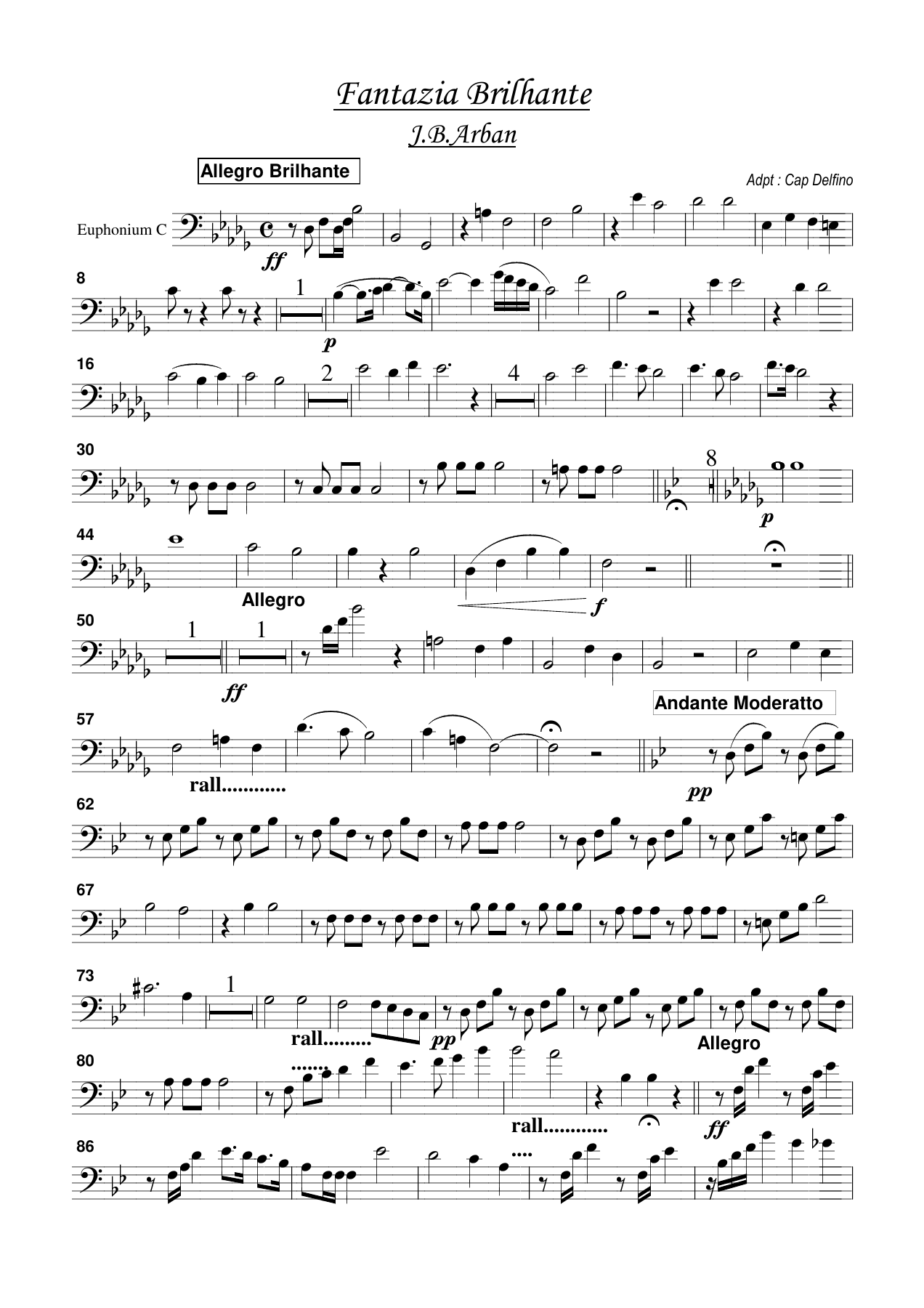
euphonium C (C.Delfino)
Composed by J.B. Arban
Arranged by Cap Delfino
- Ensemble: Concert Band
- Style: Traditional
- Pages: 18
- Instruments (16): Alto Saxophone I, Alto Saxophone II, Tenor Saxophone I, Tenor Saxophone II, Baritone Saxophone, Trumpet I, Trumpet II, Trumpet III, Trumpet IV, Solo Euphonium, Trombone II, Trombone III, Trombone IV, Guitar, Bass, Drums
- Difficulty: easy
- Content: Individual Parts
- Format: PDF Download (Instant)
- Price: $10.99
J.B. Arban's "euphonium C," meticulously arranged for concert band by Cap Delfino, transcends its origins as a foundational brass study to emerge as a captivating showcase piece. Arban, a towering figure in 19th-century brass pedagogy, composed a vast collection of etudes and solos that have remained indispensable for developing technical mastery and musicality on brass instruments. While not a "jazz standard" in the traditional sense, Delfino's arrangement recontextualizes this classical gem, transforming its inherent virtuosity into a vibrant, traditional concert band feature. The original work, deeply rooted in the Romantic era's emphasis on melodic lyricism and technical brilliance, provides a rich canvas for Delfino's interpretive vision, allowing a modern concert band to explore the expressive potential of a classic. Cap Delfino's arrangement approaches "euphonium C" with a profound respect for Arban's original melodic and technical demands, while skillfully re-orchestrating it for the full concert band palette. The piece maintains a stately, traditional march-like tempo, typically around quarter note = 100-112, allowing the euphonium soloist ample space for articulation and phrasing. The primary key of C major, with excursions into related keys, provides a bright and accessible harmonic landscape. Delfino’s signature lies in his ability to craft rich, supportive accompaniments that highlight the soloist without overshadowing them. Expect carefully voiced woodwind and brass sections providing lush harmonic pads and rhythmic propulsion, often employing counter-melodies and call-and-response figures that build dynamic interest. The arrangement skillfully navigates between moments of grand, full-ensemble statements and delicate, chamber-like textures, ensuring sustained engagement for both performers and audience. The euphonium soloist carries the melodic line throughout the majority of the piece, showcasing both lyrical phrasing and dazzling technical runs. While there are no improvised solos in the jazz sense, the arrangement demands a high level of technical proficiency and musical maturity from the featured euphonium player, including clean articulation, precise intonation across registers, and dynamic control. The ensemble parts, while supportive, are far from rudimentary; woodwinds will encounter intricate runs and sustained melodic lines, while brass sections provide powerful fanfares and rhythmic anchors. The piece builds to a triumphant climax, featuring a full-band tutti section that underscores the soloist's final flourishes. Performing this arrangement is immensely rewarding, offering a unique opportunity to present a classical virtuoso piece within the powerful and colorful framework of a modern concert band, fostering both individual brilliance and collective ensemble cohesion. This arrangement is ideally suited for advanced high school, collegiate, community, and professional concert bands. Its demands on the euphonium soloist make it an excellent choice for a featured student or professional, while the ensemble parts provide substantial musical and technical challenges for all sections. It serves as an exceptional vehicle for developing ensemble balance, blend, and dynamic control, and offers a refreshing alternative to standard concert band repertoire by bridging classical virtuosity with a traditional concert band aesthetic. Conductors should emphasize the importance of a consistent, stately tempo (quarter note = 100-112) to allow the euphonium soloist to articulate clearly and phrase expressively. Focus on achieving a balanced blend between the soloist and the accompanying ensemble, ensuring the soloist is always prominent but integrated. Technical challenges for the soloist include rapid sixteenth-note passages, wide intervallic leaps, and sustained lyrical lines requiring excellent breath support and intonation. Ensemble sections should practice precise rhythmic entrances and releases, particularly in the brass fanfares and woodwind flourishes. Dynamic contrasts are crucial; encourage a full dynamic range from *piano* accompaniments to *fortissimo* tutti sections. Rehearsal time should be dedicated to aligning articulations across sections and perfecting the interplay between the soloist and the various ensemble voicings, ensuring a cohesive and polished performance. Q: What instruments/parts are included in this arrangement? A: This arrangement for concert band includes parts for all standard concert band instrumentation, specifically featuring a prominent solo euphonium part, along with comprehensive woodwind, brass, and percussion sections. Q: What is the difficulty level of "euphonium C (C.Delfino)"? A: This arrangement is considered advanced, suitable for high school, collegiate, community, and professional concert bands, primarily due to the demanding solo euphonium part and intricate ensemble writing. Q: What musical style and historical context does this arrangement represent? A: This arrangement re-orchestrates J.B. Arban's classical virtuoso piece from the Romantic era, presenting it in a traditional concert band style, highlighting its lyrical and technical brilliance. Q: What makes Cap Delfino's arrangement of "euphonium C" unique? A: Delfino's arrangement is unique in its masterful re-orchestration of a classical solo piece for full concert band, providing a rich, supportive, and dynamically varied accompaniment that enhances the original's virtuosity. Q: What is the typical performance duration or tempo for this piece? A: The typical performance duration is approximately 4-5 minutes, performed at a stately, traditional tempo, generally around quarter note = 100-112.
Questions and answers
- What is included in the euphonium C (C.Delfino) PDF?
- The verified current file contains individual parts across 18 pages.
- How many instruments or parts are listed for euphonium C (C.Delfino)?
- The verified instrumentation list contains 16 entries for this Concert Band arrangement.
- Who is credited for euphonium C (C.Delfino)?
- Composer: J.B. Arban. Arranger: Cap Delfino.
- What difficulty is listed for euphonium C (C.Delfino)?
- The verified difficulty level is easy.
- What style is listed for euphonium C (C.Delfino)?
- The catalog lists the style as Traditional.
- Can I preview euphonium C (C.Delfino) before buying?
- Yes. The product page provides a preview generated from the current PDF file.
- How is euphonium C (C.Delfino) delivered?
- After successful payment, the digital PDF is made available for download. The displayed price is $10.99.
Musicians Also Search For
euphonium C Cap Delfino PDF • euphonium C Cap Delfino sheet music • euphonium C arranged by Cap Delfino • Cap Delfino concert band charts • Cap Delfino jazz arrangements PDF • euphonium C J.B. Arban sheet music • euphonium C J.B. Arban concert band arrangements • J.B. Arban concert band charts • euphonium C concert band arrangements • euphonium C concert band PDF download • euphonium C jazz sheet music • concert band sheet music download • euphonium C individual parts download • euphonium C sheet music PDF • euphonium C Traditional charts • Traditional concert band arrangements • buy euphonium C sheet music • download euphonium C PDF • euphonium C jazz charts • best Cap Delfino concert band arrangements • J.B. Arban arranged by Cap Delfino • euphonium C printable sheet music • concert band repertoire PDF