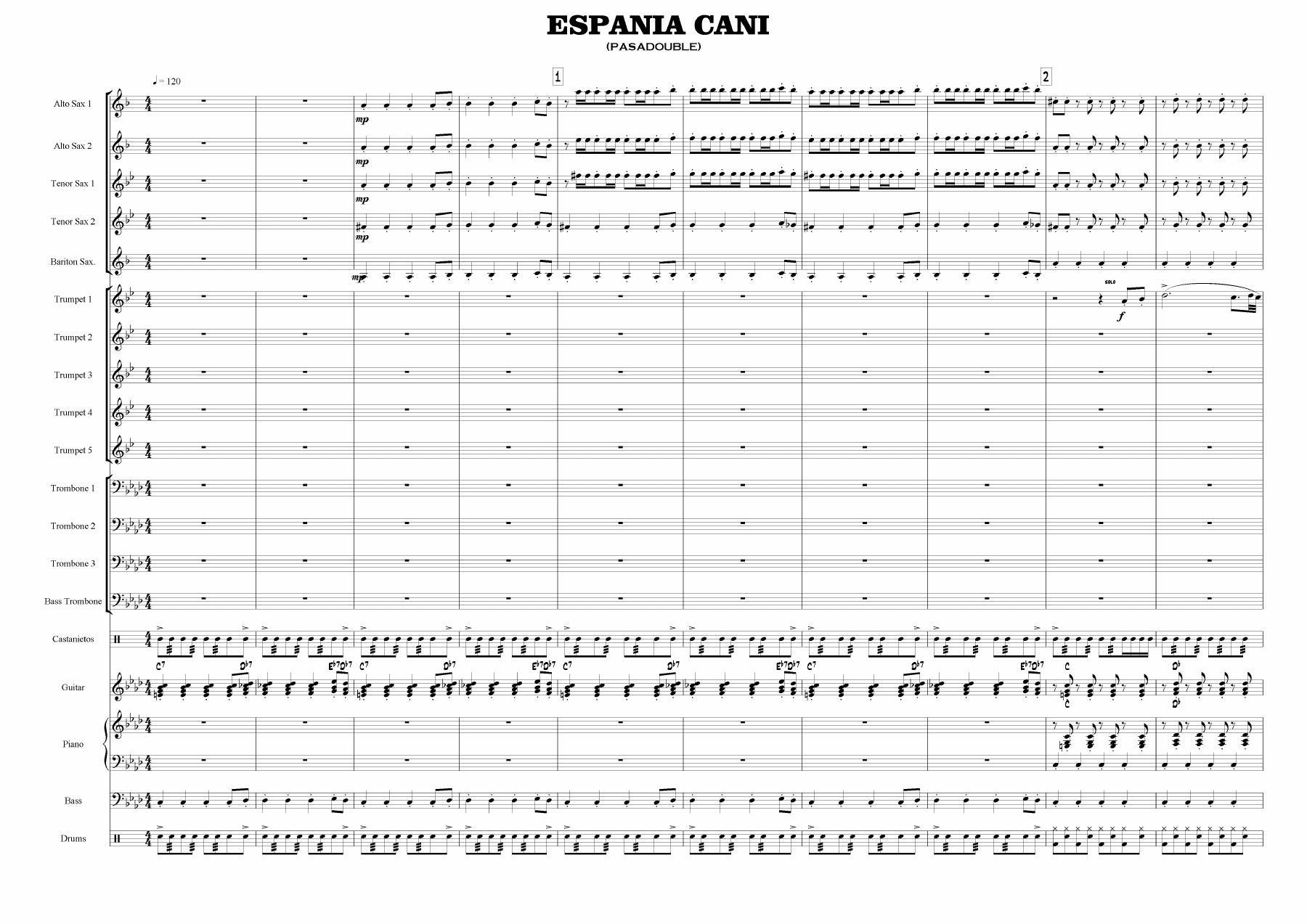
Espania Cani (B.Myagkov)
Composed by Pascual Marquina Narro
Arranged by Boris Myagkov
- Ensemble: Big Band
- Style: Jazz Standard
- Pages: 33
- Instruments (20): Flute, Alto Sax 1, Alto Sax 2, Tenor Sax 1, Tenor Sax 2, Bariton Sax., Trumpet 1, Trumpet 2, Trumpet 3, Trumpet 4, Trumpet 5, Trombone 1, Trombone 2, Trombone 3, Bass Trombone, Castanietos, Guitar, Piano, Bass, Drums
- Difficulty: medium
- Content: Individual Parts
- Format: PDF Download (Instant)
- Price: $24.99
Pascual Marquina Narro's iconic "España Cañí," originally composed in 1923, stands as a timeless pasodoble, deeply embedded in Spanish cultural heritage and frequently associated with bullfighting arenas and traditional dances. While not initially conceived as a jazz standard, its enduring melodic charm and rhythmic vitality have made it a compelling canvas for jazz interpretation, much like other popular tunes from diverse origins that found new life in the jazz idiom. The original piece evokes a sense of grandeur, passion, and vibrant Spanish flair, characterized by its memorable main theme and driving 2/4 rhythm. Boris Myagkov's arrangement masterfully re-imagines this classic, transplanting its fiery spirit into the dynamic world of the big band. Myagkov's treatment of "España Cañí" transforms its traditional essence into an exhilarating, up-tempo Latin jazz groove, primarily in a vibrant 4/4 meter with occasional rhythmic shifts that maintain the original's inherent drama. The arrangement is set in a bright, driving tempo, likely around 180-200 BPM, infusing the piece with an infectious energy that is both sophisticated and danceable. While the original key of G minor/major is often retained or subtly modulated, Myagkov expertly employs extended harmonies and rich voicings, adding a contemporary jazz sensibility without sacrificing the melodic integrity of Narro's composition. The overall mood is celebratory and energetic, evoking the excitement of a grand performance. The arranger's distinctive approach is evident from the outset, likely featuring a powerful brass introduction that immediately establishes the Latin feel. Myagkov is known for his intricate yet playable ensemble writing, often showcasing soaring saxophone soli sections that weave complex melodic lines with precision and flair. Expect dynamic contrasts, with moments of full ensemble power giving way to nuanced, tightly voiced brass or saxophone passages. The main melody is expertly passed between sections, ensuring every part of the big band has an opportunity to shine. While specific solo sections are not detailed, it is highly probable that Myagkov has crafted compelling improvised solo opportunities, perhaps for tenor saxophone or trumpet, allowing for individual expression within the structured arrangement. His signature techniques often include dramatic build-ups, unexpected rhythmic accents, and a powerful, full-band shout chorus that brings the piece to a thrilling climax. Performing this arrangement is a rewarding experience for a big band with a solid foundation in Latin jazz rhythms and ensemble precision. The technical challenges will likely include maintaining the high tempo with rhythmic accuracy, navigating complex soli passages, and executing precise dynamic shifts. The piece demands excellent blend and balance, particularly in the tightly voiced sections. It is ideally suited for college-level jazz ensembles, advanced community big bands, and professional groups seeking a vibrant, audience-pleasing showstopper. The sheer joy and energy embedded in Myagkov's interpretation make it a standout piece for any concert program, offering both a nod to a classical favorite and a thrilling contemporary jazz experience. Conductors should emphasize a consistent, driving up-tempo Latin groove from the downbeat, ensuring the rhythm section lays a solid, energetic foundation. The key technical challenge lies in the precision required for the fast-paced ensemble soli sections, particularly in the saxophones and brass. Encourage players to articulate cleanly and maintain rhythmic accuracy at speed. Dynamic contrasts are crucial; practice the dramatic crescendos and sudden diminuendos to maximize impact. While no specific special techniques are listed, a bright, open trumpet sound is generally preferred for this style. Rehearsal time should focus on locking in the rhythmic feel, perfecting ensemble blend and balance, and ensuring soloists are comfortable navigating the harmonic progression within the energetic tempo. Q: What instruments and parts are included in this arrangement? A: This big band arrangement includes parts for 20 instruments: Alto Saxophone 1, Alto Saxophone 2, Tenor Saxophone 1, Tenor Saxophone 2, Baritone Saxophone, Trumpet 1, Trumpet 2, Trumpet 3, Trumpet 4, Trombone 1, Trombone 2, Trombone 3, Trombone 4, Piano, Guitar, Bass, Drums, and potentially additional percussion. It also includes a full conductor score, totaling 33 pages. Q: What is the difficulty level of this arrangement? A: This arrangement is considered advanced, suitable for college-level jazz ensembles, advanced community big bands, and professional groups. It requires strong rhythmic precision, technical proficiency, and experience with Latin jazz styles. Q: What is the musical style and historical context of "Espania Cani (B.Myagkov)"? A: This arrangement transforms Pascual Marquina Narro's original 1923 Spanish pasodoble, "España Cañí," into an up-tempo Latin jazz big band piece. It blends the traditional melodic charm of the original with contemporary jazz harmonies and a vibrant rhythmic feel. Q: What makes Boris Myagkov's arrangement of "España Cañí" unique? A: Myagkov's arrangement is unique for its transformation of a traditional pasodoble into a high-energy Latin jazz big band chart. It features sophisticated voicings, intricate saxophone soli sections, dynamic contrasts, and a powerful full-band shout chorus, showcasing the arranger's distinctive contemporary jazz approach. Q: What is the approximate performance duration and recommended tempo for this piece? A: While the exact duration can vary with interpretation, this up-tempo Latin jazz arrangement typically performs for approximately 3-4 minutes. The recommended tempo is a bright, driving Latin groove, likely in the range of 180-200 beats per minute.
Questions and answers
- What is included in the Espania Cani (B.Myagkov) PDF?
- The verified current file contains a conductor score and individual parts across 33 pages.
- How many instruments or parts are listed for Espania Cani (B.Myagkov)?
- The verified instrumentation list contains 20 entries for this Big Band arrangement.
- Who is credited for Espania Cani (B.Myagkov)?
- Composer: Pascual Marquina Narro. Arranger: Boris Myagkov.
- What difficulty is listed for Espania Cani (B.Myagkov)?
- The verified difficulty level is medium.
- What style is listed for Espania Cani (B.Myagkov)?
- The catalog lists the style as Jazz Standard.
- Can I preview Espania Cani (B.Myagkov) before buying?
- Yes. The product page provides a preview generated from the current PDF file.
- How is Espania Cani (B.Myagkov) delivered?
- After successful payment, the digital PDF is made available for download. The displayed price is $24.99.
Musicians Also Search For
Espania Cani Boris Myagkov PDF • Espania Cani Boris Myagkov sheet music • Espania Cani arranged by Boris Myagkov • Boris Myagkov big band charts • Boris Myagkov jazz arrangements PDF • Espania Cani Pascual Marquina Narro sheet music • Espania Cani Pascual Marquina Narro big band arrangements • Pascual Marquina Narro big band charts • Espania Cani big band arrangements • Espania Cani big band PDF download • Espania Cani jazz sheet music • big band sheet music download • Espania Cani conductor score PDF • Espania Cani individual parts download • Espania Cani sheet music PDF • Espania Cani Jazz Standard charts • Jazz Standard big band arrangements • buy Espania Cani sheet music • download Espania Cani PDF • Espania Cani jazz charts • best Boris Myagkov big band arrangements • Pascual Marquina Narro arranged by Boris Myagkov • Espania Cani printable sheet music • big band repertoire PDF