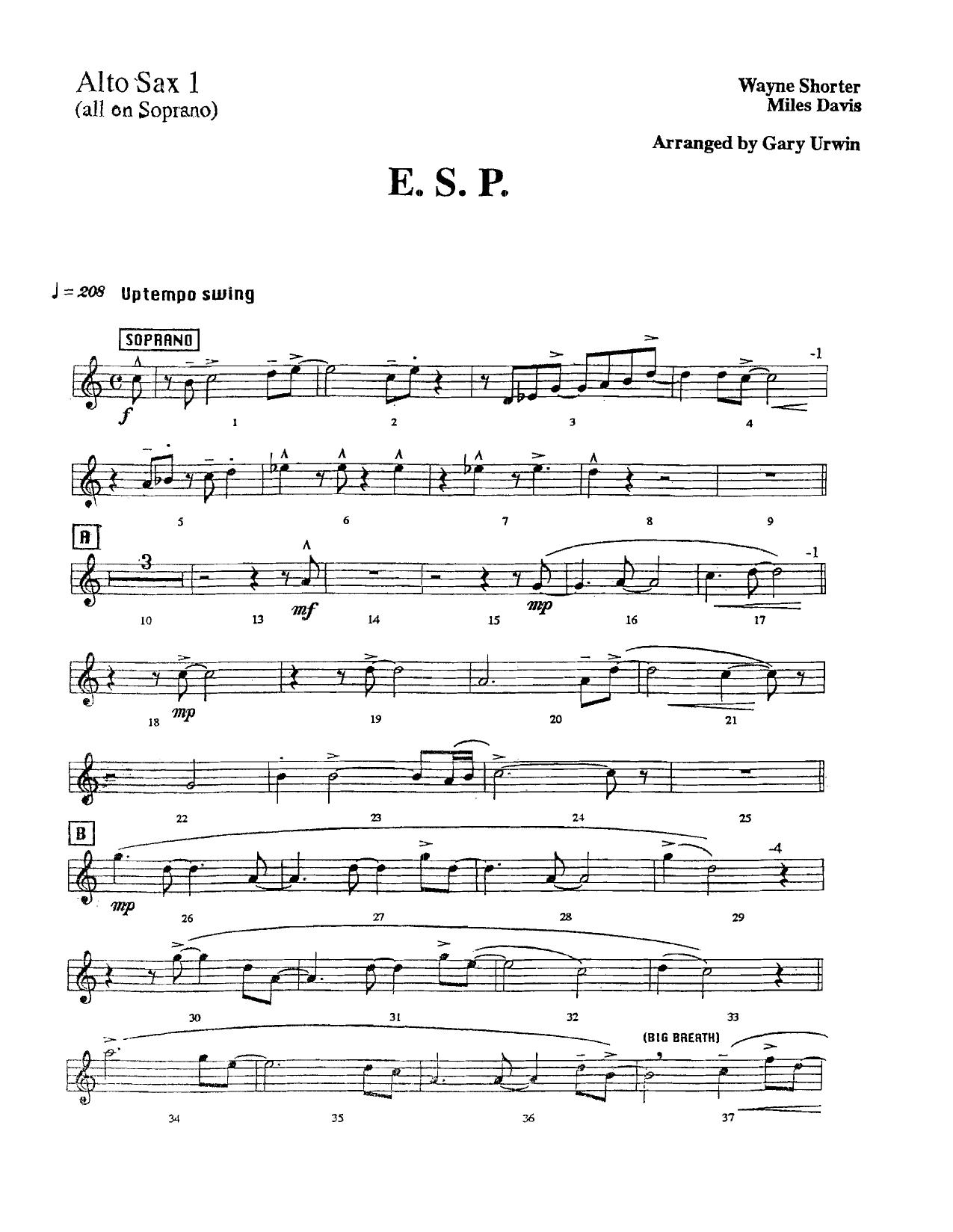
E.S.P. (G.Urwin) sheet music preview

E.S.P. (G.Urwin)

Composed by Wayne Shorter

Arranged by Gary Urwin

  • Ensemble: Big Band
  • Pages: 89
  • Instruments (18): Alto Sax 1 (Soprano), Alto Sax 2, Tenor Sax 1, Tenor Sax 2, Baritone Sax, Trumpet 1, Trumpet 2, Trumpet 3, Trumpet 4, Trumpet 5, Trombone 1, Trombone 2, Trombone 3, Bass Trombone, Guitar, Piano, Bass, Drums
  • Difficulty: advanced
  • Content: Individual Parts
  • Format: PDF Download (Instant)
  • Price: $24.99

Wayne Shorter’s iconic composition "E.S.P." first electrified the modern jazz landscape upon its 1965 release as the title track of Miles Davis’s legendary second great quintet album. Representing a pivotal bridge between post-bop exploration and modal freedom, Shorter’s labyrinthine melody and sophisticated harmonic architecture quickly established the tune as an enduring jazz standard. Capturing the restless, intellectually charged spirit of mid-1960s acoustic jazz, the original recording featured Shorter and Davis weaving through rapid-fire harmonic shifts with telepathic interplay, creating a blueprint for adventurous small-group writing that continues to challenge improvisers today. Translating this intricate small-group masterpiece into a powerhouse large-ensemble canvas, Gary Urwin’s dynamic big band adaptation retains all of the original’s harmonic edge while introducing sweeping orchestral colors. Propelled by an urgent, driving medium-up swing feel in 4/4 time, the chart crackles with nervous energy, sophisticated tension-and-release, and a relentless forward momentum. Urwin capitalizes on the shifting tonalities of Shorter's theme, utilizing modern extended chord voicings in the brass and interlocking woodwind counterlines to evoke a distinctly urbane, high-stakes modal atmosphere that demands absolute focus and precision from every player in the ensemble. Urwin’s signature arranging style shines through brilliant sectional writing, highlighted by crisp, harmonically rich sax solis and aggressive ensemble shout choruses that reframe the iconic head for full-scale brass firepower. The melody is initially introduced through tightly controlled sectional interplay before opening up into expansive, highly charged solo sections that invite adventurous improvisers to stretch over the tune's signature form. Technical challenges lie primarily in the rapid execution of Shorter’s angular intervals, agile dynamic control during dense counterpoint, and maintaining an unwavering rhythmic pocket at a brisk tempo. The reward for the ensemble is a visceral, deeply satisfying performance experience that showcases modern big band arranging at its absolute peak. Advanced college ensembles, top-tier high school jazz bands, and professional community orchestras will find this chart an exceptional centerpiece for festival repertoires or ambitious concert programs. Because it rewards meticulous sectional blend, rhythmic discipline, and advanced harmonic comprehension, the arrangement serves as both an elite pedagogical tool and a show-stopping vehicle for seasoned groups seeking to push their stylistic boundaries into sophisticated post-bop territory. Conductors tackling Gary Urwin’s chart of "E.S.P." must prioritize crisp articulation and absolute rhythmic unity, particularly during the angular unison lines that define Shorter's thematic material. The underlying medium-up swing tempo must feel effortless yet intensely driven; avoid rushing the peaks of the phrases by keeping the ride cymbal and hi-hat locked tightly with the bass. Pay close attention to dynamic contrast—the arrangement relies heavily on sudden drops to whisper-quiet backgrounds behind soloists, followed by explosive, unforced shout choruses where the brass must project without pinching their tone. Saxophones should focus on a seamless, homogeneous blend during the soli sections, ensuring that internal voice-leading is heard clearly beneath the lead alto. Rehearsal should begin slowly, isolating the complex rhythmic unisons between the lower brass and rhythm section before dialing in the final tempo and stylistic swing nuances. Q: What instrumentation and parts are included in this arrangement? A: This arrangement is scored for a standard 18-piece big band featuring 5 saxophones (Alto Saxophone 1, Alto Saxophone 2, Tenor Saxophone 1, Tenor Saxophone 2, Baritone Saxophone), 4 trumpets, 4 trombones, and a full four-piece rhythm section (piano, guitar, bass, and drums). Q: What is the difficulty level of this big band chart? A: This arrangement is classified as advanced, making it best suited for high-level collegiate jazz ensembles, advanced high school bands, and professional or premier community big bands with strong readers and experienced soloists. Q: What is the historical context and musical style of the piece? A: The work is based on Wayne Shorter’s seminal 1965 post-bop composition originally recorded by the Miles Davis Quintet, styled here as a high-energy, modern medium-up swing chart that bridges modal exploration with classic big band traditions. Q: What makes Gary Urwin's arrangement unique compared to other versions? A: Urwin brilliantly transforms a famously intricate small-group tune into a massive orchestral statement by utilizing dense, contemporary modal voicings, aggressive brass shout choruses, and intricate woodwind counterlines while preserving Shorter's original harmonic integrity. Q: What is the recommended performance duration and tempo for this piece? A: While performance time typically hovers around 5 to 6 minutes depending on the length of the open solo sections, the arrangement is anchored by a brisk, driving medium-up swing tempo that requires sustained concentration and stamina.

Questions and answers

What is included in the E.S.P. (G.Urwin) PDF?
The verified current file contains individual parts across 89 pages.
How many instruments or parts are listed for E.S.P. (G.Urwin)?
The verified instrumentation list contains 18 entries for this Big Band arrangement.
Who is credited for E.S.P. (G.Urwin)?
Composer: Wayne Shorter. Arranger: Gary Urwin.
What difficulty is listed for E.S.P. (G.Urwin)?
The verified difficulty level is advanced.
Can I preview E.S.P. (G.Urwin) before buying?
Yes. The product page provides a preview generated from the current PDF file.
How is E.S.P. (G.Urwin) delivered?
After successful payment, the digital PDF is made available for download. The displayed price is $24.99.

Musicians Also Search For

E.S.P. Gary Urwin PDFE.S.P. Gary Urwin sheet musicE.S.P. arranged by Gary UrwinGary Urwin big band chartsGary Urwin jazz arrangements PDFE.S.P. Wayne Shorter sheet musicE.S.P. Wayne Shorter big band arrangementsWayne Shorter big band chartsE.S.P. big band arrangementsE.S.P. big band PDF downloadE.S.P. jazz sheet musicbig band sheet music downloadE.S.P. individual parts downloadE.S.P. sheet music PDFbuy E.S.P. sheet musicdownload E.S.P. PDFE.S.P. jazz chartsbest Gary Urwin big band arrangementsWayne Shorter arranged by Gary UrwinE.S.P. printable sheet musicbig band repertoire PDF

All arrangements by Gary Urwin All Wayne Shorter sheet music