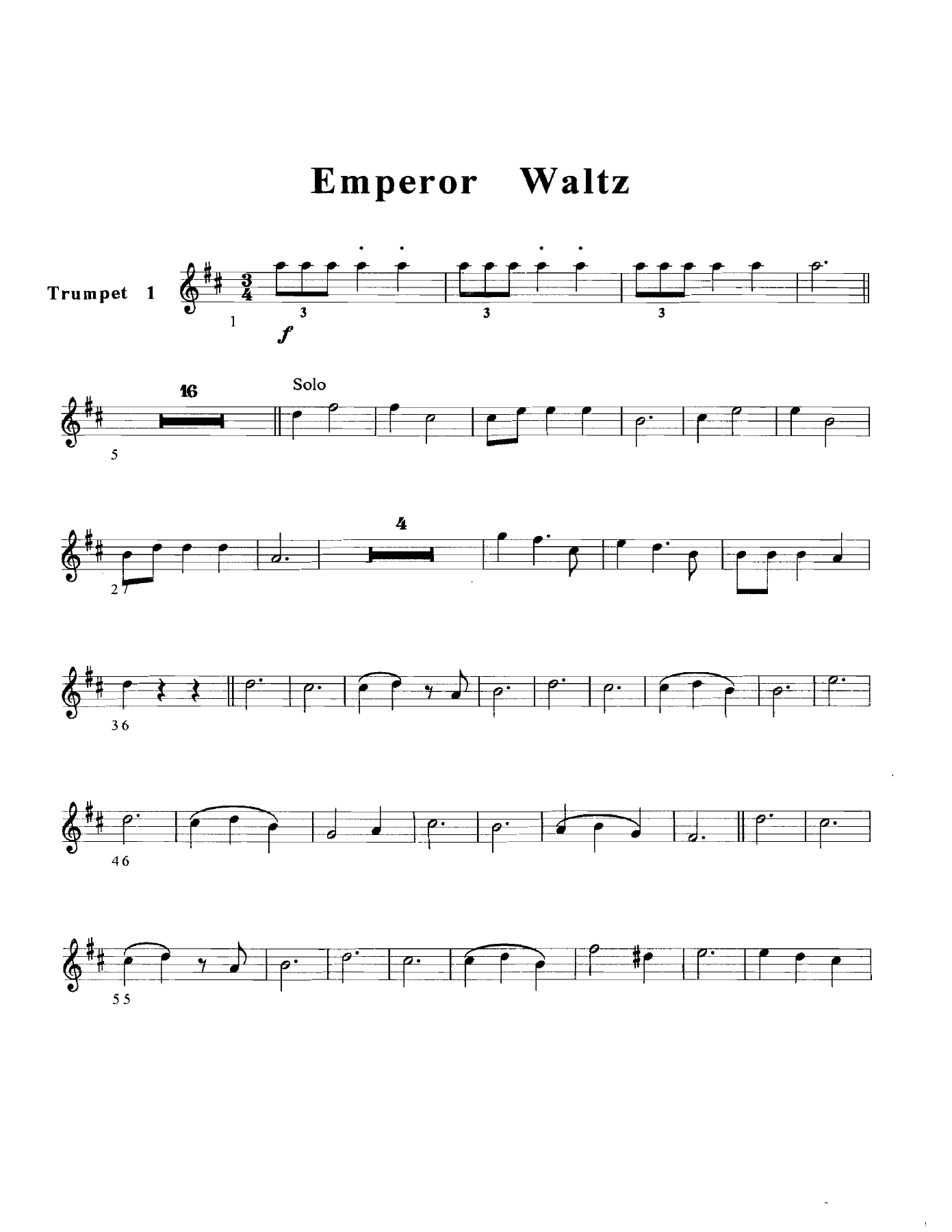
Emperor Waltz (J.DeVoe)
Composed by Johann Strauss II
Arranged by J. DeVoe
- Ensemble: Big Band
- Style: Waltz
- Pages: 55
- Instruments (17): Alto Saxophone 1, Alto Saxophone 2, Tenor Saxophone 1, Tenor Saxophone 2, Baritone Saxophone, Trumpet 1, Trumpet 2, Trumpet 3, Trumpet 4, Trombone 1, Trombone 2, Trombone 3, Bass Trombone, Piano, Bass, Drums, Guitar
- Difficulty: advanced
- Content: Individual Parts
- Format: PDF Download (Instant)
- Price: $24.99
Johann Strauss II's "Emperor Waltz" (Kaiser-Walzer), composed in 1889, stands as a quintessential masterpiece of the Viennese Romantic era. Originally conceived as a patriotic tribute to Emperor Franz Joseph I of Austria and Kaiser Wilhelm II of Germany, it quickly transcended its ceremonial origins to become one of Strauss's most beloved and frequently performed works. While not traditionally a jazz standard, its enduring melodic charm and sophisticated harmonic structure have long attracted arrangers seeking to bridge the gap between classical grandeur and contemporary jazz sensibilities. The original piece is characterized by its elegant triple meter, soaring melodies, and a sense of regal opulence, reflecting the grandeur of late 19th-century European court music. J. DeVoe's arrangement masterfully reimagines this classic, transplanting its inherent grace into the vibrant, dynamic world of the modern big band. J. DeVoe's treatment of "Emperor Waltz" transforms the original into a captivating jazz waltz, maintaining the piece's inherent dignity while infusing it with a medium swing feel. The arrangement is set in a bright, accessible key, allowing the rich brass and saxophone voicings to shine with clarity and warmth. DeVoe's signature approach is evident in the sophisticated reharmonizations, which introduce extended chords and lush substitutions without losing the melodic integrity of Strauss's original. Expect intricate soli sections for the saxophones, showcasing tight ensemble playing and DeVoe's characteristic close voicings that create a full, resonant sound. The mood shifts between moments of lyrical introspection and powerful, driving swing, culminating in a climactic shout chorus that is both exhilarating and harmonically rich. The arrangement opens with a stately, almost classical introduction, hinting at the original's grandeur before transitioning seamlessly into a medium jazz waltz groove. The main waltz themes are expertly distributed, often featuring the lead alto saxophone or trumpet section carrying the primary melodic statements, supported by intricate counter-melodies from the other sections. There are ample opportunities for featured soloists, typically in the trumpet and tenor saxophone chairs, providing space for improvisation over DeVoe's compelling harmonic framework. Technical challenges include navigating complex rhythmic figures within the waltz feel, achieving precise ensemble blend and balance in the soli sections, and executing dynamic contrasts that build tension and release. The rewarding aspects lie in the sheer beauty of the reharmonized melodies, the thrill of the powerful shout choruses, and the unique experience of performing a classical gem through a jazz lens. This arrangement is ideally suited for college-level jazz ensembles, advanced community bands, and professional groups seeking a sophisticated and engaging piece that offers both musical depth and audience appeal. Its blend of familiar melody and fresh jazz interpretation makes it a standout selection for any concert program. This arrangement of "Emperor Waltz" requires meticulous attention to articulation and dynamic shaping to convey its intended elegance and swing. The medium jazz waltz tempo (quarter note = 144-152) must be maintained with a consistent, flowing feel, avoiding any tendency to rush or drag. Conductors should emphasize a light, buoyant triplet feel in the rhythmic interpretation, particularly in the swing sections. Key technical challenges include the precise execution of saxophone solis, which demand excellent intonation and rhythmic accuracy, and the brass section's sustained, lyrical lines that require strong breath support and blend. Mutes (straight and cup) are indicated for trumpets and trombones; ensure these are used expressively to create contrasting textures. Rehearsal time should focus on balancing the intricate counterpoint, especially during the reharmonized melodic statements, and building the shout chorus to its full dynamic potential without overblowing. Pay close attention to DeVoe's specific articulation markings, as they are crucial to achieving the authentic jazz waltz character. Q: What specific instruments are required for this arrangement? A: This arrangement is scored for a standard 17-piece big band: Alto Saxophone 1, Alto Saxophone 2, Tenor Saxophone 1, Tenor Saxophone 2, Baritone Saxophone, Trumpet 1, Trumpet 2, Trumpet 3, Trumpet 4, Trombone 1, Trombone 2, Trombone 3, Bass Trombone, Piano, Bass, Drums, and Guitar. Q: What is the difficulty level of "Emperor Waltz (J.DeVoe)"? A: This arrangement is rated as advanced intermediate to advanced. It is suitable for college-level jazz ensembles, skilled community bands, and professional groups due to its complex voicings, intricate rhythmic figures, and demands for strong ensemble precision and solo improvisation. Q: What is the musical style and historical context of this arrangement? A: This is a jazz big band arrangement of Johann Strauss II's "Emperor Waltz," originally composed in 1889 during the Viennese Romantic era. J. DeVoe transforms the classical waltz into a medium jazz waltz, blending 19th-century melodic grandeur with modern big band jazz harmony and rhythm. Q: What makes J. DeVoe's arrangement of "Emperor Waltz" unique? A: DeVoe's arrangement stands out for its sophisticated reharmonizations, which enrich Strauss's original melodies with extended jazz harmonies, and its masterful integration of a medium swing waltz feel. It features intricate saxophone solis, powerful brass shout choruses, and ample space for improvisation, offering a fresh perspective on a classical masterpiece. Q: What is the typical performance duration and tempo of this piece? A: The typical performance duration for "Emperor Waltz (J.DeVoe)" is approximately 5-6 minutes. The arrangement is intended to be performed at a medium jazz waltz tempo, around a quarter note of 144-152 beats per minute.
Musicians Also Search For
Emperor Waltz J. DeVoe PDF • Emperor Waltz J. DeVoe sheet music • Emperor Waltz arranged by J. DeVoe • J. DeVoe big band charts • J. DeVoe jazz arrangements PDF • Emperor Waltz Johann Strauss II sheet music • Emperor Waltz Johann Strauss II big band arrangement • Johann Strauss II big band charts • Emperor Waltz big band arrangement • Emperor Waltz big band PDF download • Emperor Waltz jazz ensemble sheet music • big band sheet music instant download • Emperor Waltz individual parts download • Emperor Waltz sheet music with parts • Emperor Waltz Waltz chart • Waltz big band arrangements • buy Emperor Waltz sheet music online • download Emperor Waltz PDF • Emperor Waltz jazz chart • best J. DeVoe big band arrangements • Johann Strauss II songs arranged by J. DeVoe • Emperor Waltz printable sheet music • big band repertoire PDF