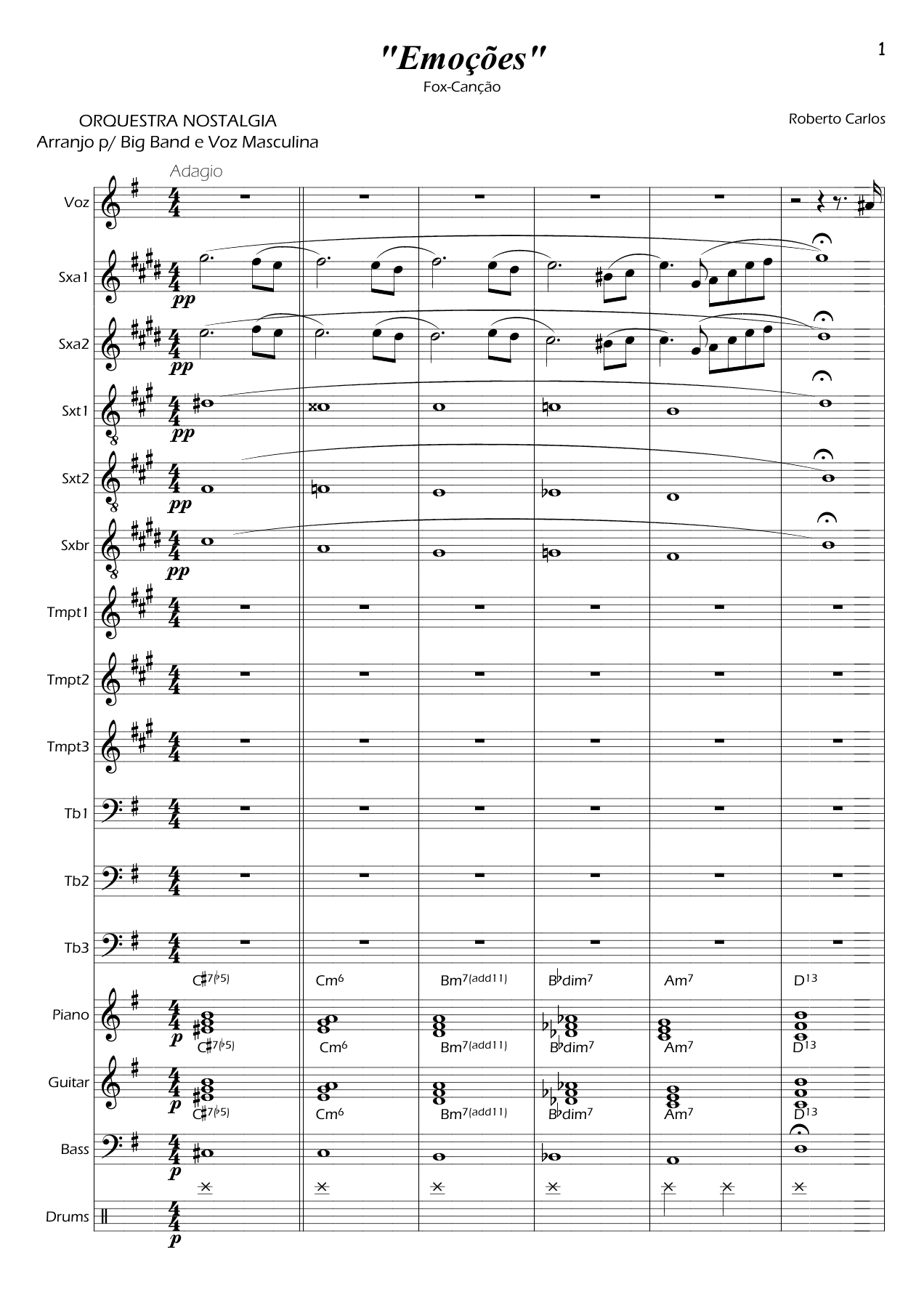
Emocoes (R.Carlos)
Composed by Roberto Carlos
Arranged by R.Carlos
- Ensemble: Big Band
- Style: Jazz Standard
- Pages: 35
- Instruments (17): Voz Masculina, Sax Alto 1, Sax Alto 2, Sax Tenor 1, Sax Tenor 2, Sax Barítono, Trompete 1, Trompete 2, Trompete 3, Trompete 4, Trombone 1, Trombone 2, Trombone 3, Piano, Guitar, Bass, Drums
- Difficulty: medium
- Content: Individual Parts
- Format: PDF Download (Instant)
- Price: $24.99
"Emocoes," originally penned by the iconic Brazilian singer-songwriter Roberto Carlos, transcends its pop roots to become a poignant jazz standard, celebrated for its enduring melody and emotional depth. While Roberto Carlos rose to international fame in the 1960s and 70s as a leading figure in Latin American romantic music, his compositions, like "Emocoes," possess a harmonic sophistication and lyrical quality that lend themselves perfectly to jazz interpretation. The original piece is a cornerstone of Brazilian popular music, known for its heartfelt expression and universal appeal, making it a natural fit for the jazz repertoire where expressive melodies and rich harmonies are paramount. This particular arrangement by R.Carlos reimagines "Emocoes" as a lush, medium-slow ballad, embracing a tender 4/4 Latin groove that evokes a sense of introspective romance and sophisticated melancholy. The primary key of C minor provides a warm, slightly melancholic foundation, allowing the melodic lines to unfold with gravitas and grace. The overall mood is one of heartfelt reflection, offering a canvas for the ensemble to explore nuanced dynamics and expressive phrasing. Listeners will be drawn into its gentle sway, experiencing a spectrum of emotions from longing to serene beauty, characteristic of the finest jazz ballads. R.Carlos's distinctive arranging style shines through in his treatment of "Emocoes." He masterfully employs rich, extended harmonies, particularly in the brass and saxophone voicings, creating dense, yet transparent textures that support the vocal lead without overpowering it. The arrangement features intricate counter-melodies in the saxophones during the B sections, adding depth and interest. A notable feature is the carefully crafted soli section for the saxophones in the second chorus, showcasing their collective artistry with flowing lines and sophisticated harmonic movement. The brass sections contribute with warm pads and subtle punctuations, building to a restrained yet powerful climax before returning to the piece's gentle opening mood. While R.Carlos is known for his versatility, his signature in ballads often involves a meticulous balance between ensemble support and individual soloistic expression, always prioritizing melodic clarity and emotional impact. The melody is primarily carried by the vocal soloist, allowing for significant interpretive freedom and emotional delivery. There is a beautifully integrated featured solo for tenor saxophone, offering a chance for improvisation over the piece's rich harmonic progression. Technical challenges include maintaining a consistent, relaxed Latin feel at a slower tempo, ensuring precise blend and balance within the dense voicings, and achieving expressive dynamic contrasts. The rewarding aspect lies in the opportunity to collectively craft a deeply moving musical statement, where every note contributes to the overall emotional narrative. This arrangement is ideally suited for college-level big bands, advanced community ensembles, and professional groups seeking a sophisticated and emotionally resonant ballad to showcase their interpretive skills and ensemble cohesion. Conductors should emphasize a relaxed, yet precise medium-slow Latin groove, ensuring the rhythm section maintains a steady, unobtrusive foundation. The key technical challenge lies in achieving seamless blend and balance within the rich, often close-voiced harmonies, particularly in the saxophone and brass sections. Encourage players to listen across sections to ensure chords bloom evenly. Dynamic contrasts are crucial; guide the ensemble to build intensity gradually towards the subtle climax, then return to a delicate, introspective feel. The tenor saxophone soloist should be encouraged to explore the harmonic landscape with lyrical phrasing. Rehearsal time should be dedicated to shaping the vocal line's emotional arc and perfecting the saxophone soli's articulation and blend. No special techniques like plunger mutes or extreme effects are required; focus should be on musicality and ensemble cohesion. Q: What instruments and parts are included in this arrangement? A: This arrangement is scored for a 17-piece big band, including Vocal, Alto Saxophone 1, Alto Saxophone 2, Tenor Saxophone 1, Tenor Saxophone 2, Baritone Saxophone, Trumpet 1, Trumpet 2, Trumpet 3, Trumpet 4, Trombone 1, Trombone 2, Trombone 3, Bass Trombone, Piano, Bass, and Drums. It also includes a full conductor's score. Q: What is the difficulty level of this arrangement? A: This arrangement is considered advanced intermediate to advanced, making it suitable for college-level big bands, advanced community ensembles, and professional groups. It requires strong ensemble playing, good intonation, and expressive soloistic capabilities. Q: What is the musical style and historical context of "Emocoes (R.Carlos)"? A: "Emocoes" is a jazz standard reimagined from a popular song by Brazilian icon Roberto Carlos, originally rising to prominence in the 1960s and 70s. This arrangement treats it as a medium-slow ballad with a Latin groove, blending sophisticated jazz harmonies with its Brazilian pop origins. Q: What makes this particular arrangement by R.Carlos unique? A: R.Carlos's arrangement is distinguished by its lush, extended harmonies, intricate saxophone counter-melodies, and a beautifully crafted saxophone soli section. It masterfully balances ensemble support for the vocal lead with opportunities for expressive solo improvisation, creating a deeply emotional and sophisticated sound. Q: What is the recommended tempo and overall performance duration for this piece? A: The recommended tempo is a medium-slow Latin groove, approximately 60-70 beats per minute. The overall performance duration typically ranges from 4 to 5 minutes, depending on the improvisational length of the featured tenor saxophone solo.
Questions and answers
- What is included in the Emocoes (R.Carlos) PDF?
- The verified current file contains a conductor score and individual parts across 35 pages.
- How many instruments or parts are listed for Emocoes (R.Carlos)?
- The verified instrumentation list contains 17 entries for this Big Band arrangement.
- Who is credited for Emocoes (R.Carlos)?
- Composer: Roberto Carlos. Arranger: R.Carlos.
- What difficulty is listed for Emocoes (R.Carlos)?
- The verified difficulty level is medium.
- What style is listed for Emocoes (R.Carlos)?
- The catalog lists the style as Jazz Standard.
- Can I preview Emocoes (R.Carlos) before buying?
- Yes. The product page provides a preview generated from the current PDF file.
- How is Emocoes (R.Carlos) delivered?
- After successful payment, the digital PDF is made available for download. The displayed price is $24.99.
Musicians Also Search For
Emocoes R.Carlos PDF • Emocoes R.Carlos sheet music • Emocoes arranged by R.Carlos • R.Carlos big band charts • R.Carlos jazz arrangements PDF • Emocoes Roberto Carlos sheet music • Emocoes Roberto Carlos big band arrangements • Roberto Carlos big band charts • Emocoes big band arrangements • Emocoes big band PDF download • Emocoes jazz sheet music • big band sheet music download • Emocoes conductor score PDF • Emocoes individual parts download • Emocoes sheet music PDF • Emocoes Jazz Standard charts • Jazz Standard big band arrangements • buy Emocoes sheet music • download Emocoes PDF • Emocoes jazz charts • best R.Carlos big band arrangements • Roberto Carlos arranged by R.Carlos • Emocoes printable sheet music • big band repertoire PDF