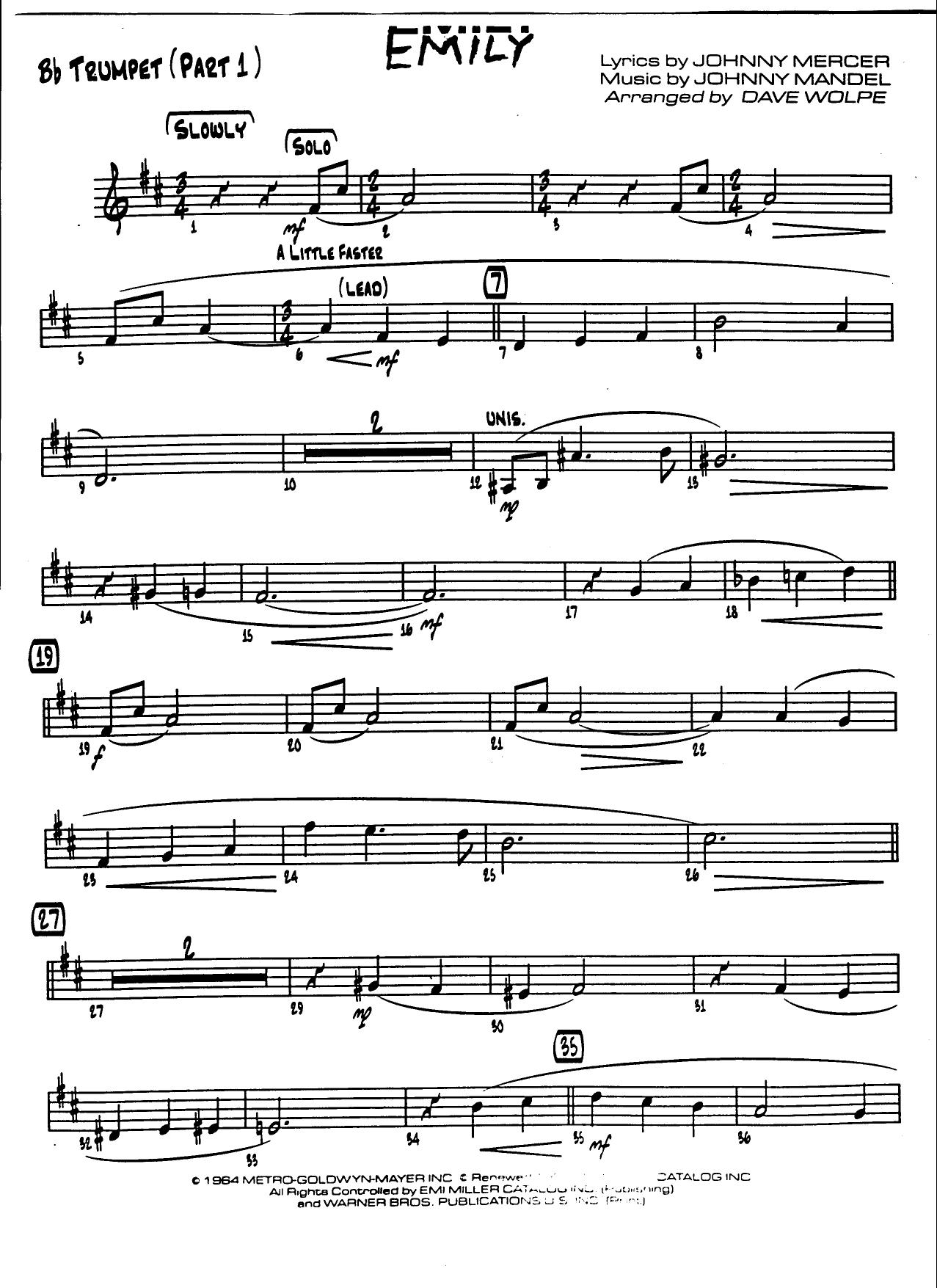
Emily (D.Wolpe)
Composed by Johnny Mandel
Arranged by Dave Wolpe
- Ensemble: Small Ensemble
- Style: Film Music
- Pages: 19
- Instruments (8): Bb Trumpet (Part 1), Eb Alto Saxophone (Part 2), Bb Tenor Saxophone (Part 3), Trombone (Part 4), Piano/Conductor, Guitar, Bass, Drums
- Difficulty: easy
- Content: Individual Parts
- Format: PDF Download (Instant)
- Price: $12.99
Johnny Mandel's timeless ballad "Emily" emerged from the 1964 film *The Americanization of Emily*, quickly transcending its cinematic origins to become a beloved jazz standard. While the film itself was a dark comedy, Mandel's melody, with lyrics by Johnny Mercer, conveyed a profound sense of longing and tender affection, establishing it as a touchstone for romantic introspection. The original recording featured Julie Andrews, but it was jazz luminaries like Frank Sinatra, Bill Evans, and Tony Bennett who cemented its place in the jazz canon, transforming it into a vehicle for sophisticated improvisation and nuanced interpretation. Its enduring appeal lies in its elegant, flowing melodic lines and rich harmonic possibilities, making it a staple for vocalists and instrumentalists alike seeking to express deep emotion within a jazz framework. Dave Wolpe's small ensemble arrangement of "Emily" captures the essence of this classic while providing a fresh, accessible interpretation. Wolpe, renowned for his ability to craft arrangements that are both musically satisfying and practical for a wide range of ensembles, approaches "Emily" as a gentle, medium-slow swing ballad. The piece is set in the key of C major, offering a bright yet tender harmonic landscape. Wolpe's signature is evident in his intelligent voicings, which provide lush support without overpowering the delicate melody. The mood is one of understated elegance and warmth, evoking a sense of nostalgic reflection. The arrangement maintains a consistent, relaxed energy, allowing the beauty of Mandel's composition to shine through with clarity and grace. The melody of "Emily" is primarily carried by the trumpet, presenting a lyrical and expressive lead voice. Wolpe masterfully employs a series of sensitive soli sections, allowing the ensemble's voices to intertwine and enrich the harmonic texture. While there isn't an extended open solo section, the arrangement provides ample opportunity for individual expression within the ensemble's framework, particularly for the lead trumpet and the rhythm section. Technical challenges are moderate, focusing more on blend, balance, and expressive phrasing rather than extreme virtuosity. The rhythm section is tasked with maintaining a steady, flowing swing feel that breathes with the melody. The rewarding aspect of performing this arrangement lies in its ability to transport both performers and audience into a world of sophisticated emotion, demanding musicality and sensitivity above all else. This arrangement is ideally suited for high school, college, and community jazz ensembles looking to cultivate a refined ballad style. Its manageable technical demands make it an excellent teaching tool for developing ensemble blend, dynamic control, and melodic interpretation. More advanced groups will find ample space for nuanced musicality, exploring the subtleties of phrasing and harmonic color. Wolpe's treatment ensures that the piece sounds full and complete with a smaller instrumentation, making it a versatile addition to any ensemble's repertoire. It's a perfect choice for concerts where a moment of tender beauty and classic jazz elegance is desired. "Emily" should be approached as a medium-slow swing ballad, with a quarter note around 80-90 BPM. The key to a successful performance lies in maintaining a consistently relaxed yet forward-moving swing feel in the rhythm section, emphasizing a light, brush-like cymbal pattern and a walking bass line that supports the melody without being intrusive. The primary technical challenge for the horn section is achieving a seamless blend and balanced voicing, particularly during the soli passages. Encourage players to listen across the section and match articulations and dynamics precisely. Phrasing should be lyrical and legato, with careful attention to dynamic swells and decays. There are no special techniques like mutes or falls indicated, keeping the focus on pure tone and expression. Rehearsal time should be dedicated to shaping the melodic lines, ensuring the lead trumpet's interpretation is both expressive and well-supported by the ensemble's rich harmonies. Q: What instruments are included in this small ensemble arrangement of "Emily"? A: This arrangement is scored for a small ensemble, typically including lead trumpet, alto saxophone, tenor saxophone, trombone, piano, bass, and drums. Specific instrumentation will be detailed on the score's cover. Q: What is the difficulty level of this arrangement? A: This arrangement is rated as medium-easy to medium difficulty. It is accessible for high school and community bands, while still offering enough musical depth for college-level ensembles to explore nuance and expression. Q: What is the musical style and historical context of "Emily"? A: "Emily" is a classic jazz ballad, originally composed by Johnny Mandel for the 1964 film *The Americanization of Emily*. It became a jazz standard, known for its elegant melody and rich harmonies, performed by artists like Frank Sinatra and Bill Evans. Q: What makes Dave Wolpe's arrangement of "Emily" unique? A: Dave Wolpe's arrangement is distinctive for its sensitive, medium-slow swing ballad treatment, lush voicings for a small ensemble, and focus on lyrical melodic interpretation, making it both accessible and musically rewarding. Q: What is the typical performance duration and tempo for this piece? A: The typical performance duration for this arrangement of "Emily" is approximately 3 to 4 minutes, performed at a medium-slow swing tempo, generally around 80-90 beats per minute.
Questions and answers
- What is included in the Emily (D.Wolpe) PDF?
- The verified current file contains a conductor score and individual parts across 19 pages.
- How many instruments or parts are listed for Emily (D.Wolpe)?
- The verified instrumentation list contains 8 entries for this Small Ensemble arrangement.
- Who is credited for Emily (D.Wolpe)?
- Composer: Johnny Mandel. Arranger: Dave Wolpe.
- What difficulty is listed for Emily (D.Wolpe)?
- The verified difficulty level is easy.
- What style is listed for Emily (D.Wolpe)?
- The catalog lists the style as Film Music.
- Can I preview Emily (D.Wolpe) before buying?
- Yes. The product page provides a preview generated from the current PDF file.
- How is Emily (D.Wolpe) delivered?
- After successful payment, the digital PDF is made available for download. The displayed price is $12.99.
Musicians Also Search For
Emily Dave Wolpe PDF • Emily Dave Wolpe sheet music • Emily arranged by Dave Wolpe • Dave Wolpe small ensemble charts • Dave Wolpe jazz arrangements PDF • Emily Johnny Mandel sheet music • Emily Johnny Mandel small ensemble arrangements • Johnny Mandel small ensemble charts • Emily small ensemble arrangements • Emily small ensemble PDF download • Emily jazz sheet music • small ensemble sheet music download • Emily conductor score PDF • Emily individual parts download • Emily sheet music PDF • Emily Film Music charts • Film Music small ensemble arrangements • buy Emily sheet music • download Emily PDF • Emily jazz charts • best Dave Wolpe small ensemble arrangements • Johnny Mandel arranged by Dave Wolpe • Emily printable sheet music • small ensemble repertoire PDF