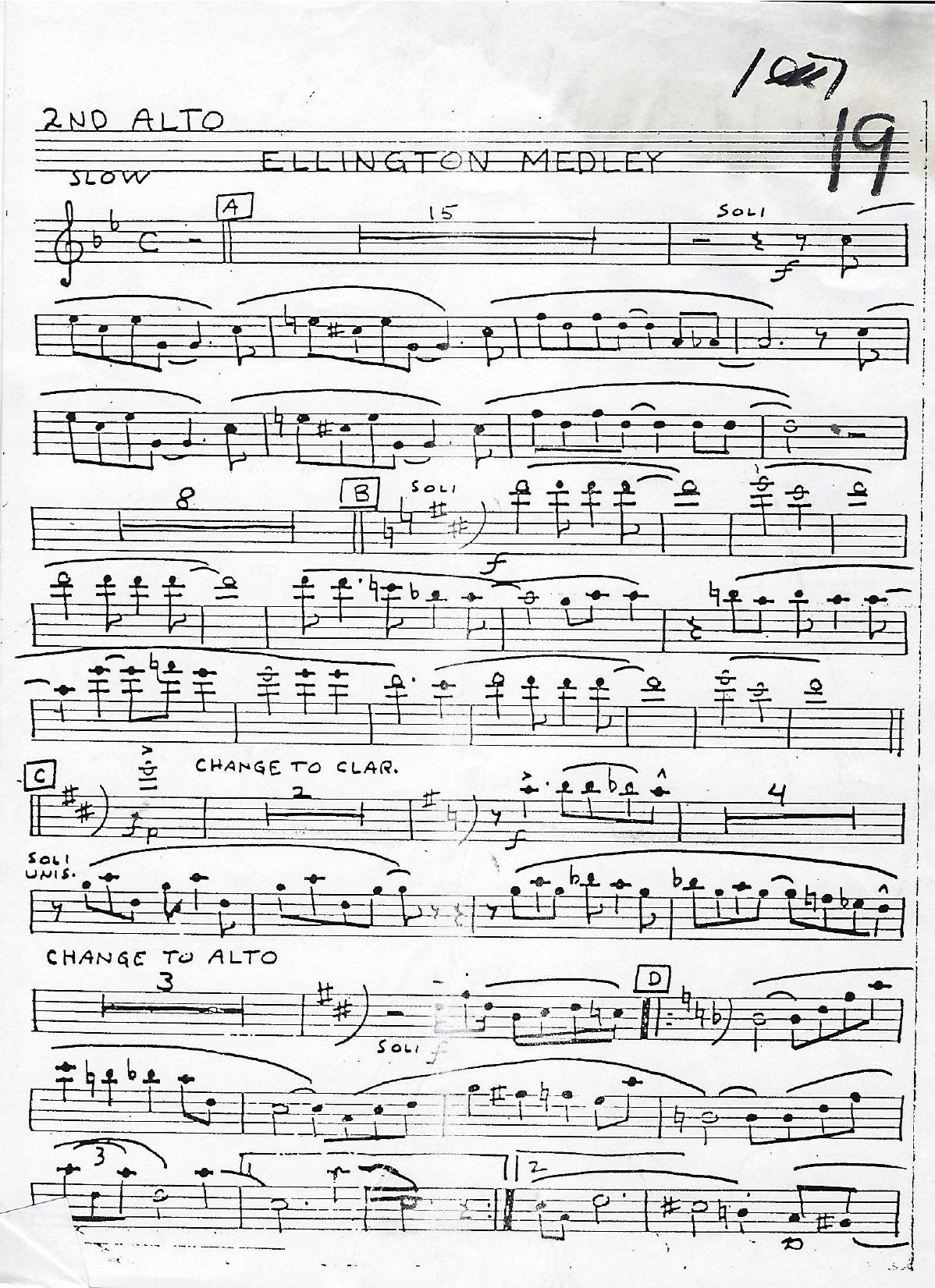
Ellington Medley # (D.B.Strayhorn.D.Berger)
Composed by D.Berger
Arranged by Duke Ellington & B.Strayhorn.D.Berger
- Ensemble: Big Band
- Pages: 31
- Instruments (15): 2nd Alto Saxophone, 1st Tenor Saxophone, 2nd Tenor Saxophone, Baritone Saxophone (doubling on Alto Saxophone), 1st Trumpet, 3rd Trumpet, 4th Trumpet, 1st Trombone, 2nd Trombone, 3rd Trombone, 4th (Bass) Trombone, Piano, Guitar, Bass, Drums
- Difficulty: medium
- Content: Individual Parts
- Format: PDF Download (Instant)
- Price: $24.99
The timeless partnership of Duke Ellington and Billy Strayhorn represents the absolute pinnacle of big band composition, fusing sophisticated harmonic extensions with the earthy, blues-soaked swing of the Harlem Renaissance and post-war jazz eras. This masterwork arrangement—collaboratively shaped through the visionary lens of David Berger—captures the quintessential Ellingtonian aesthetic, drawing from the rich palette of tone colors, textural contrast, and individualized voicing that made the famous Ellington orchestra sound like no other ensemble in jazz history. Far more than a simple retrospective medley, this 31-page suite functions as a living masterclass in Ellingtonian orchestration, honoring the sophisticated structural architecture pioneered at the Cotton Club, the Blue Note, and countless international concert halls. A swinging, sophisticated momentum drives the musical character of this arrangement, alternating between lush, harmonically dense ballad textures and driving, blues-inflected medium-up swing feels. Rich chordal extensions—major sevenths, augmented ninths, and suspended voicings—permeate the wind writing, evoking a moody, midnight-city atmosphere that quickly pivots into high-energy, syncopated jubilation. The emotional arc moves effortlessly from sultry, nocturnal introspection to exuberant, rhythmic drive, demanding a delicate balance of relaxed phrasing, precise articulation, and deep-seated rhythmic swing. David Berger’s editorial and compositional approach emphasizes the authentic restoration of classic Ellingtonian textures while maximizing the distinct voice of an 8-instrument ensemble. Rather than writing generic block chords, the scoring utilizes sub-tone clarinet effects, warm muted brass contrasts, and interwoven counterpoint across the saxophone and brass tiers. The arrangement features carefully balanced soli sections where the alto, tenor, and baritone saxophones lock in tight, harmonized interplay, underpinned by crisp trumpet and trombone punctuations. Specific moments of brilliance include a tightly wound shout chorus that builds tension through descending chromatic lines and sudden dynamic shifts, showcasing the signature Ellington habit of writing specifically for the unique tonal personalities of his sidemen. Ensemble balance and stylistic flexibility are paramount for a successful execution of this 8-instrument configuration, making it ideally suited for advanced high school, collegiate, and professional jazz ensembles looking for authentic Ellington repertory. Because the scoring relies heavily on section blend, players must possess strong command of jazz articulation—incorporating drop-offs, doits, ghost notes, and subtle vibrato controls. Solo opportunities are woven organically into the arrangement, allowing featured horn players to stretch out over classic blues and rhythm changes harmonizations. Ultimately, performing this chart provides an invaluable stylistic education, rewarding ensembles that master the elusive intersection of precision notation and loose, swinging interpretation. Unlocking the authentic spirit of this Ellington-Strayhorn-Berger collaboration requires careful attention to historical jazz articulation rather than a strictly literal reading of the page. The rhythm section acts as the primary engine; the drummer should favor a light, pulsing ride cymbal pattern with crisp hi-hat chokes on beats two and four, avoiding heavy backbeats. Horn players must master the art of the sub-tone and the long-short articulation pairing, ensuring that eighth notes are swung naturally with a relaxed, forward-moving momentum. Pay close attention to dynamic contrast: when the ensemble drops to a whisper behind a solo voice, the accompanying horns must use breath support rather than brute force to maintain a warm, breathy blend. Brass players should keep cup and straight mutes close at hand to achieve the signature Ellingtonian vocal quality, treating every muted phrase as if it were a direct translation of human speech. Rehearsals should begin slowly at a reduced tempo to lock in the intricate counterpoint and intonation of the inner harmonic voices before pushing toward the final performance speed. Q: What instruments and parts are included in this 31-page arrangement? A: The arrangement is scored for an 8-instrument jazz ensemble consisting of Alto Saxophone, Tenor Saxophone, Baritone Saxophone, Trumpet, Trombone, and a fully integrated rhythm section. Q: What is the difficulty level of this arrangement? A: This piece is rated as advanced, primarily due to its sophisticated harmonic language, stylistic demands for authentic swing articulation, and intricate sectional interdependence suited for collegiate or professional bands. Q: How does this arrangement reflect the style and historical context of Duke Ellington and Billy Strayhorn? A: It channels the mid-20th-century golden era of the Ellington Orchestra, incorporating classic stylistic traits such as lush chordal extensions, plunger and cup mute effects, and individualized writing for specific horn timbres. Q: What makes this specific arrangement by David Berger unique? A: David Berger's transcription and editorial work faithfully restores authentic Ellingtonian performance practices, utilizing specialized voicing techniques and counterpoint that capture the legendary orchestra's live sound. Q: What is the expected performance duration and tempo framework of the piece? A: The arrangement spans a multi-movement medley structure with a performance duration of approximately 6 to 8 minutes, anchored by a primary medium-swing tempo that frequently shifts to accommodate contrasting ballad interludes.
Questions and answers
- What is included in the Ellington Medley # (D.B.Strayhorn.D.Berger) PDF?
- The verified current file contains individual parts across 31 pages.
- How many instruments or parts are listed for Ellington Medley # (D.B.Strayhorn.D.Berger)?
- The verified instrumentation list contains 15 entries for this Big Band arrangement.
- Who is credited for Ellington Medley # (D.B.Strayhorn.D.Berger)?
- Composer: D.Berger. Arranger: Duke Ellington & B.Strayhorn.D.Berger.
- What difficulty is listed for Ellington Medley # (D.B.Strayhorn.D.Berger)?
- The verified difficulty level is medium.
- Can I preview Ellington Medley # (D.B.Strayhorn.D.Berger) before buying?
- Yes. The product page provides a preview generated from the current PDF file.
- How is Ellington Medley # (D.B.Strayhorn.D.Berger) delivered?
- After successful payment, the digital PDF is made available for download. The displayed price is $24.99.
Musicians Also Search For
Ellington Medley # Duke Ellington & B.Strayhorn.D.Berger PDF • Ellington Medley # Duke Ellington & B.Strayhorn.D.Berger sheet music • Ellington Medley # arranged by Duke Ellington & B.Strayhorn.D.Berger • Duke Ellington & B.Strayhorn.D.Berger big band charts • Duke Ellington & B.Strayhorn.D.Berger jazz arrangements PDF • Ellington Medley # D.Berger sheet music • Ellington Medley # D.Berger big band arrangements • D.Berger big band charts • Ellington Medley # big band arrangements • Ellington Medley # big band PDF download • Ellington Medley # jazz sheet music • big band sheet music download • Ellington Medley # individual parts download • Ellington Medley # sheet music PDF • buy Ellington Medley # sheet music • download Ellington Medley # PDF • Ellington Medley # jazz charts • best Duke Ellington & B.Strayhorn.D.Berger big band arrangements • D.Berger arranged by Duke Ellington & B.Strayhorn.D.Berger • Ellington Medley # printable sheet music • big band repertoire PDF