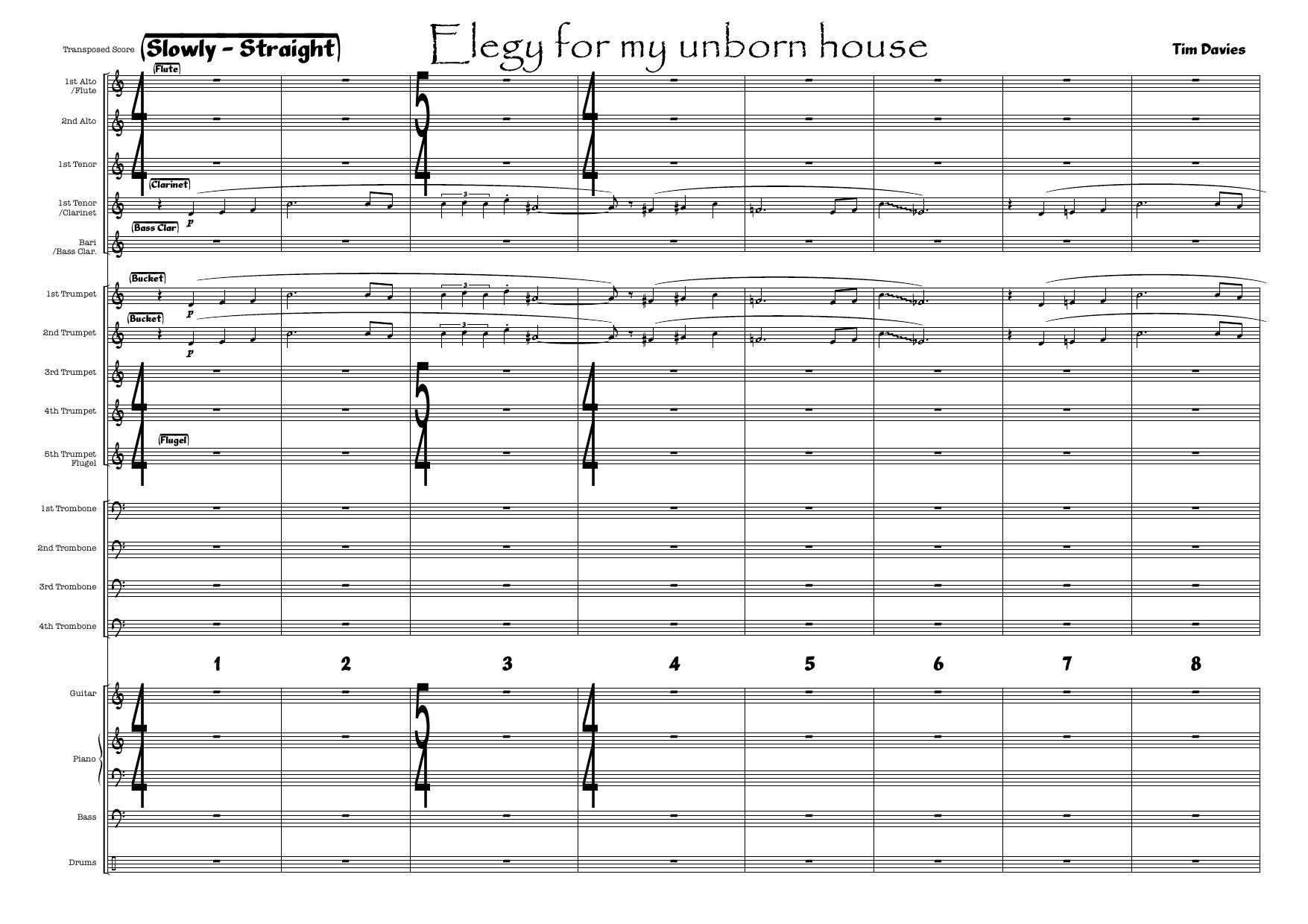
Elegy For My Unborn House (T.Davies) sheet music preview

Elegy For My Unborn House (T.Davies)

Composed by Tim Davies

Arranged by Tim Davies

  • Ensemble: Big Band
  • Pages: 74
  • Instruments (22): 1st Alto Saxophone, Flute, 2nd Alto Saxophone, 1st Tenor Saxophone, 2nd Tenor Saxophone, Clarinet, Baritone Saxophone, Bass Clarinet, 1st Trumpet, 2nd Trumpet, 3rd Trumpet, 4th Trumpet, 5th Trumpet, Flugelhorn, 1st Trombone, 2nd Trombone, 3rd Trombone, 4th Trombone, Guitar, Piano, Double Bass, Drums
  • Difficulty: advanced
  • Content: Individual Parts
  • Format: PDF Download (Instant)
  • Price: $24.99

Modern large ensemble jazz finds one of its most compelling modern expressions in "Elegy For My Unborn House," a profound compositional statement by acclaimed Australian-born composer, arranger, and conductor Tim Davies. Written as a deeply personal meditation on loss, unrealized futures, and architectural ghosts, this work bridges the gap between contemporary classical orchestration and post-bop big band jazz. While not a traditional 20th-century standard, the piece has quickly earned a reputation among contemporary jazz circles as a masterclass in modern modal writing, frequently performed by elite professional and cutting-edge collegiate jazz orchestras seeking repertoire that pushes beyond conventional swing-era boundaries. The musical character of the piece is defined by a lingering, melancholic atmosphere coupled with an underlying, restless tension. Unfolding at a deliberate, contemplative slow tempo with an elastic rubato feel that gradually settles into an intricate contemporary groove, the composition explores shifting meters and lush, extended modal harmonies. The mood is solemn yet deeply hopeful, evoking a cinematic sense of vast open spaces and internal reflection. Davies utilizes the full palette of the modern jazz orchestra to create dense, shimmering tone clusters that slowly resolve, moving from fragile, exposed woodwind textures to overwhelming, cathartic walls of brass sound. Davies approaches the 18-piece instrumentation with a composer's eye for color and counterpoint, steering far clear of standard block-voicing formulas. The arrangement makes extensive use of woodwind doubling—featuring prominent parts for flute, clarinet, and bass clarinet—which creates a rich, chamber-like transparency during exposed passages. Rather than relying on a traditional energetic shout chorus, the climax of the chart is built through a meticulous layering of independent melodic lines, polyrhythmic ostinatos, and sweeping harmonic modulations. The brass writing demands immense control, featuring subtle cup and harmon mutes that color the background textures while leaving room for the solo voices to breathe. Carrying the emotional weight of the work, the primary melodic statements are introduced by the woodwinds and fluegelhorns before being passed to a featured tenor saxophone and soaring lead trumpet. The technical challenges lie primarily in intonation, complex metric modulation, and maintaining a sustained lyricism across long phrases at soft dynamic levels. Rhythm section players must possess a sophisticated grasp of contemporary time-feel, navigating shifting meter signatures without losing the forward momentum. It is a profoundly rewarding piece for advanced collegiate and professional ensembles looking to challenge their collective listening skills, dynamic range, and interpretive depth. Conductors approaching "Elegy For My Unborn House" must prioritize balance and dynamic restraint, as the emotional impact of the chart relies heavily on its whisper-to-roar dynamic arc. The primary technical hurdle rests in the complex metric shifts and independent linear counterpoint; ensemble members must rehearse their parts with a metronome subdivision to ensure tight alignment during un-metered or rubato transitional stretches. The tempo should remain flexible yet anchored, allowing soloists room to stretch phrase lengths naturally without distorting the underlying pulse. Woodwinddoublers need to ensure seamless tone-matching between saxophones and clarinets/flutes during exposed soli passages. Brass players should keep mutes readily accessible and pay strict attention to balance markings, ensuring that background figures never obscure the primary melodic voice. Rehearsals should begin section by section, focusing first on intonation within the tight extended chord voicings before integrating the rhythm section's textural grooves. Q: What instrumentation and parts are included in this publication? A: This arrangement is scored for an 18-instrument modern big band lineup, including comprehensive parts for flute, clarinet, bass clarinet, alto and tenor saxophones, standard brass (trumpets and trombones), and a full rhythm section, alongside a complete 74-page conductor score. Q: What is the difficulty level of Tim Davies' "Elegy For My Unborn House"? A: This arrangement is graded as advanced (professional or top-tier collegiate), requiring exceptional technical control, mature intonation for complex extended harmonies, and sophisticated ensemble listening skills. Q: What is the musical style and historical background of the piece? A: Composed by Tim Davies, the piece belongs to the contemporary post-bop and modern orchestral jazz genre, blending cinematic atmospheric writing with intricate harmonic structures typical of today's progressive large jazz ensembles. Q: What makes this specific arrangement unique within big band repertoire? A: It breaks away from traditional swing-era formulas by utilizing extensive woodwind doublings, complex linear counterpoint, and non-traditional developmental climaxes rather than a standard high-energy shout chorus. Q: What is the performance duration and tempo feel of the work? A: The piece functions as a substantial, slow-to-medium contemplative ballad with an expansive, shifting pulse and an approximate duration of 8 to 10 minutes depending on solo extensions and rubato pacing.

Questions and answers

What is included in the Elegy For My Unborn House (T.Davies) PDF?
The verified current file contains a conductor score and individual parts across 74 pages.
How many instruments or parts are listed for Elegy For My Unborn House (T.Davies)?
The verified instrumentation list contains 22 entries for this Big Band arrangement.
Who is credited for Elegy For My Unborn House (T.Davies)?
Composer: Tim Davies. Arranger: Tim Davies.
What difficulty is listed for Elegy For My Unborn House (T.Davies)?
The verified difficulty level is advanced.
Can I preview Elegy For My Unborn House (T.Davies) before buying?
Yes. The product page provides a preview generated from the current PDF file.
How is Elegy For My Unborn House (T.Davies) delivered?
After successful payment, the digital PDF is made available for download. The displayed price is $24.99.

Musicians Also Search For

Elegy For My Unborn House Tim Davies PDFElegy For My Unborn House Tim Davies sheet musicElegy For My Unborn House arranged by Tim DaviesTim Davies big band chartsTim Davies jazz arrangements PDFElegy For My Unborn House Tim Davies big band arrangementsElegy For My Unborn House big band arrangementsElegy For My Unborn House big band PDF downloadElegy For My Unborn House jazz sheet musicbig band sheet music downloadElegy For My Unborn House conductor score PDFElegy For My Unborn House individual parts downloadElegy For My Unborn House sheet music PDFbuy Elegy For My Unborn House sheet musicdownload Elegy For My Unborn House PDFElegy For My Unborn House jazz chartsbest Tim Davies big band arrangementsElegy For My Unborn House printable sheet musicbig band repertoire PDF

All arrangements by Tim Davies All Tim Davies sheet music