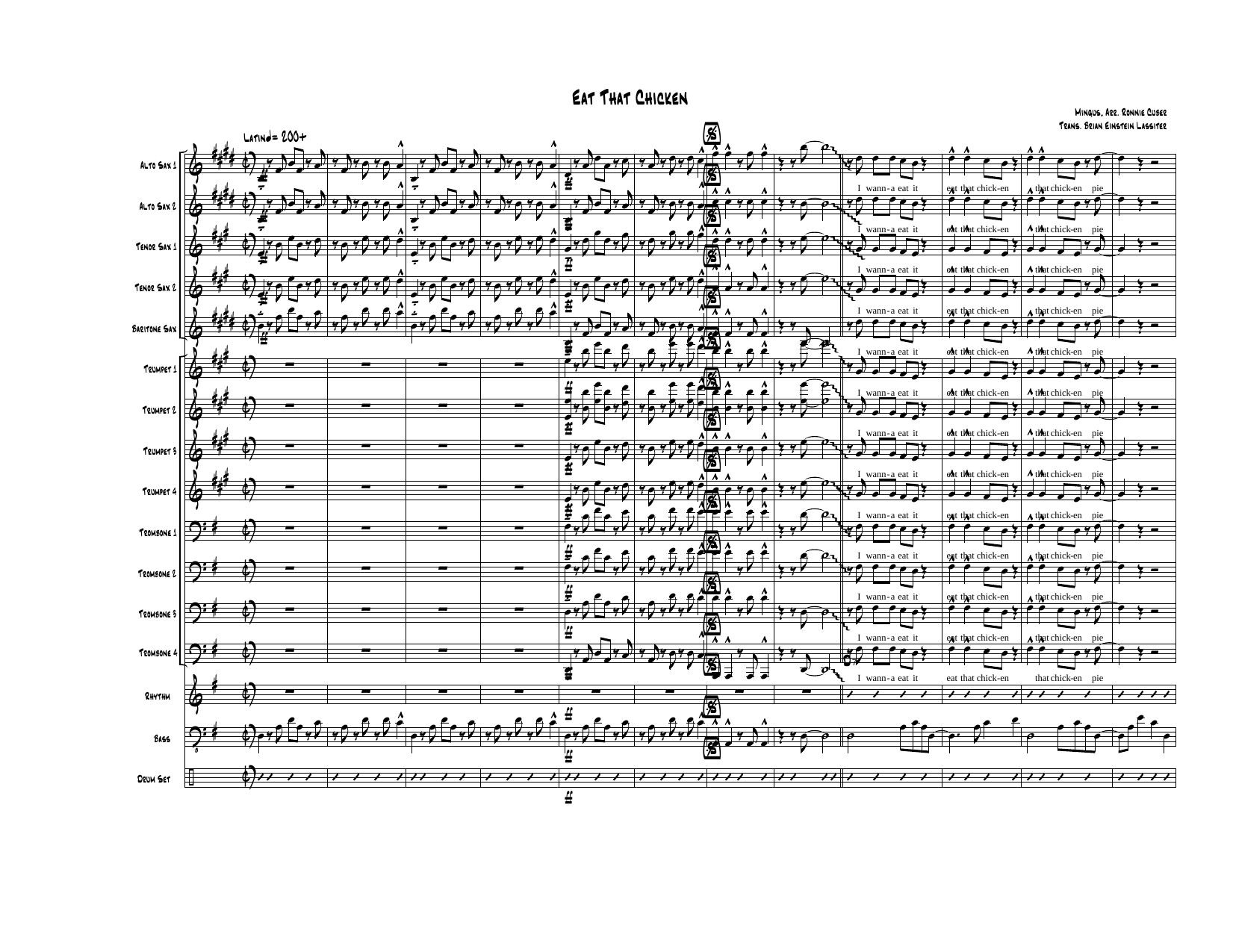
Eat That Chicken (R.Cuber) sheet music preview

Eat That Chicken (R.Cuber)

Composed by Ron Cuber

Arranged by Charles Mingus

  • Ensemble: Big Band
  • Pages: 43
  • Instruments (19): Alto Sax 1, Alto Sax 2, Tenor Sax 1, Tenor Sax 2, Baritone Sax, Trumpet 1, Trumpet 2, Trumpet 3, Trumpet 4, Trombone 1, Trombone 2, Trombone 3, Trombone 4, Rhythm, Bass, Drum Set, Solo Sheet - B-flat, Solo Sheet - Concert, Solo Sheet - E-flat
  • Difficulty: medium
  • Content: Individual Parts
  • Format: PDF Download (Instant)
  • Price: $24.99

Ron Cuber’s high-octane composition "Eat That Chicken," famously interpreted and arranged by the legendary bassist and composer Charles Mingus, stands as a roaring testament to the intersection of hard bop, blues, and New Orleans-infused jazz roots. Originally conceived by baritone saxophone titan Ron Cuber—a master of muscular, soulful phrasing—the tune thrives on an infectious, greasy groove that bridges the gap between traditional jazz vitality and modern post-bop sophistication. When filtered through Mingus’s uncompromising compositional lens, the piece transforms into a ferocious big band showcase that demands high energy, technical agility, and a deep understanding of the jazz idiom's historical lineage. A blistering medium-up tempo governs the chart, driven by an unyielding swing feel that requires absolute rhythmic precision from the rhythm section. The mood is raucous, joyful, and intensely driving, blending barrelhouse blues sensibilities with intricate, harmonically dense avant-garde voicings characteristic of Mingus's workshop bands. The composition opens with a greasy, infectious hook before launching into cascading horn lines that evoke the spirit of early jazz subverted by modern harmonic extensions. The underlying energy is relentless, creating a sense of ecstatic urgency that consistently captivates audiences and pushes the ensemble to its absolute limits. Mingus’s approach to the arrangement is masterclass-level writing for a compact yet powerful 8-instrument ensemble. Rather than relying on a massive wall of sound, Mingus exploits the unique sonic colors of the reduced horn section—alto sax, tenor sax, baritone sax, trumpet, and trombone—by employing razor-sharp counterpoint, aggressive shout choruses, and dense, blues-infused voicings. The baritone saxophone understandably anchors the low end with ferocious authority, serving as both a rhythmic engine and a melodic foil. The arrangement features tight, interlocking sax solis and explosive brass stabs that mimic the call-and-response patterns of early jazz while utilizing contemporary chromaticism and unexpected modal shifts. Navigating this 43-page score demands exceptional proficiency from all players, making it ideally suited for advanced college ensembles, professional big bands, and elite community jazz orchestras. The melody is shared fluidly across the frontline, requiring seamless blend and intonation, particularly during the fast-moving unison passages. Solo opportunities are prominent, giving featured improvisers a chance to stretch out over blues-based changes that reward both traditional vocabulary and modern chromatic exploration. Rehearsing this chart will sharpen an ensemble's collective swing feel, dynamic control, and stylistic versatility, providing a thrilling centerpiece for any advanced concert program. Conductors tackling this arrangement should establish a rock-solid, driving medium-up swing tempo from the downbeat, ensuring the rhythm section maintains an unhurried, heavy-footed groove that prevents the faster passages from rushing. A primary technical challenge lies in the execution of the intricate, fast-moving unison lines between the saxophones and brass; these require meticulous sectional rehearsals using slow practice with a metronome to lock in articulation and phrasing. Pay close attention to dynamic contrast, particularly during the transition from the roaring ensemble shout choruses back to the greasy, understated head statements. Players should utilize natural, aggressive jazz articulations—such as sharp accents, controlled doits, and blues-drenched bends—rather than sterile classical tonguing. The rhythm section is the anchor of this chart; the drummer must drive the ensemble with a heavy ride cymbal pulse and crisp hi-hat on beats two and four, while the bassist lays down a relentless, walking quarter-note foundation that embraces the earthy, blues-soaked character of the composition. Q: What instruments and parts are included in this arrangement? A: This chart is scored for an 8-instrument ensemble featuring Alto Saxophone, Tenor Saxophone, Baritone Saxophone, Trumpet, Trombone, and a standard rhythm section. The comprehensive 43-page score provides fully articulated parts tailored specifically to highlight the distinct tonal colors of this compact instrumentation. Q: What is the difficulty level of this arrangement? A: This arrangement is graded as advanced, making it best suited for college jazz bands, professional big bands, and elite community ensembles. It requires strong technical proficiency, advanced sight-reading skills, and a mature command of fast swing phrasing and tight sectional intonation. Q: What is the musical style and historical context of "Eat That Chicken"? A: Originally composed by baritone saxophonist Ron Cuber and arranged by Charles Mingus, the piece sits firmly in the hard bop and post-bop tradition while heavily drawing upon early jazz, barrelhouse blues, and New Orleans second-line grooves. It represents Mingus's unique ability to honor jazz history while infusing it with modern harmonic complexity and raw emotional power. Q: What makes this specific Charles Mingus arrangement unique? A: Mingus adapts a high-energy tune built for a small-group mentality into a powerhouse chart for a reduced 8-instrument ensemble, utilizing dense, blues-infused voicings, razor-sharp counterpoint, and aggressive call-and-response figures. The arrangement cleverly balances chaotic, joyous abandon with strict, meticulously crafted ensemble discipline. Q: What is the recommended tempo and performance duration for this piece? A: The arrangement is set at a blistering medium-up swing tempo designed to test an ensemble's rhythmic endurance and precision. A standard performance typically runs between 4 to 6 minutes, depending on the length and number of improvised solos taken during the changes.

Questions and answers

What is included in the Eat That Chicken (R.Cuber) PDF?
The verified current file contains a conductor score and individual parts across 43 pages.
How many instruments or parts are listed for Eat That Chicken (R.Cuber)?
The verified instrumentation list contains 19 entries for this Big Band arrangement.
Who is credited for Eat That Chicken (R.Cuber)?
Composer: Ron Cuber. Arranger: Charles Mingus.
What difficulty is listed for Eat That Chicken (R.Cuber)?
The verified difficulty level is medium.
Can I preview Eat That Chicken (R.Cuber) before buying?
Yes. The product page provides a preview generated from the current PDF file.
How is Eat That Chicken (R.Cuber) delivered?
After successful payment, the digital PDF is made available for download. The displayed price is $24.99.

Musicians Also Search For

Eat That Chicken Charles Mingus PDFEat That Chicken Charles Mingus sheet musicEat That Chicken arranged by Charles MingusCharles Mingus big band chartsCharles Mingus jazz arrangements PDFEat That Chicken Ron Cuber sheet musicEat That Chicken Ron Cuber big band arrangementsRon Cuber big band chartsEat That Chicken big band arrangementsEat That Chicken big band PDF downloadEat That Chicken jazz sheet musicbig band sheet music downloadEat That Chicken conductor score PDFEat That Chicken individual parts downloadEat That Chicken sheet music PDFbuy Eat That Chicken sheet musicdownload Eat That Chicken PDFEat That Chicken jazz chartsbest Charles Mingus big band arrangementsRon Cuber arranged by Charles MingusEat That Chicken printable sheet musicbig band repertoire PDF

All arrangements by Charles Mingus All Ron Cuber sheet music