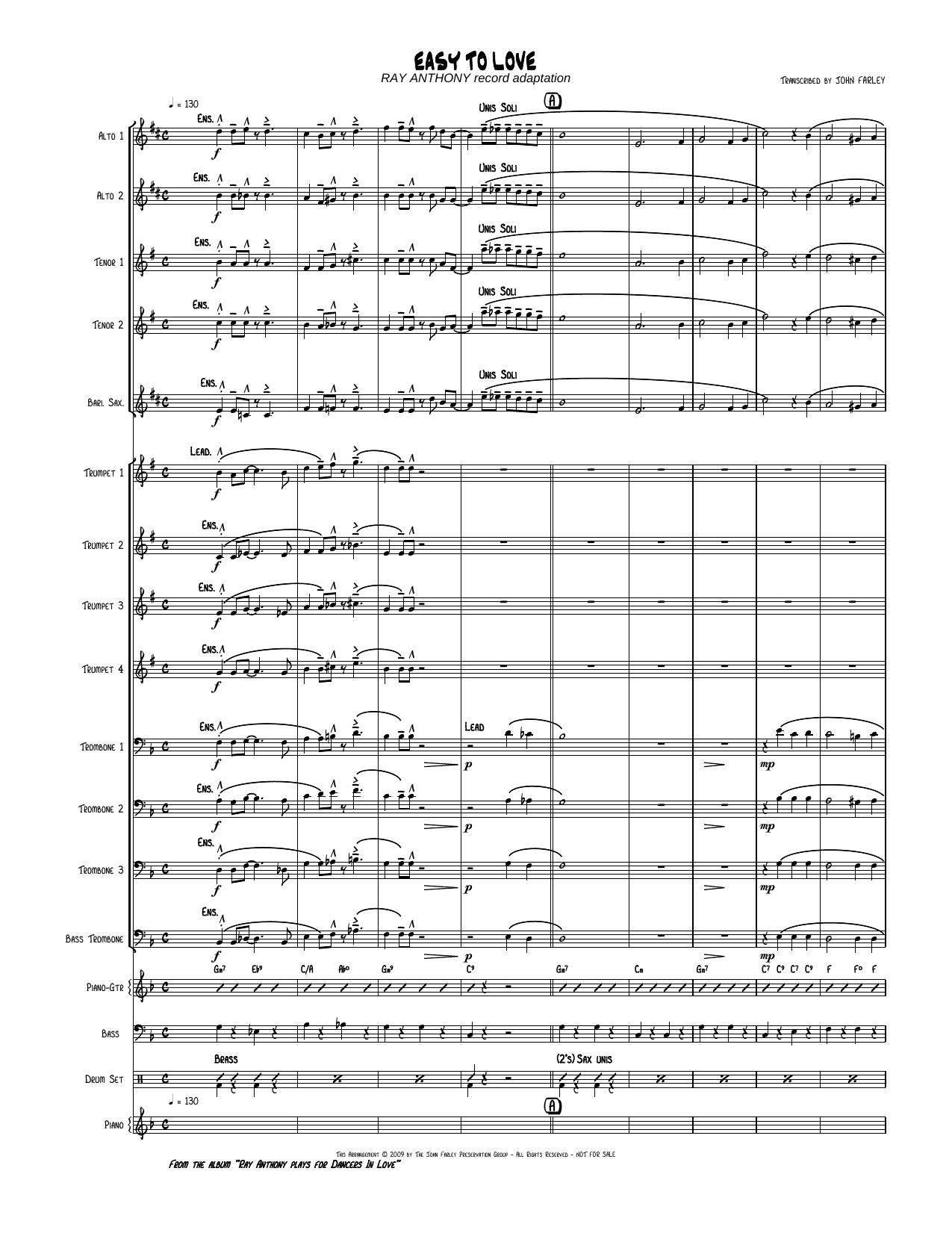
Easy To Love (J.Farley) sheet music preview

Easy To Love (J.Farley)

Composed by Cole Porter

Arranged by John Farley

  • Ensemble: Big Band
  • Pages: 42
  • Instruments (16): Alto 1, Alto 2, Tenor 1, Tenor 2, Bari. Sax., Trumpet 1, Trumpet 2, Trumpet 3, Trumpet 4, Trombone 1, Trombone 2, Trombone 3, Trombone 4 (Bass Trombone), Piano-Gtr, Bass, Drum Set
  • Difficulty: medium
  • Content: Individual Parts
  • Format: PDF Download (Instant)
  • Price: $24.99

Cole Porter originally penned "Easy To Love" for the 1936 MGM musical *Born to Dance*, where it was famously introduced by James Stewart, and it rapidly ascended to the upper echelon of the Great American Songbook. Embraced by jazz luminaries from Billie Holiday to Sonny Rollins, the composition's sophisticated AABA form, graceful upward leaps, and deceptive harmonic sophistication make it an enduring vehicle for jazz improvisation. Rooted in the golden era of Broadway and adapted swiftly by the swing-era architects, the tune balances romantic yearning with an inherent melodic buoyancy that invites creative reinterpretation. John Farley’s big band treatment casts this timeless standard in a vibrant medium-up swing groove (approx. quarter note = 168 BPM), striking an ideal balance between driving momentum and lyrical sophistication. Opening with a harmonically rich, rubato introduction in the brass before settling into a crisp walking bassline, the arrangement radiates an effervescent, sophisticated energy reminiscent of classic Nelson Riddle or Sammy Nestico charts. Farley employs lush, extended chord voicings—utilizing sharp 11ths and altered dominants—that add a modern harmonic gloss while fiercely respecting Porter’s original tonal architecture. The mood shifts effortlessly from sultry, muted trumpet statements to roaring, brass-heavy interludes that evoke the quintessential mid-century jazz club atmosphere. The structural architecture of the chart showcases exceptional sectional writing, with the lead alto saxophone and first trumpet sharing primary melodic duties through the head before handing off to a tightly knit, harmonized saxophone soli that recalls the brilliance of the Woody Herman or Count Basie saxophone sections. A dedicated blowing section provides ample space for improvised solos—suggested for tenor saxophone and piano—backed by tasteful, comping horn background figures that build in density. The chart culminates in a powerful, high-energy shout chorus featuring dynamic cross-rhythms between the saxes and the brass, ultimately resolving into a shimmering, punchy coda that leaves a lasting impression on the listener. Advanced high school ensembles with strong section leaders, as well as collegiate and professional community big bands, will find this arrangement an exceptionally rewarding centerpiece for a concert or festival program. While the rhythm section requires a tight, driving pocket and facility with jazz-standard changes, the horn parts demand clean articulation, balanced blend, and precise intonation on exposed upper-register passages. The 42-page comprehensive publication provides every player with meticulously marked articulations and dynamics, ensuring that conductors can easily extract professional-grade results from their personnel. Executing John Farley’s arrangement of "Easy To Love" successfully requires rigorous attention to stylistic uniformity, particularly regarding swing eighth-note articulation. The rhythm section must establish a relentless, unhurried medium-up swing feel; the bassist should prioritize a strong acoustic two-feel opening that transitions smoothly into a robust four-to-the-bar walking pattern, while the drummer keeps crisp, driving time on the ride cymbal with a characteristic hi-hat crispness on beats two and four. Brass players should master the transition between cup-muted textures in the exposition and open, resonant shout choruses, ensuring that falls and doits remain controlled rather than sloppy. Rehearsal efforts should initially isolate the saxophone soli to lock in intonation and rhythmic unison before integrating the subtle dynamic swells requested in the background figures. Conductors should emphasize that the ballad-esque rubato intro flows naturally into the tempo drop, avoiding any rushing as the full ensemble enters. Q: What specific instruments and parts are included in this publication? A: This standard 17-instrument big band arrangement includes full parts for Alto Saxophone 1, Alto Saxophone 2, Tenor Saxophone 1, Tenor Saxophone 2, Baritone Saxophone, 4 Trumpets, 4 Trombones, Guitar, Piano, Bass, and Drum Set, alongside a comprehensive 42-page conductor score. Q: What is the overall difficulty level of this arrangement? A: This chart is rated as advanced-intermediate to advanced, making it exceptionally well-suited for high school bands with strong sections, collegiate ensembles, and professional community big bands looking for a polished festival piece. Q: What is the historical style and context of this chart? A: Rooted in Cole Porter's 1936 standard from *Born to Dance*, this arrangement honors the swing-era tradition while incorporating modern, extended harmonic voicings and dynamic arranging techniques reminiscent of classic mid-century big band writing. Q: What makes John Farley’s arrangement unique compared to other versions of this standard? A: Farley’s chart stands out through its sophisticated harmonic reharmonizations, a brilliant harmonized saxophone soli, and a dynamic shout chorus that cleverly utilizes cross-rhythms between the brass and reed sections. Q: What is the approximate performance duration and tempo of the piece? A: The arrangement is designed for a performance duration of approximately 3.5 to 4 minutes, anchored by a vibrant medium-up swing tempo set at around 168 beats per minute.

Questions and answers

What is included in the Easy To Love (J.Farley) PDF?
The verified current file contains a conductor score and individual parts across 42 pages.
How many instruments or parts are listed for Easy To Love (J.Farley)?
The verified instrumentation list contains 16 entries for this Big Band arrangement.
Who is credited for Easy To Love (J.Farley)?
Composer: Cole Porter. Arranger: John Farley.
What difficulty is listed for Easy To Love (J.Farley)?
The verified difficulty level is medium.
Can I preview Easy To Love (J.Farley) before buying?
Yes. The product page provides a preview generated from the current PDF file.
How is Easy To Love (J.Farley) delivered?
After successful payment, the digital PDF is made available for download. The displayed price is $24.99.

Musicians Also Search For

Easy To Love John Farley PDFEasy To Love John Farley sheet musicEasy To Love arranged by John FarleyJohn Farley big band chartsJohn Farley jazz arrangements PDFEasy To Love Cole Porter sheet musicEasy To Love Cole Porter big band arrangementsCole Porter big band chartsEasy To Love big band arrangementsEasy To Love big band PDF downloadEasy To Love jazz sheet musicbig band sheet music downloadEasy To Love conductor score PDFEasy To Love individual parts downloadEasy To Love sheet music PDFbuy Easy To Love sheet musicdownload Easy To Love PDFEasy To Love jazz chartsbest John Farley big band arrangementsCole Porter arranged by John FarleyEasy To Love printable sheet musicbig band repertoire PDF

All arrangements by John Farley All Cole Porter sheet music