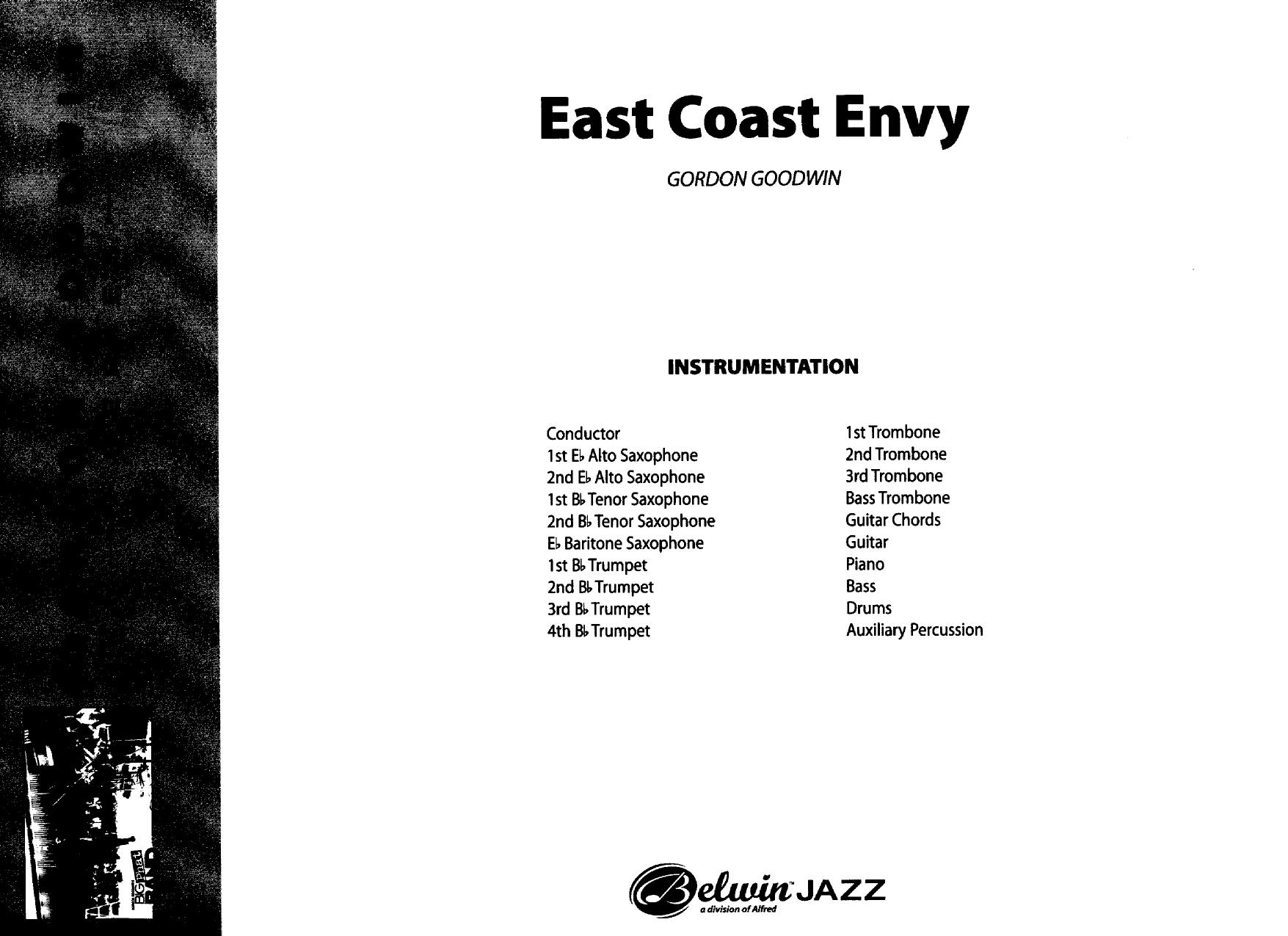
East Coast Envy (G.Goodwin) sheet music preview

East Coast Envy (G.Goodwin)

Composed by Gordon Goodwin

Arranged by Gordon Goodwin

  • Ensemble: Big Band
  • Pages: 112
  • Instruments (18): 1st Eb Alto Saxophone, 2nd Eb Alto Saxophone, 1st Bb Tenor Saxophone, 2nd Bb Tenor Saxophone, Eb Baritone Saxophone, 1st Bb Trumpet, 2nd Bb Trumpet, 3rd Bb Trumpet, 4th Bb Trumpet, 1st Trombone, 2nd Trombone, 3rd Trombone, Bass Trombone, Guitar, Piano, Bass, Drums, Auxiliary Percussion
  • Difficulty: advanced
  • Content: Individual Parts
  • Format: PDF Download (Instant)
  • Price: $24.99

Gordon Goodwin’s "East Coast Envy" stands as a brilliant contemporary big band showcase, capturing the high-octane energy, intricate harmonic language, and relentless drive that define the modern West Coast jazz composer's writing. Written to pit the fiery, hard-swinging aesthetic traditionally associated with New York jazz against Goodwin’s signature sophisticated West Coast polish, this composition bridges generations of big band tradition. While not a historical jazz standard from the swing era, Goodwin's catalog with the Gordon Goodwin's Big Phat Band has achieved legendary status in contemporary large ensemble literature, celebrated for pushing the technical and stylistic boundaries of modern jazz composition. Driven by a relentless, high-velocity swing feel, "East Coast Envy" operates at a brisk tempo that demands absolute precision and immaculate time from the rhythm section. The mood is fierce, confident, and relentlessly optimistic, propelled by dense, contemporary chord voicings that utilize extended and altered dominants. Sonically, the piece evokes the atmosphere of a top-tier Los Angeles studio session, marrying the complex, multi-layered orchestrations reminiscent of Sammy Nestico and Bob Mintzer with modern fusion-infused bite. The emotional arc moves from taut, nervous anticipation in the intro to unbridled jubilation during the massive ensemble shout choruses. Goodwin’s arranging approach is immediately recognizable through his meticulous voice-leading, inventive sax solid, and sparkling brass writing. The saxophones are treated as a tightly knit harmonic unit, frequently navigating lightning-fast bebop lines in unison or rich, close-interval block voicings. Brass writing features aggressive, punchy background figures that contrast with soaring trumpet leads and rich, trombone-driven sub-melodies. Goodwin expertly balances transparency in the arrangement—allowing inner voices to be heard clearly beneath the primary melody—with massive, wall-of-sound tutti sections that exploit the full dynamic range of the 18-piece instrumentation. Melodic responsibility is shared dynamically across the ensemble, passing swiftly from the saxophone section to the trumpets before culminating in explosive full-band statements. Solo opportunities are provided for standout improvisers, typically inviting feature spots for tenor saxophone and piano that require fluency in modern post-bop harmonic vocabularies. Technical challenges abound, particularly in the rapid articulation required across the woodwind and brass sections, syncopated rhythmic figures that cross bar lines, and the stamina needed to sustain high-energy phrasing throughout. Advanced college ensembles, elite high school jazz bands, and professional repertory orchestras will find this chart immensely rewarding, as it forces players to refine their ensemble listening, articulation matching, and stylistic versatility. Conquering "East Coast Envy" requires meticulous attention to articulation, balance, and time. The tempo is brisk, meaning the rhythm section must establish an unyielding, forward-moving swing feel without rushing. Drummers should focus on a crisp, driving ride-cymbal pattern with a feathered bass drum, avoiding heavy-handedness that could bog down the fast-moving chart. The primary technical hurdle for the winds lies in the razor-sharp execution of rapid, syncopated unison lines. Brass players must execute falls, doits, and tongue-slurs with absolute uniformity to maintain the crisp, studio-polished aesthetic. In the saxophone soli, blend and intonation are paramount; players should match the vibrato width and tone color of the lead alto. Rehearsals should begin under tempo, isolating complex rhythmic unisons between the sections and the rhythm piano/bass comping figures. Ensure the dynamic contrast between whispered background figures and roaring shout choruses is exaggerated to maximize the dramatic impact of Goodwin’s dynamic architecture. Q: What instruments and parts are included in this big band arrangement? A: This 112-page publication is scored for a standard 18-instrument big band lineup, featuring 5 saxophones (1st/2nd Alto, 1st/2nd Tenor, Baritone), 4 trumpets, 4 trombones, guitar, piano, bass, and drums, and includes a comprehensive conductor score. Q: What is the difficulty level of "East Coast Envy"? A: This arrangement is graded as advanced (typically suitable for top-tier college, advanced high school, and professional big bands) due to its demanding tempo, complex post-bop harmonies, and rapid ensemble unison passages. Q: What is the musical style and historical context of this piece? A: Composed by Gordon Goodwin, the piece is a contemporary jazz chart in a fast swing style that reflects the modern big band tradition popularized by the Gordon Goodwin's Big Phat Band. Q: What makes this specific arrangement unique? A: It features Goodwin's signature dense harmonic voicings, intricate saxophone soli sections, and a high-energy dialogue between sections that playfully contrasts East Coast grit with West Coast polish. Q: What is the performance duration and tempo of the arrangement? A: "East Coast Envy" is designed as a high-velocity feature piece, set at a brisk, driving up-tempo swing groove that typically runs between 4 to 5 minutes in performance length.

Questions and answers

What is included in the East Coast Envy (G.Goodwin) PDF?
The verified current file contains a conductor score and individual parts across 112 pages.
How many instruments or parts are listed for East Coast Envy (G.Goodwin)?
The verified instrumentation list contains 18 entries for this Big Band arrangement.
Who is credited for East Coast Envy (G.Goodwin)?
Composer: Gordon Goodwin. Arranger: Gordon Goodwin.
What difficulty is listed for East Coast Envy (G.Goodwin)?
The verified difficulty level is advanced.
Can I preview East Coast Envy (G.Goodwin) before buying?
Yes. The product page provides a preview generated from the current PDF file.
How is East Coast Envy (G.Goodwin) delivered?
After successful payment, the digital PDF is made available for download. The displayed price is $24.99.

Musicians Also Search For

East Coast Envy Gordon Goodwin PDFEast Coast Envy Gordon Goodwin sheet musicEast Coast Envy arranged by Gordon GoodwinGordon Goodwin big band chartsGordon Goodwin jazz arrangements PDFEast Coast Envy Gordon Goodwin big band arrangementsEast Coast Envy big band arrangementsEast Coast Envy big band PDF downloadEast Coast Envy jazz sheet musicbig band sheet music downloadEast Coast Envy conductor score PDFEast Coast Envy individual parts downloadEast Coast Envy sheet music PDFbuy East Coast Envy sheet musicdownload East Coast Envy PDFEast Coast Envy jazz chartsbest Gordon Goodwin big band arrangementsEast Coast Envy printable sheet musicbig band repertoire PDF

All arrangements by Gordon Goodwin All Gordon Goodwin sheet music