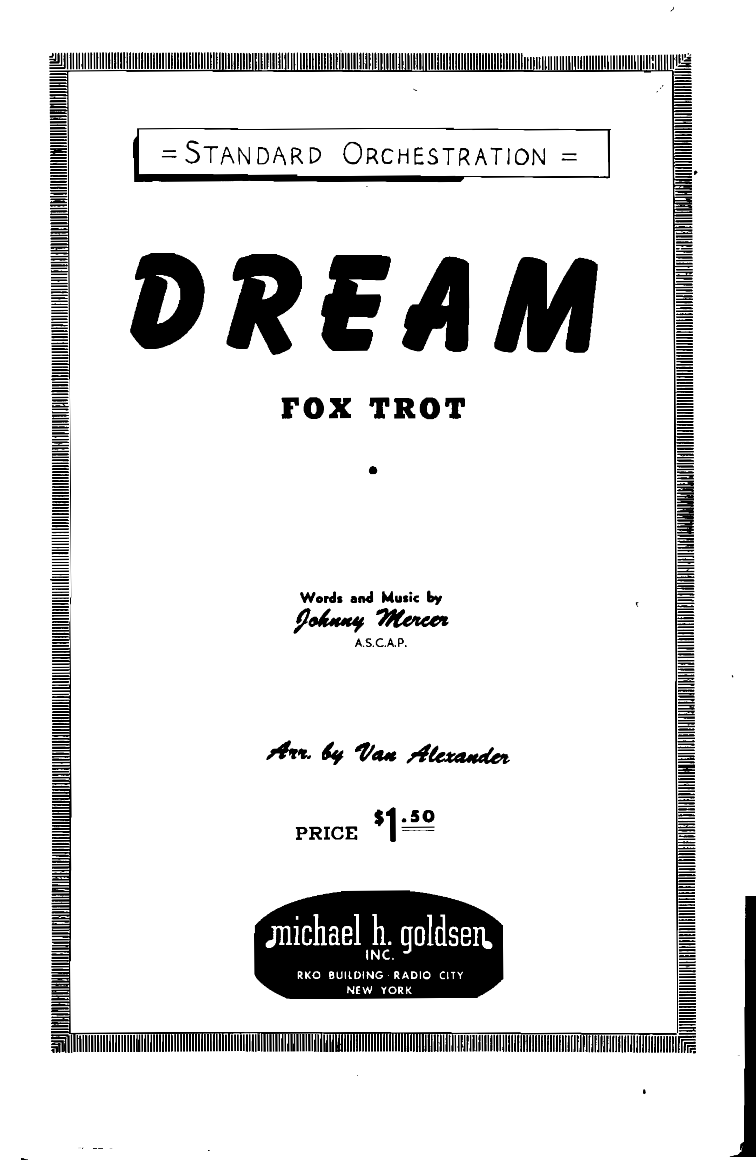
Dream (V.Alexander)
Composed by Johnny Mercer
Arranged by Van Alexander
- Ensemble: Big Band Dance
- Style: Foxtrot
- Pages: 30
- Instruments (17): Alto Saxophone 1, Alto Saxophone 2, Tenor Saxophone 1, Tenor Saxophone 2, Baritone Saxophone, Trumpet 1, Trumpet 2, Trumpet 3, Trumpet 4, Trombone 1, Trombone 2, Trombone 3, Bass Trombone, Piano, Bass, Drums, Guitar
- Difficulty: medium
- Content: Individual Parts
- Format: PDF Download (Instant)
- Price: $24.99
Johnny Mercer's timeless ballad "Dream" emerged in 1944, a tender melody born amidst the wartime sentimentality that permeated American popular music. While Mercer himself penned the lyrics and music, it was Frank Sinatra's 1945 recording with Axel Stordahl's orchestra that truly etched "Dream" into the public consciousness, solidifying its status as a quintessential American standard. The song embodies the romantic, yearning quality characteristic of the mid-20th century big band era, a period when sophisticated arrangements and smooth vocal delivery reigned supreme. Its enduring appeal lies in its simple, yet profound, lyrical message and its intrinsically melodious structure, making it a favorite for vocalists and instrumentalists alike who seek to evoke a sense of nostalgic warmth and gentle introspection. This arrangement of "Dream," crafted by the legendary Van Alexander, is a masterclass in the classic big band dance foxtrot style. Alexander, known for his meticulous and often innovative charts for artists like Chick Webb and Ella Fitzgerald, approaches "Dream" with an elegant, medium-slow tempo, typically around 80-90 BPM, allowing the melody to breathe and the rich harmonies to unfold. The key of F Major provides a comfortable and resonant foundation for the brass and saxophones. The overall mood is one of sophisticated romance and gentle swing, avoiding any overt sentimentality in favor of a refined, danceable interpretation. Listeners will find themselves transported to a bygone era of ballroom dancing, where the interplay of lush saxophone voicings and understated brass figures created an irresistible allure. Van Alexander's distinctive touch is evident throughout this chart. He masterfully employs his signature close-voicing techniques within the saxophone section, creating a warm, cohesive blanket of sound that carries the primary melodic statements. The arrangement features several beautifully crafted soli sections, particularly for the saxophones, where the ensemble plays with a unified, expressive voice. While there isn't a traditional "shout chorus" in the high-energy sense, Alexander builds dynamic intensity through layered brass figures and subtle counter-melodies that support the main theme. The chart features a brief, lyrical solo opportunity, typically for Tenor Saxophone 1 or Trumpet 2, offering a moment for individual expression without deviating from the song's gentle character. The arrangement's strength lies in its ability to maintain the original song's integrity while imbuing it with the full, sophisticated sound of a 17-piece big band. Performing "Dream (V.Alexander)" is a rewarding experience for an ensemble. The melody is predominantly carried by the lead alto saxophone and lead trumpet, often doubled or harmonized by the rest of their respective sections. Technical challenges are moderate, focusing more on blend, balance, and rhythmic precision within the medium-slow tempo rather than extreme ranges or rapid passages. The brass sections will need to articulate clearly and play with warmth, while the saxophones must achieve a seamless blend for the soli passages. The rhythm section provides a steady, understated foxtrot groove, requiring a sensitive touch. This arrangement is ideally suited for college and community big bands, as well as professional ensembles looking for a classic, well-crafted chart that showcases their ability to perform with nuance and stylistic authenticity. High school bands with strong lead players and a good grasp of ensemble blend will also find it accessible and highly educational. Conductors should emphasize a consistent, relaxed medium-slow foxtrot feel, around 80-90 BPM, allowing the melody to sing without rushing. The primary challenge lies in achieving a seamless blend and balance, particularly within the saxophone soli sections; encourage players to listen across the section and match articulations precisely. Brass entrances should be warm and sustained, avoiding harsh attacks, especially on sustained chords. Dynamics are crucial for shaping the piece; observe the subtle crescendos and diminuendos to enhance the romantic mood. The rhythm section should lay down a steady, unobtrusive groove, with the bass and drums providing a solid foundation and the piano offering tasteful harmonic support. No special techniques like plungers or falls are explicitly notated, but a sensitive use of vibrato, particularly in the saxophones and sustained brass notes, will greatly enhance the overall character. Rehearsals should focus on intonation within the close voicings and the unified phrasing of melodic lines. Q: What instruments and parts are included in this arrangement? A: This arrangement is scored for a full 17-piece big band dance ensemble, including Alto Saxophone 1 & 2, Tenor Saxophone 1 & 2, Baritone Saxophone, Trumpet 1-4, Trombone 1-4, Piano, Bass, Guitar, and Drums. Q: What is the difficulty level of "Dream (V.Alexander)"? A: This arrangement is rated as medium difficulty. It requires good ensemble blend, precise articulation, and a mature understanding of dynamics and phrasing, making it suitable for college, community, and advanced high school jazz ensembles. Q: What musical style and historical context does this arrangement represent? A: This is a classic big band dance foxtrot arrangement of Johnny Mercer's 1944 standard "Dream." It perfectly encapsulates the romantic and sophisticated sound of the mid-20th century big band era. Q: What makes Van Alexander's arrangement of "Dream" unique? A: Van Alexander's treatment is distinguished by his elegant close-voicing techniques for the saxophones, lush harmonic textures, and a refined, danceable medium-slow tempo that highlights the song's inherent beauty without excessive embellishment. Q: What is the typical performance duration and tempo for this piece? A: The typical performance duration is approximately 3-4 minutes, depending on any improvised solos. It should be played at a medium-slow foxtrot tempo, ideally between 80-90 beats per minute.
Musicians Also Search For
Dream Van Alexander PDF • Dream Van Alexander sheet music • Dream arranged by Van Alexander • Van Alexander big band dance charts • Van Alexander jazz arrangements PDF • Dream Johnny Mercer sheet music • Dream Johnny Mercer big band dance arrangement • Johnny Mercer big band dance charts • Dream big band dance arrangement • Dream big band dance PDF download • Dream jazz ensemble sheet music • big band dance sheet music instant download • Dream individual parts download • Dream sheet music with parts • Dream Foxtrot chart • Foxtrot big band dance arrangements • buy Dream sheet music online • download Dream PDF • Dream jazz chart • best Van Alexander big band dance arrangements • Johnny Mercer songs arranged by Van Alexander • Dream printable sheet music • big band dance repertoire PDF