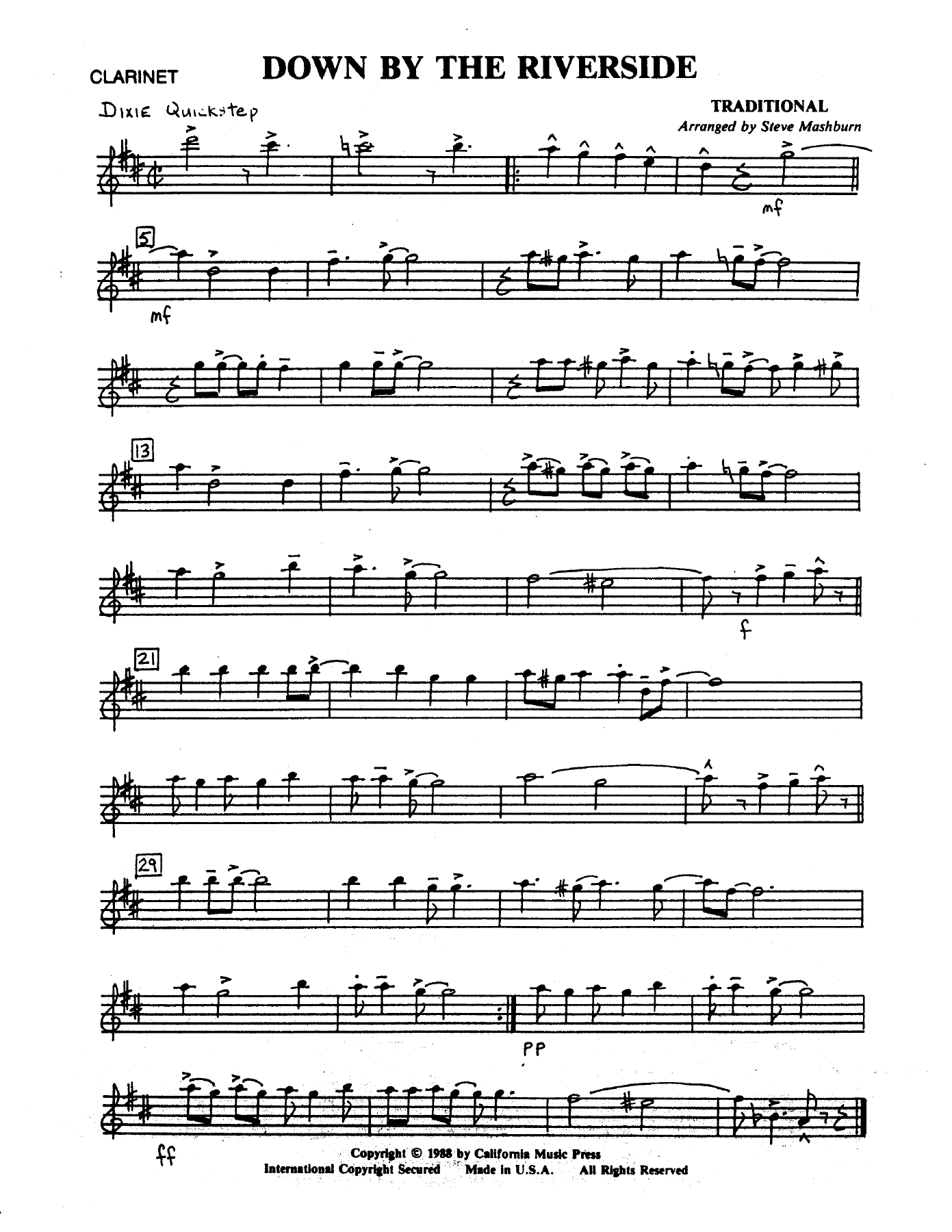
Down By The Riverside Trad. (S.Mashburn)
Composed by Traditional
Arranged by Steve Mashburn
- Ensemble: Dixieland Band
- Style: Dixieland
- Pages: 9
- Instruments (8): Clarinet, Tenor Saxophone, Trumpet, Trombone, Bass, Piano, Drums, Guitar
- Difficulty: easy
- Content: Individual Parts
- Format: PDF Download (Instant)
- Price: $18.99
"Down By The Riverside" stands as a quintessential American spiritual, its origins tracing back to the 19th century, though its exact composition date remains elusive. This powerful anthem of peace and spiritual resolve gained widespread popularity during the American Civil War and later became a prominent protest song during the Civil Rights Movement. Within the jazz canon, it was enthusiastically embraced by early Dixieland and New Orleans jazz ensembles, who found its simple, singable melody and call-and-response structure perfectly suited for improvisation and collective exuberance. Artists like Louis Armstrong, Sidney Bechet, and countless traditional jazz bands cemented its status as a foundational piece, representing the joyous, communal spirit inherent in early jazz. Its enduring appeal lies in its infectious rhythmic drive and universal message, making it a beloved staple in traditional jazz repertoire. Steve Mashburn's arrangement of "Down By The Riverside" captures the authentic spirit of Dixieland jazz with a vibrant, medium-up tempo two-beat feel, firmly rooted in the key of F Major. The mood is unequivocally celebratory and energetic, evoking the lively atmosphere of a New Orleans street parade or a bustling riverboat. Mashburn's distinctive approach honors the traditional collective improvisation while providing a structured framework that allows for both ensemble precision and individual expression. Expect characteristic Dixieland voicings, with the trumpet often carrying the lead melody, the clarinet weaving intricate counter-melodies, and the trombone providing harmonic fills and rhythmic punctuation. The arrangement features a dynamic interplay between these front-line instruments, culminating in a classic Dixieland shout chorus that builds excitement through layered textures and rhythmic drive, without venturing into extended harmonies that would detract from the traditional aesthetic. This arrangement is designed for a standard Dixieland band, offering a rewarding experience for musicians at the high school, college, community, and even emerging professional levels. The melody is predominantly carried by the trumpet, with the clarinet and trombone engaging in contrapuntal lines and fills, characteristic of the style. While there are no explicitly notated "solos" in the modern sense, the arrangement provides ample space and cues for the traditional collective improvisation that defines Dixieland, particularly in the later choruses. Technical challenges include maintaining a consistent, driving two-beat feel, executing precise ensemble entrances and cut-offs, and navigating the often-busy counter-melodies in the clarinet and trombone parts. The rewarding aspect lies in the sheer joy of performing this iconic tune, the communal energy generated by the collective improvisation, and the opportunity to delve into the historical roots of jazz. Standout moments include the spirited ensemble passages and the climactic, full-band shout chorus that brings the piece to a rousing conclusion. This arrangement thrives on a consistent, driving medium-up tempo two-beat feel, approximately quarter note = 144-160 BPM. Emphasize a light, buoyant articulation, particularly in the rhythm section, to avoid a heavy or plodding feel. The bass and tuba should clearly articulate on beats one and three, while the banjo/guitar and piano provide rhythmic strumming or comping on all four beats. Front-line players (trumpet, clarinet, trombone) should strive for a conversational interplay, listening intently to each other to create a cohesive yet spontaneous sound. Encourage trumpet players to lead with confidence, clarinets to weave fluid counter-melodies without overpowering, and trombones to provide robust, rhythmic fills and glissandi where appropriate. Specific techniques like subtle falls and scoops, characteristic of Dixieland, should be encouraged but executed tastefully to enhance the style rather than detract from clarity. Rehearsal should focus on solidifying the ensemble sections and then allowing space for players to develop their collective improvisation within the established harmonic framework. Q: What instruments are included in this arrangement? A: This arrangement includes parts for a standard Dixieland band instrumentation, typically featuring Trumpet, Clarinet, Trombone, Banjo/Guitar, Piano, Tuba/String Bass, and Drums. Q: What is the difficulty level of "Down By The Riverside Trad. (S.Mashburn)"? A: This arrangement is suitable for intermediate to advanced ensembles, including high school, college, and community bands. It requires solid rhythmic precision and an understanding of Dixieland stylistic nuances. Q: What musical style and historical context does this arrangement represent? A: This arrangement is firmly rooted in the Dixieland jazz style, reflecting the lively and communal music of early 20th-century New Orleans. The original "Down By The Riverside" is a traditional American spiritual. Q: What makes Steve Mashburn's arrangement of this traditional piece unique? A: Mashburn's arrangement provides a structured yet authentic Dixieland framework, balancing ensemble precision with opportunities for collective improvisation. It features characteristic voicings and a dynamic shout chorus, capturing the celebratory spirit of the genre. Q: What is the typical performance duration and tempo for this piece? A: The typical performance duration for this arrangement is approximately 2:30 to 3:30 minutes, depending on the number of improvised choruses. It should be performed at a medium-up tempo with a driving two-beat feel (quarter note = 144-160 BPM).
Questions and answers
- What is included in the Down By The Riverside Trad. (S.Mashburn) PDF?
- The verified current file contains individual parts across 9 pages.
- How many instruments or parts are listed for Down By The Riverside Trad. (S.Mashburn)?
- The verified instrumentation list contains 8 entries for this Dixieland Band arrangement.
- Who is credited for Down By The Riverside Trad. (S.Mashburn)?
- Composer: Traditional. Arranger: Steve Mashburn.
- What difficulty is listed for Down By The Riverside Trad. (S.Mashburn)?
- The verified difficulty level is easy.
- What style is listed for Down By The Riverside Trad. (S.Mashburn)?
- The catalog lists the style as Dixieland.
- Can I preview Down By The Riverside Trad. (S.Mashburn) before buying?
- Yes. The product page provides a preview generated from the current PDF file.
- How is Down By The Riverside Trad. (S.Mashburn) delivered?
- After successful payment, the digital PDF is made available for download. The displayed price is $18.99.
Musicians Also Search For
Down By The Riverside Trad. Steve Mashburn PDF • Down By The Riverside Trad. Steve Mashburn sheet music • Down By The Riverside Trad. arranged by Steve Mashburn • Steve Mashburn dixieland band charts • Steve Mashburn jazz arrangements PDF • Down By The Riverside Trad. Traditional sheet music • Down By The Riverside Trad. Traditional dixieland band arrangements • Traditional dixieland band charts • Down By The Riverside Trad. dixieland band arrangements • Down By The Riverside Trad. dixieland band PDF download • Down By The Riverside Trad. jazz sheet music • dixieland band sheet music download • Down By The Riverside Trad. individual parts download • Down By The Riverside Trad. sheet music PDF • Down By The Riverside Trad. Dixieland charts • Dixieland dixieland band arrangements • buy Down By The Riverside Trad. sheet music • download Down By The Riverside Trad. PDF • Down By The Riverside Trad. jazz charts • best Steve Mashburn dixieland band arrangements • Traditional arranged by Steve Mashburn • Down By The Riverside Trad. printable sheet music • dixieland band repertoire PDF