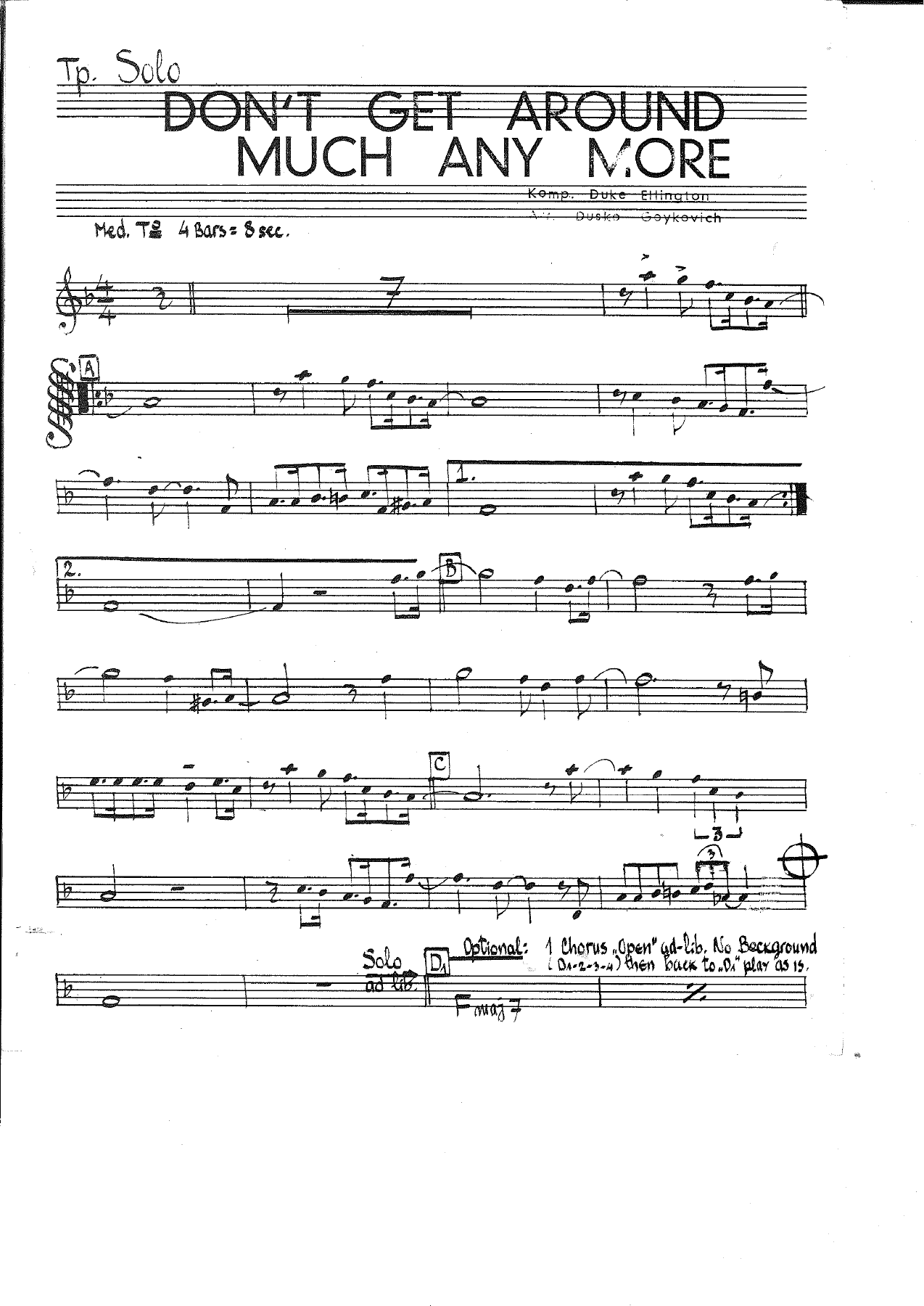
Don't get around much anymore Tpt 3 (comp. Duke Ellington)
Composed by Duke Ellington
Arranged by Unknown Arranger
- Ensemble: Big Band Vocal
- Style: Swing
- Pages: 52
- Instruments (19): Trumpet Solo, Alto Saxophone 1, Alto Saxophone 2, Tenor Saxophone 1, Tenor Saxophone 2, Baritone Saxophone, Trombone 1, Trombone 2, Trombone 3, Trombone 4, Trombone Solo, Trumpet 1, Trumpet 2, Trumpet 3, Trumpet 4, Piano, Guitar, Bass, Drums
- Difficulty: advanced
- Content: Individual Parts
- Format: PDF Download (Instant)
- Price: $24.99
"Don't Get Around Much Anymore," originally titled "Never No Lament," emerged from the prolific pen of Duke Ellington in 1940, quickly becoming one of his most enduring and beloved compositions. This timeless swing standard captures the melancholic yet sophisticated essence of the big band era, a period defined by its elegant melodies, rich harmonies, and infectious rhythmic drive. The song gained widespread popularity through iconic recordings by Ellington's own orchestra, featuring vocalists like Ivie Anderson, and later by legends such as The Ink Spots, Nat King Cole, and Ella Fitzgerald, solidifying its place in the jazz canon. Its memorable, blues-inflected melody and sophisticated chord changes make it a perennial favorite for both performers and listeners, embodying the golden age of swing with a touch of poignant reflection. This particular arrangement by Unknown Arranger for big band with a vocal feature presents "Don't Get Around Much Anymore" in a medium swing tempo, typically hovering around 120-130 BPM. The key is set in F Major, providing a comfortable range for most vocalists while allowing the brass and saxophones to articulate the melody with warmth and clarity. The overall mood is one of sophisticated melancholy, evolving into a gently swinging optimism. The arrangement opens with a classic big band introduction, establishing the harmonic and rhythmic foundation before the vocalist enters. Throughout the piece, the texture shifts between lush ensemble voicings supporting the vocal line and engaging instrumental soli sections that showcase the band's capabilities. Unknown Arranger's treatment of this classic is characterized by a respectful yet fresh approach. Expect well-crafted voicings that highlight the rich harmonic language of Ellington, particularly in the saxophone and brass sections. There are distinct soli passages for both saxophones and trombones, providing excellent opportunities for sections to shine. A notable feature is the inclusion of a written-out solo for Tenor Saxophone (or an optional improvised solo over the changes), offering a moment for individual expression. The arrangement builds dynamically, culminating in a tasteful shout chorus that provides a gentle lift without becoming overly bombastic, perfectly suiting the song's reflective nature. The chart concludes with a classic big band tag, leaving a lingering impression of elegance and swing. Performing this arrangement is a rewarding experience for intermediate to advanced ensembles, typically suitable for strong high school, college, community, and professional bands. The challenges lie in maintaining a consistent, relaxed medium swing feel, executing precise ensemble attacks and releases, and navigating the nuanced dynamics required to convey the song's emotional depth. The vocal part is central, requiring a vocalist with good phrasing and a warm tone. Instrumentalists will find the soli sections engaging, and the lead trumpet range is manageable, generally not exceeding a written high C. The chart's length of 52 pages suggests a comprehensive and well-developed arrangement, offering plenty of musical substance for a full performance. Conductors should emphasize a relaxed, medium swing feel at approximately 120-130 BPM, ensuring the rhythm section lays down a solid, unhurried groove. Articulation is key: encourage light, detached eighth notes in swing passages, avoiding a heavy or stiff feel. The vocal part is paramount; ensure the band provides sensitive accompaniment, dynamically supporting without overpowering. Pay close attention to blend and balance, particularly in the saxophone and trombone soli sections, aiming for a unified, warm sound. The Tenor Saxophone solo (written or improvised) should be encouraged to capture the song's bluesy, lyrical character. Brass players should use straight mutes as indicated for specific sections, and subtle falls and scoops should be executed with taste, enhancing the swing aesthetic without exaggeration. Rehearsal time should focus on ensemble precision, dynamic contrast, and the seamless transitions between vocal and instrumental sections. Q: What instruments and parts are included in this arrangement? A: This arrangement is for a standard big band instrumentation, including 5 saxophones (AATTB), 4 trumpets, 4 trombones, guitar, piano, bass, drums, and a dedicated vocal part. Q: What is the difficulty level of "Don't Get Around Much Anymore" (Unknown Arranger)? A: This arrangement is rated as intermediate to advanced, suitable for strong high school, college, community, and professional jazz ensembles due to its nuanced musicality and ensemble demands. Q: What musical style and historical context does this arrangement represent? A: This arrangement embodies the classic Swing style of the 1940s, featuring Duke Ellington's timeless composition, known for its elegant melodies and sophisticated harmonic language. Q: What makes this specific arrangement unique compared to other versions of the song? A: Unknown Arranger's treatment features well-crafted voicings, distinct saxophone and trombone soli sections, a featured Tenor Saxophone solo (written or improvised), and a tasteful shout chorus, all while maintaining the song's original sophisticated melancholy. Q: What is the approximate performance duration and recommended tempo for this piece? A: The approximate performance duration is typically around 3-4 minutes, and it is intended to be performed at a medium swing tempo, ideally between 120-130 beats per minute.
Questions and answers
- What is included in the Don't get around much anymore Tpt 3 (comp. Duke Ellington) PDF?
- The verified current file contains individual parts across 52 pages.
- How many instruments or parts are listed for Don't get around much anymore Tpt 3 (comp. Duke Ellington)?
- The verified instrumentation list contains 19 entries for this Big Band Vocal arrangement.
- Who is credited for Don't get around much anymore Tpt 3 (comp. Duke Ellington)?
- Composer: Duke Ellington. Arranger: Unknown Arranger.
- What difficulty is listed for Don't get around much anymore Tpt 3 (comp. Duke Ellington)?
- The verified difficulty level is advanced.
- What style is listed for Don't get around much anymore Tpt 3 (comp. Duke Ellington)?
- The catalog lists the style as Swing.
- Can I preview Don't get around much anymore Tpt 3 (comp. Duke Ellington) before buying?
- Yes. The product page provides a preview generated from the current PDF file.
- How is Don't get around much anymore Tpt 3 (comp. Duke Ellington) delivered?
- After successful payment, the digital PDF is made available for download. The displayed price is $24.99.
Musicians Also Search For
Don't get around much anymore Tpt 3 Unknown Arranger PDF • Don't get around much anymore Tpt 3 Unknown Arranger sheet music • Don't get around much anymore Tpt 3 arranged by Unknown Arranger • Unknown Arranger big band vocal charts • Unknown Arranger jazz arrangements PDF • Don't get around much anymore Tpt 3 Duke Ellington sheet music • Don't get around much anymore Tpt 3 Duke Ellington big band vocal arrangements • Duke Ellington big band vocal charts • Don't get around much anymore Tpt 3 big band vocal arrangements • Don't get around much anymore Tpt 3 big band vocal PDF download • Don't get around much anymore Tpt 3 jazz sheet music • big band vocal sheet music download • Don't get around much anymore Tpt 3 individual parts download • Don't get around much anymore Tpt 3 sheet music PDF • Don't get around much anymore Tpt 3 Swing charts • Swing big band vocal arrangements • buy Don't get around much anymore Tpt 3 sheet music • download Don't get around much anymore Tpt 3 PDF • Don't get around much anymore Tpt 3 jazz charts • best Unknown Arranger big band vocal arrangements • Duke Ellington arranged by Unknown Arranger • Don't get around much anymore Tpt 3 printable sheet music • big band vocal repertoire PDF