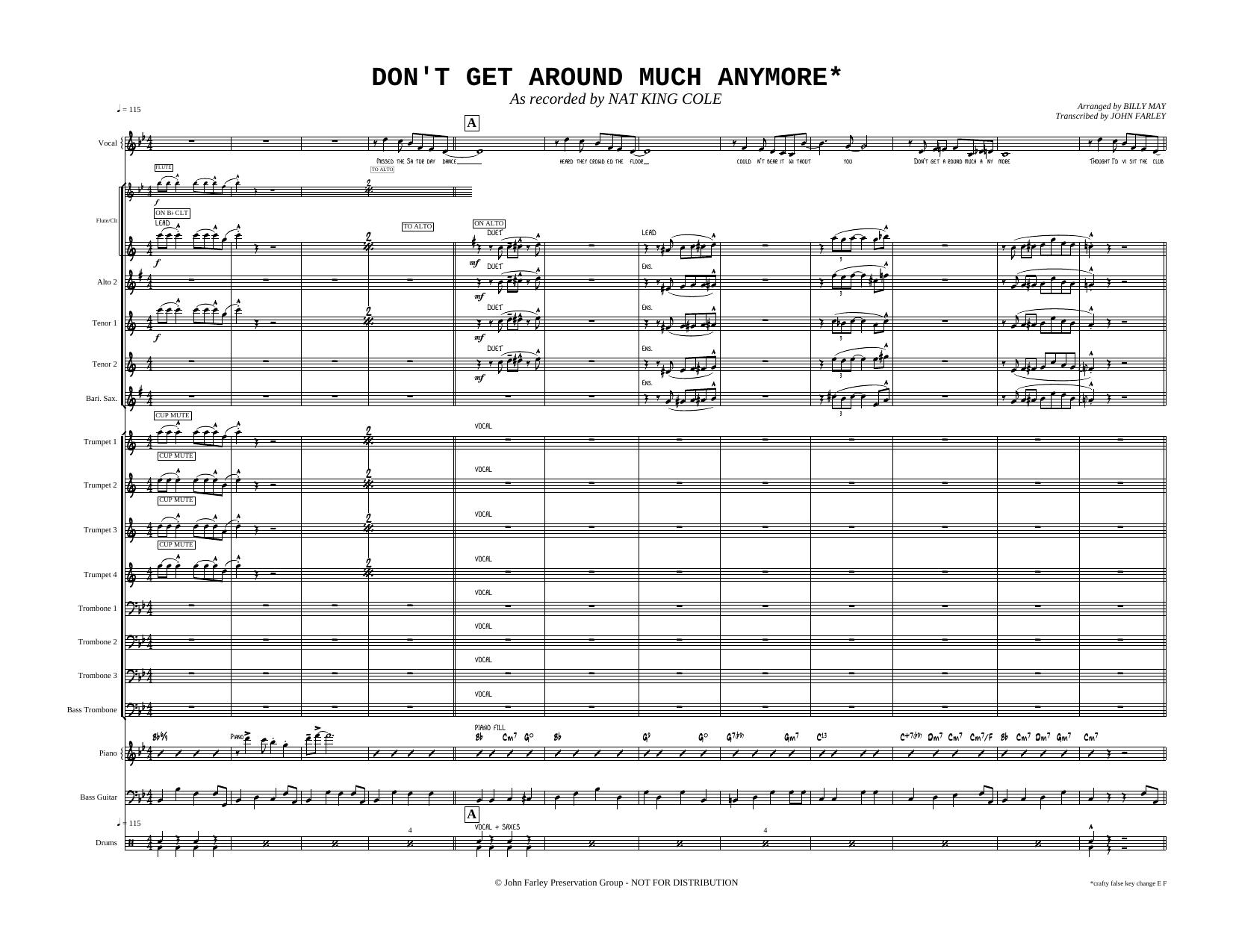
Don't Get Around Much Anymore (N.KCole - B.May - J.Farley)
Composed by Duke Ellington
Arranged by Billy May
- Ensemble: Big Band
- Pages: 37
- Instruments (20): Vocal, Flute, Clarinet Bb, Alto Saxophone 1, Alto Saxophone 2, Tenor Saxophone 1, Tenor Saxophone 2, Baritone Saxophone, Trumpet 1, Trumpet 2, Trumpet 3, Trumpet 4, Trombone 1, Trombone 2, Trombone 3, Bass Trombone, Piano, Guitar, Bass Guitar, Drums
- Difficulty: medium
- Content: Individual Parts
- Format: PDF Download (Instant)
- Price: $24.99
Duke Ellington’s timeless 1942 masterpiece "Don't Get Around Much Anymore"—originally titled "Never No Lament" before Bob Russell added lyrics—stands as one of the defining pillars of the swing era and the Great American Songbook. While Ellington’s own orchestra popularized the tune, subsequent vocal and instrumental interpretations forever cemented its status as a jazz standard. Among the most iconic mid-century treatments is the sophisticated vocal-jazz and instrumental fusion associated with Nat King Cole, propelled by the wildly inventive, brass-heavy arranging genius of Billy May. This specific big band publication captures that elite intersection of cool-era vocal styling and swinging, punchy chart-writing, making it a masterclass in mid-century jazz arrangement. Swinging at a comfortable, driving medium-tempo groove in 4/4 time, the arrangement exudes a suave, confident, and laid-back sophistication characteristic of Billy May’s signature writing style. The emotional landscape shifts brilliantly between sultry, late-night intimacy and high-energy, brass-driven jubilation. May avoids overly dense, modern chord clusters in favor of rich, accessible extended harmonies that prioritize vocal clarity and forward-moving momentum. The harmonic language relies on lush major-seventh voicings, blues-infused chromaticism, and playful minor-mode colorations that keep the listener constantly engaged while maintaining the infectious, toe-tapping pulse essential to the genre. Billy May’s distinctive approach is immediately recognizable in the snappy, harmonized saxophone solis and the characteristic, biting brass swells that punctuate the arrangement. The 9-instrument configuration (comprising a tight horn section of Alto Sax, Tenor Sax, Baritone Sax, Trumpet, and Trombone, among others) is utilized with maximum economy and maximum impact, sounding far larger than the notation suggests through clever doubling and transparent counterpoint. The melody is shared fluidly across sections, passing seamlessly from the sultry woodwinds to the brass, supported by a rhythm section that must maintain a steady, unyielding pocket. While the chart avoids excessive technical acrobatics, it demands impeccable stylistic cohesion, particularly in executing May’s trademark sliding brass effects and razor-sharp articulation. Advanced high school, collegiate, and professional big bands will find this 37-page score exceptionally rewarding to rehearse and perform. The primary technical hurdle lies not in rapid-fire execution, but in stylistic precision—achieving the precise articulation, dynamic contrast, and relaxed swing eighth-note feel that separates a mediocre reading from an authentic performance. Featured instrumental breaks provide wonderful opportunities for individual expression within a tight ensemble framework. Ultimately, this chart serves as an incredible showcase for a vocalist or a premier instrumental soloist, guaranteeing an unforgettable highlight for any advanced jazz concert program. Unlocking the authentic swagger of this Billy May arrangement requires absolute precision in articulation and a relaxed, forward-leaning medium-swing feel. The rhythm section must anchor the chart with an unhurried, buoyant pulse; the drummer should favor crisp ride-cymbal definition and subtle hi-hat chick on beats two and four, avoiding any tendency to rush the tempo. Horn players must pay meticulous attention to dynamic markings, treating May’s signature brass bites and stylistic accents with sharp, clean attacks rather than harsh blasts. Plunger mutes and gentle lip-slurs should be executed with vocal-like flexibility to mimic the expressive inflections of the Nat King Cole era. Rehearsal time should be heavily dedicated to locking in the ensemble balance during the saxophone soli sections, ensuring the moving inner voices remain transparent beneath the primary melodic line. Directors should encourage players to listen across sections to match vibrato widths and stylistic phrasing uniformly. Q: What specific instruments and parts are included in this 37-page arrangement? A: This arrangement is scored for a 9-instrument compact big band configuration, featuring Alto Saxophone, Tenor Saxophone, Baritone Saxophone, Trumpet, and Trombone parts, fully supported by a complete rhythm section rhythm framework. Q: What is the difficulty level of this Billy May arrangement? A: It is targeted at advanced high school, collegiate, and professional jazz ensembles due to its heavy emphasis on stylistic precision, section blend, and authentic swing interpretation rather than extreme technical speed. Q: What is the historical style and background of this specific chart? A: This chart reflects the sophisticated, brass-heavy jazz style popularized by arranger Billy May in collaboration with vocal icons like Nat King Cole during the post-swing and cool jazz eras of the 1950s. Q: What makes this particular Billy May arrangement unique? A: It features May's signature playful brass effects, crisp saxophone solis, and clever harmonic voicings that make a 9-piece horn section sound with the rich density and drive of a full-sized big band. Q: What is the recommended performance tempo and duration? A: The arrangement is set at a comfortable, driving medium-swing tempo (approximately 116–124 BPM) and typically runs around 3 to 4 minutes in duration, depending on solo extensions.
Questions and answers
- What is included in the Don't Get Around Much Anymore (N.KCole - B.May - J.Farley) PDF?
- The verified current file contains a conductor score and individual parts across 37 pages.
- How many instruments or parts are listed for Don't Get Around Much Anymore (N.KCole - B.May - J.Farley)?
- The verified instrumentation list contains 20 entries for this Big Band arrangement.
- Who is credited for Don't Get Around Much Anymore (N.KCole - B.May - J.Farley)?
- Composer: Duke Ellington. Arranger: Billy May.
- What difficulty is listed for Don't Get Around Much Anymore (N.KCole - B.May - J.Farley)?
- The verified difficulty level is medium.
- Can I preview Don't Get Around Much Anymore (N.KCole - B.May - J.Farley) before buying?
- Yes. The product page provides a preview generated from the current PDF file.
- How is Don't Get Around Much Anymore (N.KCole - B.May - J.Farley) delivered?
- After successful payment, the digital PDF is made available for download. The displayed price is $24.99.
Musicians Also Search For
Don't Get Around Much Anymore Billy May PDF • Don't Get Around Much Anymore Billy May sheet music • Don't Get Around Much Anymore arranged by Billy May • Billy May big band charts • Billy May jazz arrangements PDF • Don't Get Around Much Anymore Duke Ellington sheet music • Don't Get Around Much Anymore Duke Ellington big band arrangements • Duke Ellington big band charts • Don't Get Around Much Anymore big band arrangements • Don't Get Around Much Anymore big band PDF download • Don't Get Around Much Anymore jazz sheet music • big band sheet music download • Don't Get Around Much Anymore conductor score PDF • Don't Get Around Much Anymore individual parts download • Don't Get Around Much Anymore sheet music PDF • buy Don't Get Around Much Anymore sheet music • download Don't Get Around Much Anymore PDF • Don't Get Around Much Anymore jazz charts • best Billy May big band arrangements • Duke Ellington arranged by Billy May • Don't Get Around Much Anymore printable sheet music • big band repertoire PDF