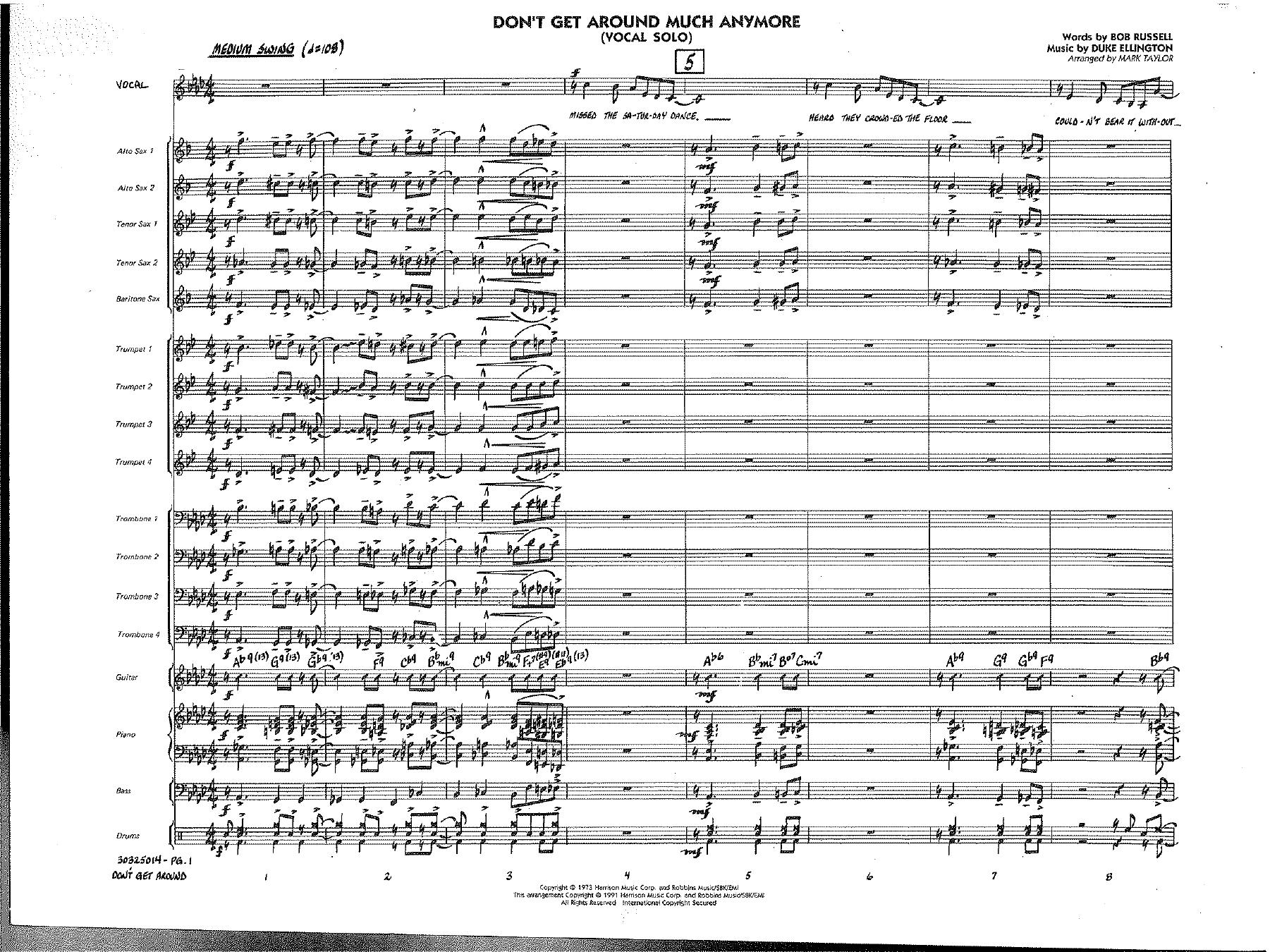
Don't Get Around Much Anymore (M.Taylor)
Composed by Duke Ellington
Arranged by Mark Taylor
- Ensemble: Big Band
- Pages: 46
- Instruments (18): Vocal Solo, Alto Sax 1, Alto Sax 2, Tenor Sax 1, Tenor Sax 2, Baritone Sax, Trumpet 1, Trumpet 2, Trumpet 3, Trumpet 4, Trombone 1, Trombone 2, Trombone 3, Trombone 4, Guitar, Piano, Bass, Drums
- Difficulty: medium
- Content: Individual Parts
- Format: PDF Download (Instant)
- Price: $24.99
Duke Ellington’s immortal standard "Don’t Get Around Much Anymore," originally penned as an instrumental titled "Never No Lament" in 1940 before Bob Russell added lyrics for the Ink Spots' massive 1942 hit, stands as a quintessential pillar of the Swing Era and the Great American Songbook. This timeless composition captures the sophisticated urban melancholy and relaxed urbanity that defined Ellington’s signature style during his legendary Blanton-Webster band era. The tune’s deceptive simplicity—built on an AABA 32-bar form with infectious, blues-inflected harmony—has invited countless interpretations over the decades, transitioning effortlessly from small-group swing to lush big band orchestrations. Mark Taylor’s masterful big band treatment infuses this classic with a buoyant, medium-swing groove (approx. 120 BPM) that balances nostalgic warmth with crisp, contemporary articulation. Opening with a playful, teasing vamp that highlights the rhythm section's understated pocket, the chart establishes an easygoing yet driving momentum. The emotional landscape shifts fluidly between breezy sophistication and moments of rich, late-night introspection. Taylor utilizes warm, Ellingtonian brass voicings—utilizing muted trumpets and open trombones—to evoke a smoky club atmosphere, driving the ensemble with a playful cadence that keeps both performers and audiences thoroughly engaged. Taylor’s arranging genius shines particularly in his treatment of the melodic line and dynamic contrast. The vocal soloist takes center stage, supported by sophisticated sax solis that weave fluid counterlines behind the lyrics. The arrangement features a cleverly orchestrated shout chorus that builds organically without sacrificing the relaxed tempo, layering brass stabs over a rolling saxophones background before opening the floor for a featured improvised solo (with suggested changes provided for flexibility). The harmonic palette incorporates tasteful secondary dominants and subtle tritone substitutions while remaining accessible, making it a masterclass in economy and space. Advanced high school ensembles, collegiate jazz orchestras, and professional community big bands will find this chart to be an exceptionally rewarding addition to their repertoires. While the rhythmic figures demand precision and a unified section concept of swing subdivision, the technical threshold is approachable enough to allow developing players to focus on style, blend, and phrasing. It serves as an ideal showcase for a guest vocalist, offering a sophisticated vehicle that highlights interpretive nuance over sheer velocity. Achieving an authentic performance of this Mark Taylor arrangement requires rigorous attention to stylistic articulation and rhythmic placement. The tempo should sit comfortably in a relaxed medium swing; avoid rushing the quarter-note pulse, as the chart relies heavily on a deep, laid-back pocket to generate its characteristic charm. Horn players must pay strict attention to short, articulated notes on the off-beats (the "and" of the beat), applying a consistent, lightweight tongue ("doodle-tonguing" where appropriate) to mimic classic Ellington-style phrasing. Brass players should utilize cup or straight mutes where indicated to achieve the requisite textural contrast against the open saxophones, ensuring that background figures never overpower the featured vocal line. The rhythm section acts as the primary engine: the drummer should maintain a feather-light ride cymbal pattern with a crisp hi-hat chop on beats two and four, while the bassist walks a steady, acoustic-style line that locks firmly with the piano's comping shells. Rehearsal should initially isolate the sax soli to balance internal voicings before integrating the rhythm section's harmonic support. Q: What instruments and parts are included in this big band arrangement? A: This complete 18-instrument arrangement includes a full conductor score and individual parts for Vocal, 2 Alto Saxophones, 2 Tenor Saxophones, Baritone Saxophone, 4 Trumpets, 3 Trombones, Bass Trombone, Guitar, Piano, Bass, and Drums. Q: What is the difficulty level of this Mark Taylor arrangement? A: This chart is graded as medium (Grade 3.5 to 4), making it ideal for accomplished high school jazz ensembles, university bands, and professional community groups looking for a polished, accessible crowd-pleaser. Q: What is the historical and stylistic background of this piece? A: Originally composed by Duke Ellington in 1940 as "Never No Lament" and later popularized with Bob Russell's lyrics, this arrangement embraces the classic medium-swing aesthetic of the 1940s Big Band Era while incorporating modern, sophisticated orchestration techniques by Mark Taylor. Q: What makes this specific arrangement unique? A: Mark Taylor’s version stands out due to its clever integration of a vocal feature with sophisticated, Ellington-inspired muted brass voicings, a conversational sax soli, and an organically unfolding shout chorus that maintains a relaxed, danceable groove. Q: What is the performance duration and tempo guideline for this piece? A: The arrangement runs approximately 3 to 4 minutes in duration and should be performed at a relaxed medium-swing tempo of around 120 BPM to capture its authentic stylistic feel.
Questions and answers
- What is included in the Don't Get Around Much Anymore (M.Taylor) PDF?
- The verified current file contains a conductor score and individual parts across 46 pages.
- How many instruments or parts are listed for Don't Get Around Much Anymore (M.Taylor)?
- The verified instrumentation list contains 18 entries for this Big Band arrangement.
- Who is credited for Don't Get Around Much Anymore (M.Taylor)?
- Composer: Duke Ellington. Arranger: Mark Taylor.
- What difficulty is listed for Don't Get Around Much Anymore (M.Taylor)?
- The verified difficulty level is medium.
- Can I preview Don't Get Around Much Anymore (M.Taylor) before buying?
- Yes. The product page provides a preview generated from the current PDF file.
- How is Don't Get Around Much Anymore (M.Taylor) delivered?
- After successful payment, the digital PDF is made available for download. The displayed price is $24.99.
Musicians Also Search For
Don't Get Around Much Anymore Mark Taylor PDF • Don't Get Around Much Anymore Mark Taylor sheet music • Don't Get Around Much Anymore arranged by Mark Taylor • Mark Taylor big band charts • Mark Taylor jazz arrangements PDF • Don't Get Around Much Anymore Duke Ellington sheet music • Don't Get Around Much Anymore Duke Ellington big band arrangements • Duke Ellington big band charts • Don't Get Around Much Anymore big band arrangements • Don't Get Around Much Anymore big band PDF download • Don't Get Around Much Anymore jazz sheet music • big band sheet music download • Don't Get Around Much Anymore conductor score PDF • Don't Get Around Much Anymore individual parts download • Don't Get Around Much Anymore sheet music PDF • buy Don't Get Around Much Anymore sheet music • download Don't Get Around Much Anymore PDF • Don't Get Around Much Anymore jazz charts • best Mark Taylor big band arrangements • Duke Ellington arranged by Mark Taylor • Don't Get Around Much Anymore printable sheet music • big band repertoire PDF