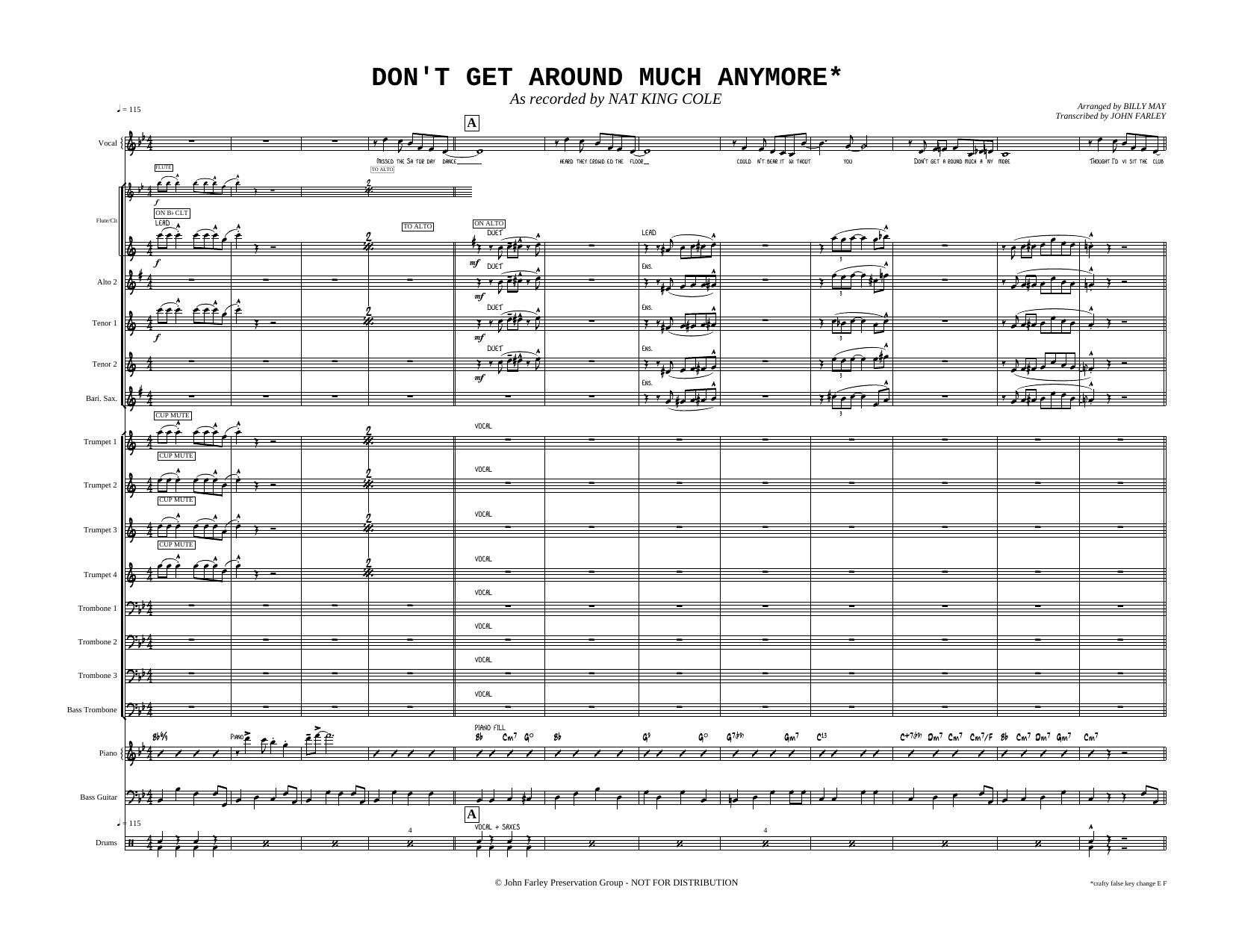
Don't Get Around Much Anymore (J.Farley)
Composed by Duke Ellington
Arranged by John Farley
- Ensemble: Big Band
- Pages: 37
- Instruments (20): Vocal, Flute, Clarinet Bb, Alto Saxophone 1, Alto Saxophone 2, Tenor Saxophone 1, Tenor Saxophone 2, Baritone Saxophone, Trumpet 1, Trumpet 2, Trumpet 3, Trumpet 4, Trombone 1, Trombone 2, Trombone 3, Bass Trombone, Piano, Guitar, Bass Guitar, Drums
- Difficulty: medium
- Content: Individual Parts
- Format: PDF Download (Instant)
- Price: $24.99
Duke Ellington’s timeless 1940 composition, originally penned as an instrumental titled "Never No Lament" before Bob Russell added lyrics in 1942 to create "Don't Get Around Much Anymore," stands as a towering pillar of the Swing Era and the Great American Songbook. Immortalized by Ellington’s orchestra and later by vocal icons like Nat King Cole and Ella Fitzgerald, the tune's bittersweet, nostalgic lyricism and irresistible harmonic progression have secured its status as an enduring jazz standard. This classic framework captures the sophisticated urban melancholy and relaxed elegance that defined the height of big band swing, offering an effortless blend of sophisticated blues-inflected harmonies and accessible melodic charm. John Farley’s masterful big band adaptation breathes fresh life into the standard while honoring its rich heritage, establishing a relaxed, infectious medium-swing groove that immediately draws both the ensemble and the audience in. Operating in a comfortable key that flatters vocalists and instrumentalists alike, the arrangement balances breezy sophistication with a warm, inviting emotional core. The mood shifts effortlessly from sultry and introspective during the vocal verses to an open, jubilant communal swing during the instrumental interludes, evoking the vibrant atmosphere of an after-hours Harlem club where precision meets unpretentious joy. Farley approaches the 19-instrument canvas with a deft hand, utilizing classic Ellingtonian voicings juxtaposed with contemporary harmonic extensions that give the brass and reed sections a modern sheen. The arrangement features lush, harmonized sax solis that weave underneath the vocal line, a clever counter-melody in the clarinets and flutes that adds textural depth, and a vibrant shout chorus that builds natural dramatic tension before resolving into a satisfying, laid-back coda. The woodwind doubling (specifically flute and clarinet parts) introduces a rich, orchestral color palette rarely found in standard stock charts, allowing the ensemble to achieve a sophisticated, multi-timbral soundscape. Advanced high school ensembles, collegiate jazz orchestras, and professional community big bands will find this chart to be an exceptionally rewarding addition to their repertoire. While the individual parts are accessible enough to be mastered with standard sectional rehearsal, the true challenge and triumph lie in achieving an authentic, relaxed swing articulation and a unified dynamic balance between the featured vocalist and the accompanying ensemble. Memorable moments include a subtle, Ellington-esque plunger-mute brass statement behind the vocal bridge and a swinging trading section that showcases the lead alto saxophone and trumpet. It is a consummate showcase piece that rewards stylistic nuance, rhythmic precision, and deep, pocket-driven swing. Achieving an authentic performance of this John Farley arrangement requires rigorous attention to the classic medium-swing articulation style. The tempo should remain locked in a steady, relaxed pocket around 112-120 BPM; rushing the beat will immediately strip the chart of its characteristic Ellingtonian swagger. Conductors should emphasize the standard jazz convention of weighting the upbeat (the "and" of the beat), ensuring that eighth-note passages are swung naturally rather than squared off. The woodwind section (flute and clarinet) must blend seamlessly with the saxes during soli passages, requiring careful intonation adjustments in the upper registers. Brass players should utilize standard cup or bucket mutes where indicated, and ensure that any fall-offs or doits are executed cleanly without sacrificing pitch center. Rehearsals should begin with the rhythm section establishing a deep, unhurried groove before layering in the horns, paying special attention to the dynamic contrast between the subdued vocal accompaniment and the soaring, harmonically rich shout chorus. Q: What instruments and parts are included in this arrangement? A: This comprehensive 19-instrument big band arrangement includes a vocal lead sheet, flute, clarinet, two alto saxophones, tenor saxophones, baritone saxophone, four trumpets, four trombones, piano, guitar, bass, drums, and a full conductor score spanning 37 pages. Q: What is the difficulty level of this chart? A: This arrangement is rated as medium (Grade 3.5 to 4), making it ideal for advanced high school, collegiate, and professional community big bands that have a solid grasp of swing articulation and ensemble balance. Q: What is the historical and stylistic context of the piece? A: Based on Duke Ellington's 1940 classic standard with lyrics by Bob Russell, this arrangement honors the sophisticated Swing Era aesthetic while incorporating modern voicing techniques and extended jazz harmonies. Q: What makes John Farley's arrangement unique compared to standard stock charts? A: It features unique woodwind doublings (flute and clarinet) integrated into the reed section, sophisticated harmonic counter-melodies, and a brilliantly constructed shout chorus that breathes new life into a familiar standard. Q: What is the performance duration and recommended tempo? A: The arrangement runs approximately 3.5 to 4 minutes when performed at the recommended medium-swing tempo of roughly 116 BPM.
Questions and answers
- What is included in the Don't Get Around Much Anymore (J.Farley) PDF?
- The verified current file contains a conductor score and individual parts across 37 pages.
- How many instruments or parts are listed for Don't Get Around Much Anymore (J.Farley)?
- The verified instrumentation list contains 20 entries for this Big Band arrangement.
- Who is credited for Don't Get Around Much Anymore (J.Farley)?
- Composer: Duke Ellington. Arranger: John Farley.
- What difficulty is listed for Don't Get Around Much Anymore (J.Farley)?
- The verified difficulty level is medium.
- Can I preview Don't Get Around Much Anymore (J.Farley) before buying?
- Yes. The product page provides a preview generated from the current PDF file.
- How is Don't Get Around Much Anymore (J.Farley) delivered?
- After successful payment, the digital PDF is made available for download. The displayed price is $24.99.
Musicians Also Search For
Don't Get Around Much Anymore John Farley PDF • Don't Get Around Much Anymore John Farley sheet music • Don't Get Around Much Anymore arranged by John Farley • John Farley big band charts • John Farley jazz arrangements PDF • Don't Get Around Much Anymore Duke Ellington sheet music • Don't Get Around Much Anymore Duke Ellington big band arrangements • Duke Ellington big band charts • Don't Get Around Much Anymore big band arrangements • Don't Get Around Much Anymore big band PDF download • Don't Get Around Much Anymore jazz sheet music • big band sheet music download • Don't Get Around Much Anymore conductor score PDF • Don't Get Around Much Anymore individual parts download • Don't Get Around Much Anymore sheet music PDF • buy Don't Get Around Much Anymore sheet music • download Don't Get Around Much Anymore PDF • Don't Get Around Much Anymore jazz charts • best John Farley big band arrangements • Duke Ellington arranged by John Farley • Don't Get Around Much Anymore printable sheet music • big band repertoire PDF