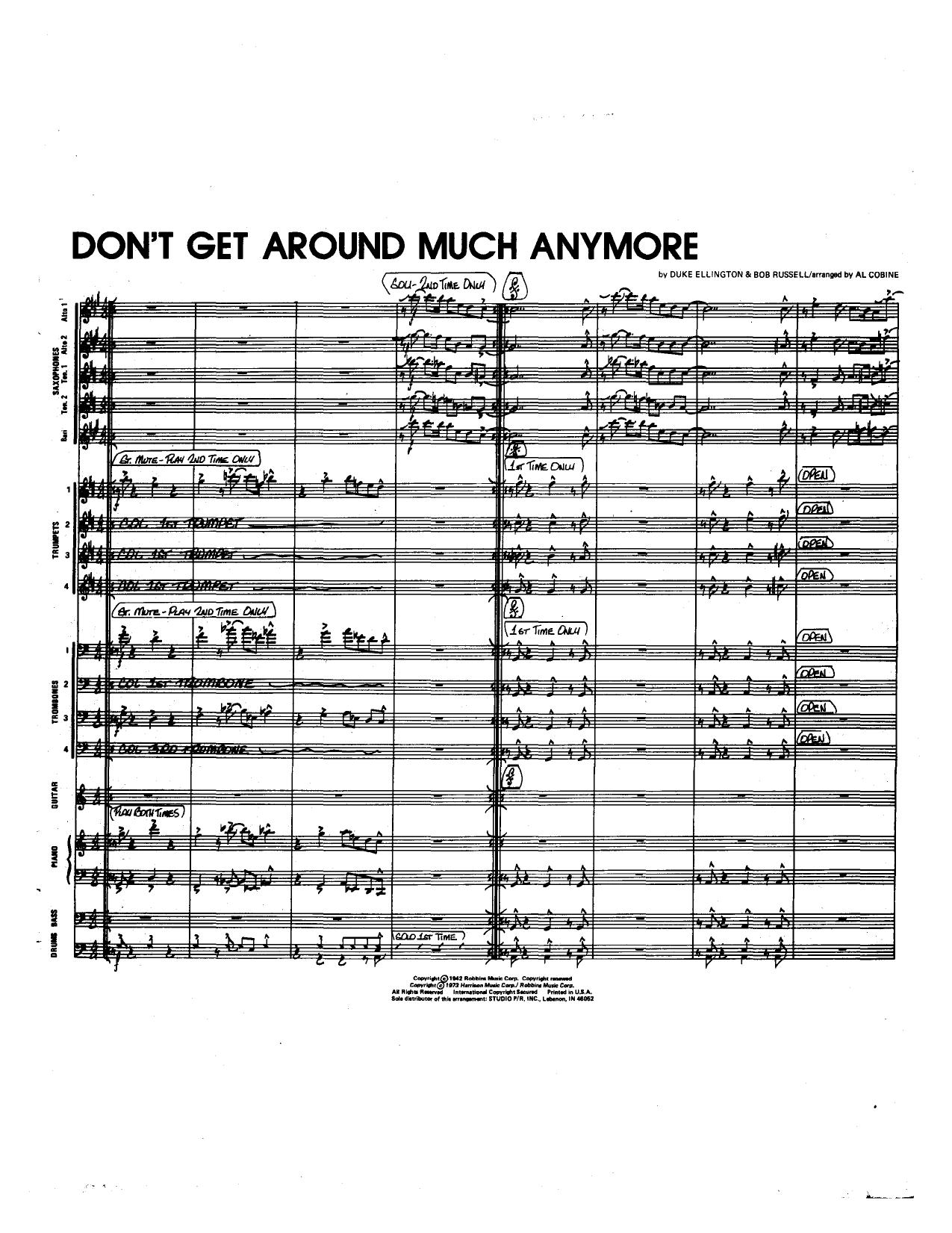
Don't Get Around Much Anymore (A.Cobine)
Composed by Duke Ellington
Arranged by A.Cobine
- Ensemble: Big Band
- Style: Jazz Standard
- Pages: 85
- Instruments (17): Alto Saxophone 1, Alto Saxophone 2, Tenor Saxophone 1, Tenor Saxophone 2, Baritone Saxophone, Trumpet 1, Trumpet 2, Trumpet 3, Trumpet 4, Trombone 1, Trombone 2, Trombone 3, Trombone 4, Piano, Bass, Drums, Guitar
- Difficulty: advanced
- Content: Individual Parts
- Format: PDF Download (Instant)
- Price: $24.99
Duke Ellington's "Don't Get Around Much Anymore," originally titled "Never No Lament" and composed in 1942, emerged as a quintessential piece from the Golden Age of Swing. This enduring jazz standard, with lyrics added by Bob Russell, became a massive hit for Ellington's orchestra, solidifying its place in the American Songbook. Its melancholic yet sophisticated melody and harmonic progression perfectly encapsulate the bittersweet sentiment of wartime separation and longing, resonating deeply with audiences and establishing it as a touchstone of the big band era. The tune's inherent swing feel, often delivered at a medium tempo, offers a canvas for both poignant melodic expression and the rhythmic drive characteristic of Ellington's innovative sound. A.Cobine's big band arrangement of this classic standard masterfully preserves the original's elegant charm while injecting contemporary vitality. Departing from a literal transcription, Cobine's treatment is a thoughtful reinterpretation, focusing on rich, nuanced voicings and dynamic contrasts that elevate the familiar melody. The arrangement opens with a sophisticated, harmonically dense introduction, immediately setting a refined mood. Throughout, listeners will discern Cobine's signature use of layered woodwind colors, often featuring intricate saxophone soli sections that weave complex melodic lines with remarkable clarity and balance. The brass sections are utilized with precision, providing both powerful punctuations and warm, sustained harmonies, avoiding overly bombastic gestures in favor of controlled power. This arrangement is structured to highlight various sections of the ensemble, ensuring engagement for all players. The melody is initially presented by the alto saxophone, offering a lyrical and expressive solo opportunity, before being taken up by the full saxophone section in a beautifully voiced soli. Later, the trumpet section takes a turn with a harmonized melodic statement, showcasing their blend and articulation. There are thoughtfully crafted solo opportunities for both tenor saxophone and trumpet, allowing for improvisational creativity within the arrangement's sophisticated framework. A.Cobine introduces subtle harmonic reharmonizations that add a fresh perspective without distorting the original's integrity, culminating in a powerful yet controlled shout chorus that builds to a satisfying, full-ensemble conclusion. Designed for a robust high school, college, or community big band, this arrangement offers both rewarding musicality and appropriate challenges. The technical demands are moderate, focusing more on ensemble blend, dynamic control, and accurate rhythmic interpretation rather than extreme ranges or rapid-fire technical passages. The 4/4 medium swing feel requires a solid rhythmic foundation and a nuanced understanding of swing articulation. Performing this piece is particularly rewarding for its ability to develop a band's sense of lyrical phrasing and harmonic awareness, making it an excellent choice for concert programs seeking a blend of historical reverence and fresh interpretation. This arrangement thrives on a relaxed, authentic medium swing feel at approximately quarter note = 120-128 BPM. Conductors should emphasize a consistent rhythmic pulse from the rhythm section, particularly the walking bass line and a light, articulate ride cymbal pattern. Key technical challenges include achieving precise balance and blend within the saxophone soli sections, where intricate voicings require careful listening across the section. The brass should focus on warm, sustained tones in harmonized passages and crisp, unified articulation in rhythmic figures, utilizing plunger mutes where indicated for authentic period color. Dynamic contrasts are crucial; observe the marked crescendos and decrescendos to build tension and release effectively. Rehearsal time should be dedicated to shaping the lyrical phrases, ensuring the melody always sings above the accompaniment, and allowing soloists ample space to develop their improvisations within the arrangement's harmonic context. Q: What instruments are included in this arrangement? A: This big band arrangement includes parts for 17 instruments: Alto Saxophone 1, Alto Saxophone 2, Tenor Saxophone 1, Tenor Saxophone 2, Baritone Saxophone, Trumpet 1, Trumpet 2, Trumpet 3, Trumpet 4, Trombone 1, Trombone 2, Trombone 3, Trombone 4, Piano, Bass, Drums, and Guitar. Q: What is the difficulty level of this arrangement? A: This arrangement is rated as medium difficulty, suitable for advanced high school, college, community, or professional big bands. It requires solid ensemble playing, good intonation, and a nuanced understanding of swing articulation. Q: What is the musical style and historical context of "Don't Get Around Much Anymore"? A: "Don't Get Around Much Anymore" is a classic jazz standard from the Swing Era, composed by Duke Ellington in 1942. It embodies the sophisticated, melancholic, yet swinging character of big band jazz from that period. Q: What makes A.Cobine's arrangement of this standard unique? A: A.Cobine's arrangement is distinguished by its sophisticated voicings, intricate saxophone soli sections, subtle harmonic reharmonizations, and dynamic contrasts that offer a fresh, contemporary perspective while honoring the original's timeless elegance. Q: What is the typical performance duration and tempo for this piece? A: The typical performance duration for this arrangement is approximately 3.5 to 4.5 minutes, depending on the length of improvised solos. It is intended to be performed at a medium swing tempo, around quarter note = 120-128 BPM.
Questions and answers
- What is included in the Don't Get Around Much Anymore (A.Cobine) PDF?
- The verified current file contains a conductor score and individual parts across 85 pages.
- How many instruments or parts are listed for Don't Get Around Much Anymore (A.Cobine)?
- The verified instrumentation list contains 17 entries for this Big Band arrangement.
- Who is credited for Don't Get Around Much Anymore (A.Cobine)?
- Composer: Duke Ellington. Arranger: A.Cobine.
- What difficulty is listed for Don't Get Around Much Anymore (A.Cobine)?
- The verified difficulty level is advanced.
- What style is listed for Don't Get Around Much Anymore (A.Cobine)?
- The catalog lists the style as Jazz Standard.
- Can I preview Don't Get Around Much Anymore (A.Cobine) before buying?
- Yes. The product page provides a preview generated from the current PDF file.
- How is Don't Get Around Much Anymore (A.Cobine) delivered?
- After successful payment, the digital PDF is made available for download. The displayed price is $24.99.
Musicians Also Search For
Don't Get Around Much Anymore A.Cobine PDF • Don't Get Around Much Anymore A.Cobine sheet music • Don't Get Around Much Anymore arranged by A.Cobine • A.Cobine big band charts • A.Cobine jazz arrangements PDF • Don't Get Around Much Anymore Duke Ellington sheet music • Don't Get Around Much Anymore Duke Ellington big band arrangements • Duke Ellington big band charts • Don't Get Around Much Anymore big band arrangements • Don't Get Around Much Anymore big band PDF download • Don't Get Around Much Anymore jazz sheet music • big band sheet music download • Don't Get Around Much Anymore conductor score PDF • Don't Get Around Much Anymore individual parts download • Don't Get Around Much Anymore sheet music PDF • Don't Get Around Much Anymore Jazz Standard charts • Jazz Standard big band arrangements • buy Don't Get Around Much Anymore sheet music • download Don't Get Around Much Anymore PDF • Don't Get Around Much Anymore jazz charts • best A.Cobine big band arrangements • Duke Ellington arranged by A.Cobine • Don't Get Around Much Anymore printable sheet music • big band repertoire PDF