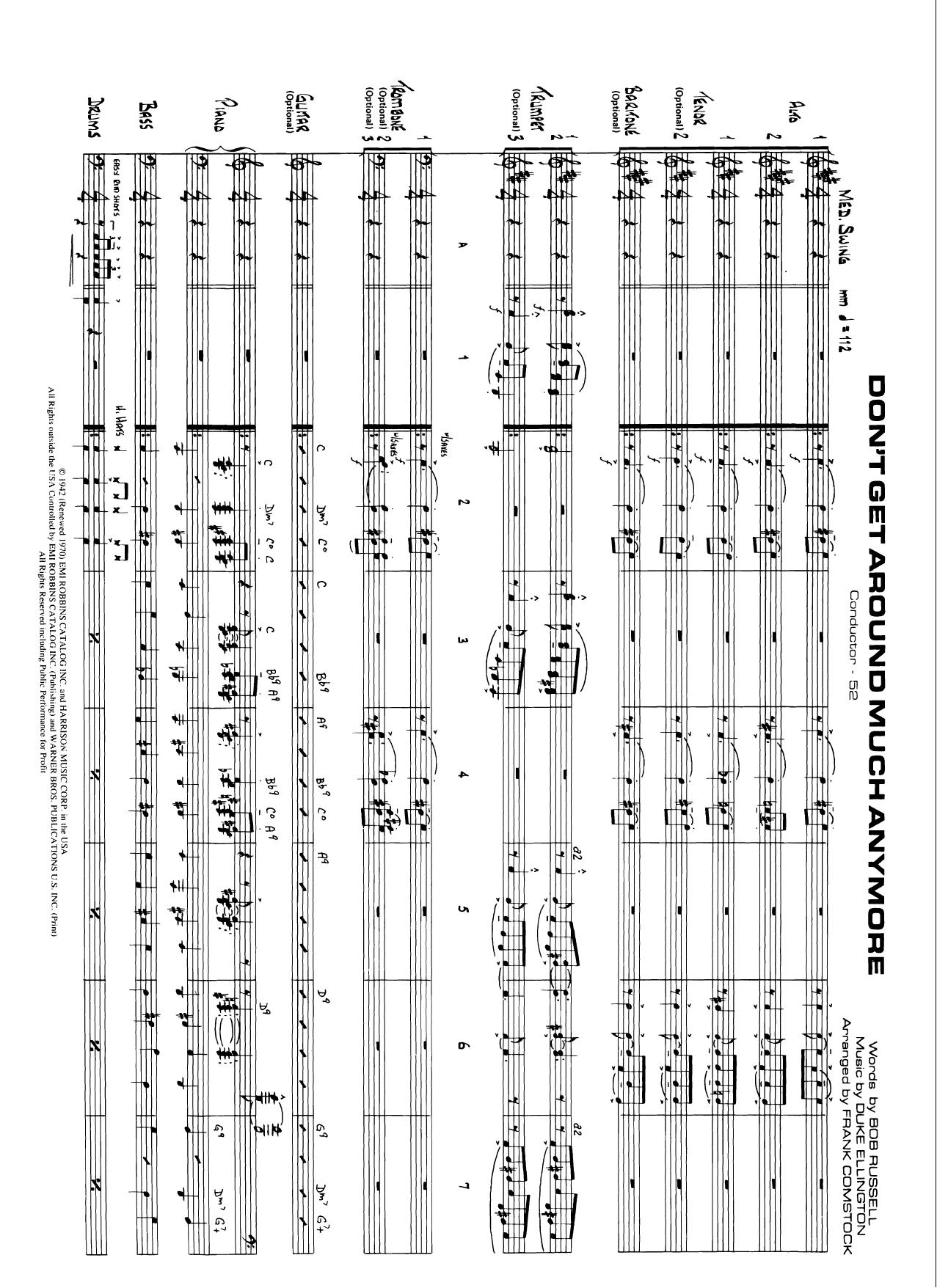
Don't Get Around Much Anymore (F.Comstock) sheet music preview

Don't Get Around Much Anymore (F.Comstock)

Composed by Duke Ellington

Arranged by Frank Comstock

  • Ensemble: Big Band
  • Pages: 22
  • Instruments (15): 1st Eb Alto Saxophone, 2nd Eb Alto Saxophone, 1st Bb Tenor Saxophone, 2nd Bb Tenor Saxophone, Eb Baritone Saxophone, 1st Bb Trumpet, 2nd Bb Trumpet, 3rd Bb Trumpet, 1st Trombone, 2nd Trombone, 3rd Trombone, Guitar, Piano, Bass, Drums
  • Difficulty: medium
  • Content: Individual Parts
  • Format: PDF Download (Instant)
  • Price: $24.99

Duke Ellington’s timeless 1940 composition "Don't Get Around Much Anymore"—originally titled "Never No Lament" before Bob Russell added lyrics in 1942—stands as one of the definitive pillars of the American Songbook and the swing era. Immortalized by Ellington’s orchestra and later transformed into a major hit by The Ink Spots, the tune bridges sophisticated Harlem stride-rooted harmonies with accessible, hook-driven popular appeal. Its melancholic yet resilient lyricism captures the bittersweet essence of urban isolation, making it an endlessly malleable vehicle for jazz interpreters across generations. Frank Comstock’s masterful big band adaptation injects a vibrant, polished mid-century studio vitality into Ellington’s classic framework. Set in a buoyant, driving medium-swing groove (4/4 time), the arrangement balances sophisticated West Coast cool restraint with traditional Kansas City-style drive. Comstock utilizes lush, extended brass voicings and intricate saxophone interjections that evoke his legendary work in television and radio orchestras. The mood shifts effortlessly from smoky, intimate dialogue between the rhythm section and lead horns to expansive, harmonically rich ensemble passages that ooze sophisticated 1950s elegance. Comstock structures the chart to highlight color and contrast across the 17-piece ensemble. The lead alto saxophone and muted trumpets frequently share melodic duties, establishing a classic, airy texture before handing off to tightly wound sax solis. Subtle counter-melodies in the trombones add harmonic depth without cluttering the canvas, while a tastefully structured solo section provides a featured soloist space to stretch out over standard changes. The arrangement builds toward a masterclass in dynamic control, avoiding a bombastic shout chorus in favor of a clever, buoyant collective interplay that showcases ensemble tightness and articulation precision. Advanced high school, collegiate, and professional community big bands will find this arrangement an ideal vehicle for developing subtle swing feel, section balance, and stylistic maturity. Because the technical demands rely less on blazing finger-busters and more on rhythmic placement, blend, and intonation, it serves as an exceptional tool for teaching stylistic phrasing. Conductors will appreciate how naturally the chart sits under the fingers of the players, rewarding meticulous attention to articulation, dynamic shading, and the subtle art of the backbeat. Achieving the authentic, buoyant feel of Frank Comstock’s writing requires strict attention to rhythmic placement and light, articulated tonguing. The tempo should remain a steady, confident medium swing; pushing the tempo too hard will strip the arrangement of its sophisticated swagger. Brass players should utilize cup or basket mutes where indicated to achieve that classic West Coast cool warmth, ensuring that muted lines blend rather than pierce the ensemble texture. Pay close attention to the dynamic markings in the sax soli; the lines must breathe together, treating eighth-note lines with a natural, triplet-based swing articulation (da-doo da-doo). The rhythm section plays a crucial role—the pianist should comp sparingly with tasteful rootless voicings, while the drummer maintains a feather-light ride cymbal pattern with crisp hi-hat chicks on beats two and four. Rehearsal should initially focus on sectional blend and intonation during the sustained harmonic pads before integrating the driving swing groove. Q: What instruments and parts are included in this big band arrangement? A: The arrangement is scored for a standard 17-piece big band instrumentation: Alto Sax 1, Alto Sax 2, Tenor Sax 1, Tenor Sax 2, Baritone Sax, 4 Trumpets, 4 Trombones, Guitar, Piano, Bass, and Drums, complete with a full 22-page score and part set. Q: What is the difficulty level of this Frank Comstock chart? A: This arrangement is graded as medium-advanced, making it well-suited for collegiate ensembles, advanced high school jazz bands, and professional community groups that excel at stylistic nuance and balance. Q: How does this arrangement fit into the broader jazz repertoire? A: It fuses Duke Ellington’s iconic 1940 swing-era melody with Frank Comstock’s sophisticated, mid-century arranging style, offering a brilliant bridge between classic big band swing and West Coast cool elegance. Q: What makes Frank Comstock’s treatment unique compared to other versions? A: Comstock avoids an overblown, aggressive shout chorus, opting instead for clever counter-melodies, lush extended harmonic voicings, and tightly woven sax solis that emphasize dynamic control and subtle ensemble interplay. Q: What is the recommended performance duration and tempo feel? A: The piece is performed at a comfortable medium-swing tempo (around 120–126 BPM) and typically runs between 3 and 4 minutes, depending on the length of the improvised solos.

Questions and answers

What is included in the Don't Get Around Much Anymore (F.Comstock) PDF?
The verified current file contains a conductor score and individual parts across 22 pages.
How many instruments or parts are listed for Don't Get Around Much Anymore (F.Comstock)?
The verified instrumentation list contains 15 entries for this Big Band arrangement.
Who is credited for Don't Get Around Much Anymore (F.Comstock)?
Composer: Duke Ellington. Arranger: Frank Comstock.
What difficulty is listed for Don't Get Around Much Anymore (F.Comstock)?
The verified difficulty level is medium.
Can I preview Don't Get Around Much Anymore (F.Comstock) before buying?
Yes. The product page provides a preview generated from the current PDF file.
How is Don't Get Around Much Anymore (F.Comstock) delivered?
After successful payment, the digital PDF is made available for download. The displayed price is $24.99.

Musicians Also Search For

Don't Get Around Much Anymore Frank Comstock PDFDon't Get Around Much Anymore Frank Comstock sheet musicDon't Get Around Much Anymore arranged by Frank ComstockFrank Comstock big band chartsFrank Comstock jazz arrangements PDFDon't Get Around Much Anymore Duke Ellington sheet musicDon't Get Around Much Anymore Duke Ellington big band arrangementsDuke Ellington big band chartsDon't Get Around Much Anymore big band arrangementsDon't Get Around Much Anymore big band PDF downloadDon't Get Around Much Anymore jazz sheet musicbig band sheet music downloadDon't Get Around Much Anymore conductor score PDFDon't Get Around Much Anymore individual parts downloadDon't Get Around Much Anymore sheet music PDFbuy Don't Get Around Much Anymore sheet musicdownload Don't Get Around Much Anymore PDFDon't Get Around Much Anymore jazz chartsbest Frank Comstock big band arrangementsDuke Ellington arranged by Frank ComstockDon't Get Around Much Anymore printable sheet musicbig band repertoire PDF

All arrangements by Frank Comstock All Duke Ellington sheet music