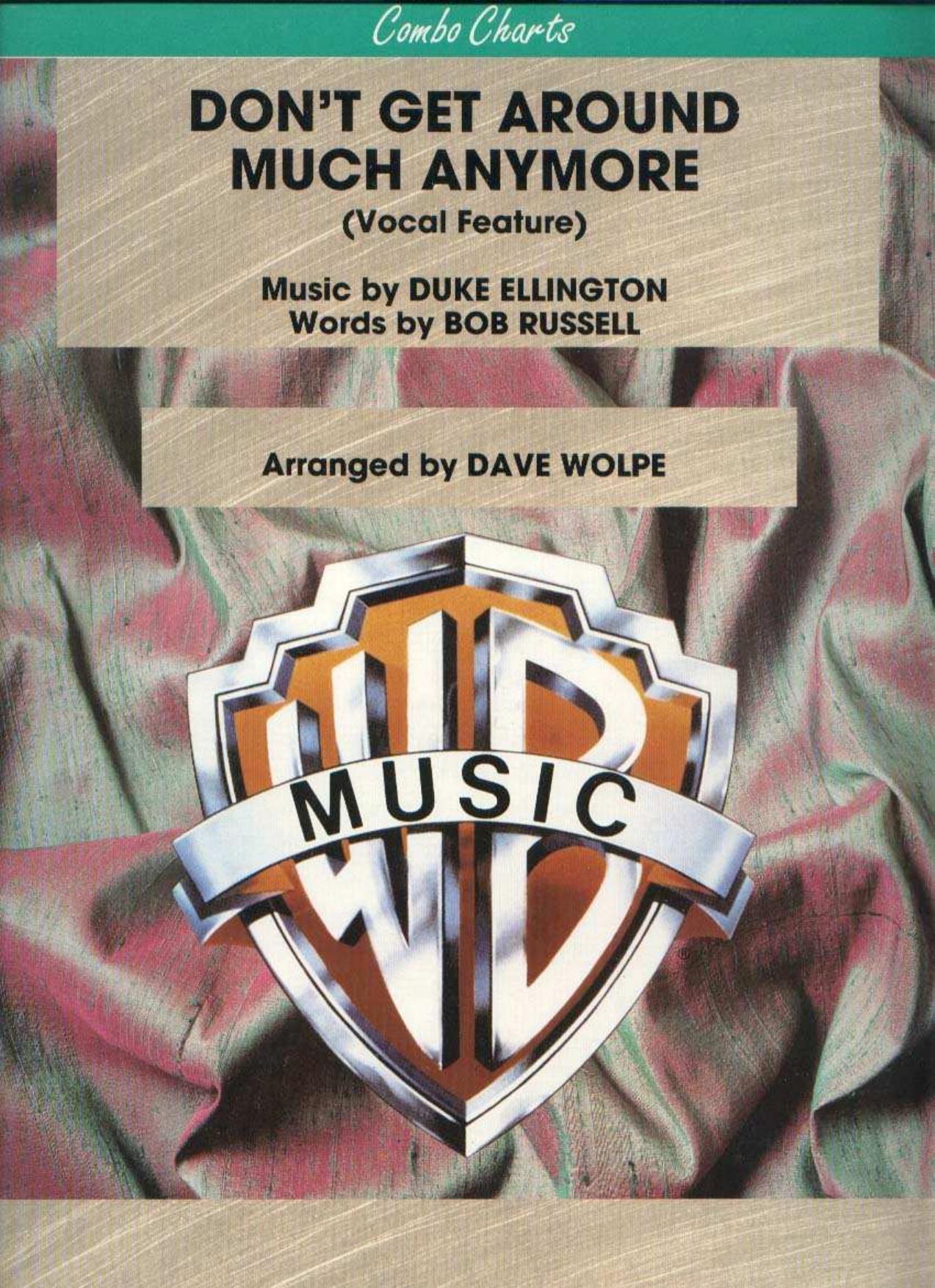
Don't Get Around Much Anymore (arr Dave Wolpe ) sheet music preview

Don't Get Around Much Anymore (arr Dave Wolpe )

Composed by Duke Ellington

Arranged by Dave Wolpe

  • Ensemble: Big Band
  • Pages: 33
  • Instruments (14): Conductor, Bb Trumpet (Part I), Eb Alto Saxophone (Part II), Bb Tenor Saxophone (Part III), Trombone (Part IV), Piano, Guitar, Bass, Drums, Vocal Solo, Solo Bb Tenor Saxophone (Substitute for Vocal), Bb Tenor Saxophone (Part IV - Substitute for Trombone), Trombone (Part III - Substitute for Tenor), Bb Trumpet (Part II - Substitute for Alto)
  • Difficulty: medium
  • Content: Individual Parts
  • Format: PDF Download (Instant)
  • Price: $24.99

Duke Ellington’s timeless 1940 composition, originally penned as an instrumental titled "Never No Lament" before Bob Russell added lyrics in 1942, stands as a towering pillar of the Great American Songbook. Immortalized by Ellington’s orchestra and later by vocal and instrumental icons alike, the tune epitomizes the sophisticated swing era aesthetic developed at Harlem's Cotton Club and refined on international stages. Its harmonic sophistication—blending blues-inflected voicings with rich, extended chord structures—captures the bittersweet longing of a former socialite who prefers staying home, a narrative weight that translates brilliantly into instrumental jazz ensemble writing. Dave Wolpe’s masterwork big band arrangement breathes fresh life into this classic standard through a quintessential medium-swing groove that swings effortlessly right from the downbeat. Operating at a comfortable yet driving tempo, the chart opens with a sultry, understated introduction before settling into a relaxed, pocket-driven 4/4 feel. The mood oscillates between playful urban sophistication and sultry, late-night nostalgia. Wolpe avoids overcomplicating the time-tested melody, instead utilizing clever dynamic shifts and lush sectional writing to evoke the sophisticated, brass-warm ambiance of a 1940s supper club while maintaining an energetic, modern rhythmic drive. Renowned for his idiomatic, highly playable writing for scholastic and professional ensembles alike, Wolpe constructs an arrangement that balances accessibility with rich harmonic color. The chart features tight, harmonized sax solis that pay homage to the classic Ellington reed sound while incorporating contemporary block-chord voicings. Brass writing is transparent and punchy, avoiding excessive endurance demands while still delivering impactful, roaring shout choruses that build organically. The rhythm section is given clear direction, with the piano part featuring authentic comping voicings that guide the harmonic movement, and the bass line walking a steady, foundational pulse that anchors the ensemble's collective time feel. Designed specifically for a flexible 7-instrument instrumentation (Alto Saxophone, Tenor Saxophone, Trumpet, Trombone, Piano, Bass, and Drums), this 33-page publication scales down the power of a full 17-piece big band without sacrificing harmonic density or textural variety. Solo opportunities are thoughtfully integrated, allowing featured horn players to stretch out over standard blues-derived changes. Advanced high school, community, and collegiate jazz ensembles will find this arrangement an exceptional vehicle for developing stylistic swing articulation, section blend, and micro-timing. It serves as a brilliant festival chart or a crowd-pleasing centerpiece for any standard jazz club performance. Achieving an authentic performance of this Dave Wolpe chart requires absolute precision with medium-swing eighth-note interpretation. The eighth notes must be swung loosely and naturally, avoiding both rigid straight-eighths and overly exaggerated dotted-eighth/sixteenth clichés. Conductors should emphasize the importance of lightweight, bouncing articulation in the rhythm section, ensuring the hi-hat explicitly drives beats two and four. Technically, the chart is accessible to intermediate players, but stylistic nuance is paramount. Saxophones must execute their soli sections with a unified concept of tone and breath support, blending vibrato smoothly across the section. Brass players should pay careful attention to dynamic markings, keeping background figures behind the soloists subservient to the lead melodic voice. Pay special attention to the dynamic peaks leading into the shout chorus; avoid overblowing, allowing Wolpe's natural orchestration to create the desired volume increase. Rehearsals should initially focus on locking the groove at a slightly slower tempo before bringing it up to performance speed, ensuring every syncopated line sits comfortably in the pocket. Q: What instruments and parts are included in this 33-page publication? A: This arrangement is scored for a 7-instrument ensemble comprising Alto Saxophone, Tenor Saxophone, Trumpet, Trombone, Piano, Bass, and Drums, complete with full score and individual instrument parts. Q: What is the difficulty level of this Dave Wolpe arrangement? A: It is moderately graded, making it exceptionally well-suited for advanced high school bands, collegiate smaller jazz ensembles, and community big bands looking for professional-sounding charts without extreme technical demands. Q: What is the musical style and historical background of the piece? A: Written by Duke Ellington in 1940 and given lyrics by Bob Russell in 1942, the piece is a foundational jazz standard presented here in a quintessential medium-swing big band style. Q: What makes this particular arrangement by Dave Wolpe unique? A: Wolpe expertly condenses the rich, sophisticated harmonic language of a full 17-piece big band into a tight 7-instrument setting, utilizing lush block-chord voicings, idiomatic horn solis, and punchy shout choruses. Q: What is the recommended performance tempo and duration? A: The chart is set in a comfortable medium-swing tempo (approx. 116–124 BPM) in 4/4 time, resulting in a standard performance duration of roughly 3 to 4 minutes depending on solo extensions.

Questions and answers

What is included in the Don't Get Around Much Anymore (arr Dave Wolpe ) PDF?
The verified current file contains a conductor score and individual parts across 33 pages.
How many instruments or parts are listed for Don't Get Around Much Anymore (arr Dave Wolpe )?
The verified instrumentation list contains 14 entries for this Big Band arrangement.
Who is credited for Don't Get Around Much Anymore (arr Dave Wolpe )?
Composer: Duke Ellington. Arranger: Dave Wolpe.
What difficulty is listed for Don't Get Around Much Anymore (arr Dave Wolpe )?
The verified difficulty level is medium.
Can I preview Don't Get Around Much Anymore (arr Dave Wolpe ) before buying?
Yes. The product page provides a preview generated from the current PDF file.
How is Don't Get Around Much Anymore (arr Dave Wolpe ) delivered?
After successful payment, the digital PDF is made available for download. The displayed price is $24.99.

Musicians Also Search For

Don't Get Around Much Anymore Dave Wolpe PDFDon't Get Around Much Anymore Dave Wolpe sheet musicDon't Get Around Much Anymore arranged by Dave WolpeDave Wolpe big band chartsDave Wolpe jazz arrangements PDFDon't Get Around Much Anymore Duke Ellington sheet musicDon't Get Around Much Anymore Duke Ellington big band arrangementsDuke Ellington big band chartsDon't Get Around Much Anymore big band arrangementsDon't Get Around Much Anymore big band PDF downloadDon't Get Around Much Anymore jazz sheet musicbig band sheet music downloadDon't Get Around Much Anymore conductor score PDFDon't Get Around Much Anymore individual parts downloadDon't Get Around Much Anymore sheet music PDFbuy Don't Get Around Much Anymore sheet musicdownload Don't Get Around Much Anymore PDFDon't Get Around Much Anymore jazz chartsbest Dave Wolpe big band arrangementsDuke Ellington arranged by Dave WolpeDon't Get Around Much Anymore printable sheet musicbig band repertoire PDF

All arrangements by Dave Wolpe All Duke Ellington sheet music