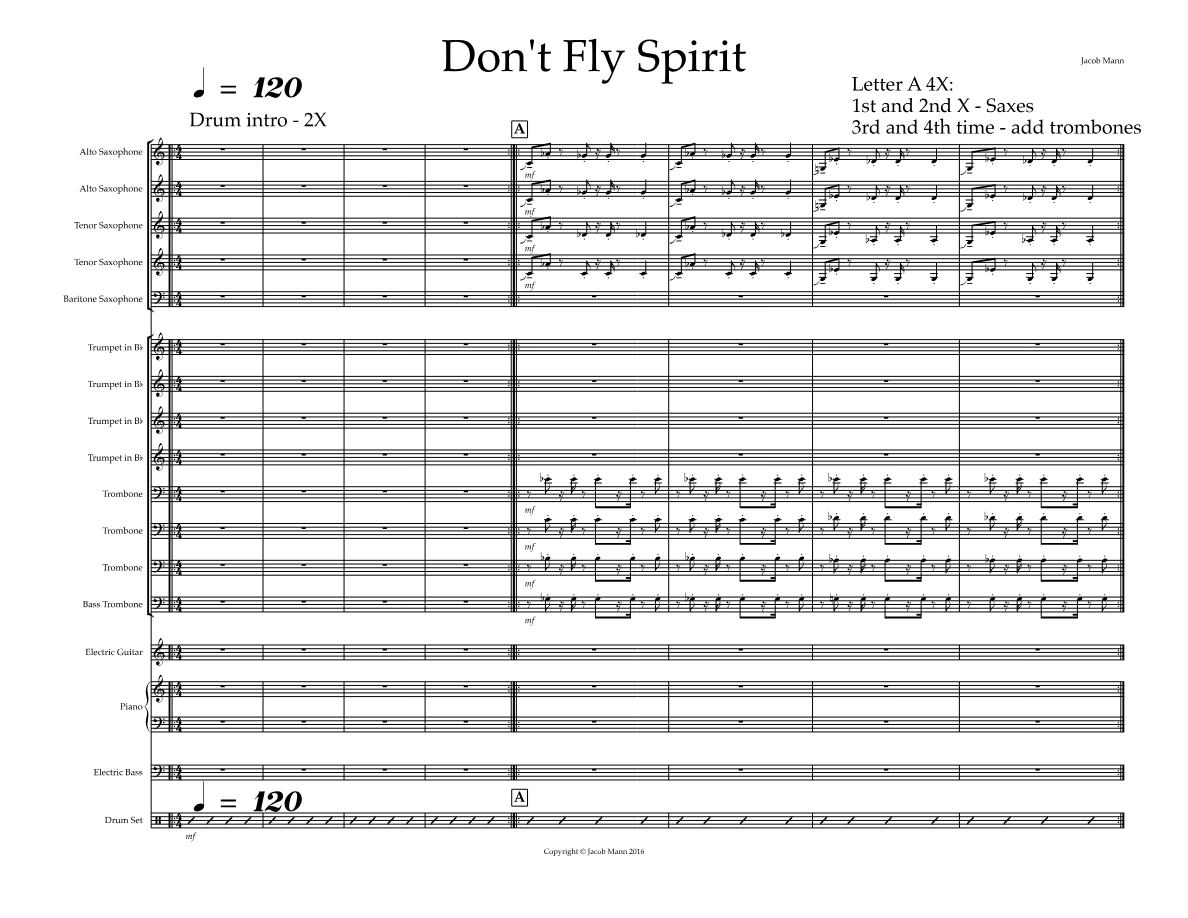
Don't Fly Spirit (J.Mann) sheet music preview

Don't Fly Spirit (J.Mann)

Composed by J. Mann

Arranged by J.Mann

  • Ensemble: Big Band
  • Style: Jazz Standard
  • Pages: 35
  • Instruments (17): Alto Saxophone 1, Alto Saxophone 2, Tenor Saxophone 1, Tenor Saxophone 2, Baritone Saxophone, Trumpet 1, Trumpet 2, Trumpet 3, Trumpet 4, Trombone 1, Trombone 2, Trombone 3, Bass Trombone, Electric Guitar, Piano, Electric Bass, Drum Set
  • Difficulty: medium
  • Content: Individual Parts
  • Format: PDF Download (Instant)
  • Price: $24.99

"Don't Fly Spirit" by J. Mann emerges as a vibrant, contemporary jazz standard, offering a refreshing take on the big band idiom while firmly rooted in the tradition of sophisticated swing. While not a historical composition in the traditional sense, its immediate appeal and robust melodic and harmonic structures position it as a modern classic, reflecting the evolution of jazz composition in the 21st century. J. Mann, both composer and arranger, crafts a piece that feels instantly familiar yet innovative, drawing inspiration from the dynamic energy of post-bop and the intricate voicings of modern big band writing. The piece embodies a medium-up swing feel, typically around 160-180 BPM, characterized by its infectious groove and an underlying sense of joyful urgency. Its primary key of F major provides a bright, accessible tonal center, though it navigates through several engaging harmonic landscapes. The musical character of "Don't Fly Spirit" is defined by its clever interplay between sections and its driving rhythmic pulse. The opening statement features a unison melody carried by the saxophone section, immediately establishing the piece's memorable theme. This quickly gives way to layered voicings across the brass and saxes, showcasing Mann's penchant for rich, extended harmonies that maintain clarity and forward motion. The mood is generally ebullient and optimistic, evoking the feeling of a spirited journey or an exhilarating musical conversation. There's an undeniable sense of momentum throughout, propelled by a walking bass line and a swinging drum pattern that provides a solid, unwavering foundation. J. Mann's arranging approach is distinctive for its intelligent use of counterpoint and its ability to build intensity organically. Expect tightly voiced saxophone soli sections that demand precision and blend, contrasted with powerful brass punches that punctuate the melodic lines. A hallmark of Mann's style is the strategic use of call-and-response between instrument families, creating a dynamic dialogue that keeps both performers and listeners engaged. The arrangement features several prominent solo sections, typically for tenor saxophone and trumpet, allowing improvisers ample space over a sophisticated, yet grooving, harmonic progression. The shout chorus is a particular highlight, building to a thrilling climax with full ensemble voicings and rhythmic unison figures that are both challenging and incredibly rewarding to execute. Performing "Don't Fly Spirit" offers a rewarding experience for a wide range of ensembles. The technical demands are significant, particularly in the saxophone soli passages and the precise articulation required across the brass section. However, the clarity of the writing and the compelling musical narrative make these challenges surmountable for a dedicated college or advanced community big band, and it would be a stellar addition to a professional ensemble's repertoire. The piece rewards meticulous attention to dynamics, blend, and rhythmic accuracy, culminating in a powerful and cohesive performance. Specific moments, such as the unexpected harmonic shifts in the bridge sections and the exhilarating final chorus, stand out as particularly impactful. "Don't Fly Spirit" thrives on a consistent, driving medium-up swing feel (quarter note = 160-180 BPM). Emphasize a light, articulate approach in the saxophone soli sections, ensuring precise rhythmic alignment and blend. Brass players should focus on strong, unified attacks and releases, particularly in the shout chorus, utilizing a bright, controlled tone. No special techniques like plungers or doits are explicitly notated, but tasteful falls and scoops can be added by individual players to enhance the jazz aesthetic, especially in the trumpet and trombone sections. Rehearsal time should be dedicated to perfecting the ensemble's rhythmic precision, especially in the unison and harmonized figures, and balancing the intricate voicings to ensure harmonic clarity. Encourage soloists to embrace the energetic spirit of the piece, building their improvisations dynamically. Q: What instruments and parts are included in this arrangement? A: This big band arrangement includes parts for 17 instruments: Alto Saxophone 1, Alto Saxophone 2, Tenor Saxophone 1, Tenor Saxophone 2, Baritone Saxophone, Trumpet 1, Trumpet 2, Trumpet 3, Trumpet 4, Trombone 1, Trombone 2, Trombone 3, Trombone 4, Piano, Bass, Drums, and Guitar. Q: What is the difficulty level of "Don't Fly Spirit (J.Mann)"? A: This arrangement is rated as advanced intermediate to advanced. It is suitable for college-level ensembles, advanced community big bands, and professional groups, requiring strong technical proficiency and rhythmic precision from all sections. Q: What is the musical style and historical context of this piece? A: "Don't Fly Spirit" is a contemporary jazz standard composed and arranged by J. Mann. It embodies a modern big band swing style, drawing influences from post-bop and contemporary jazz, reflecting current trends in jazz composition. Q: What makes J. Mann's arrangement of "Don't Fly Spirit" unique? A: J. Mann's arrangement is distinguished by its infectious medium-up swing groove, sophisticated extended harmonies, dynamic call-and-response between sections, and a powerful, well-constructed shout chorus that builds to an exciting climax. Q: What is the typical performance duration or tempo for this piece? A: The typical performance duration for "Don't Fly Spirit" is approximately 4-5 minutes, depending on the length of the improvised solos. It is designed to be performed at a medium-up swing tempo, generally between 160-180 beats per minute.

Musicians Also Search For

Don't Fly Spirit J.Mann PDFDon't Fly Spirit J.Mann sheet musicDon't Fly Spirit arranged by J.MannJ.Mann big band chartsJ.Mann jazz arrangements PDFDon't Fly Spirit J. Mann sheet musicDon't Fly Spirit J. Mann big band arrangementJ. Mann big band chartsDon't Fly Spirit big band arrangementDon't Fly Spirit big band PDF downloadDon't Fly Spirit jazz ensemble sheet musicbig band sheet music instant downloadDon't Fly Spirit individual parts downloadDon't Fly Spirit sheet music with partsDon't Fly Spirit Jazz Standard chartJazz Standard big band arrangementsbuy Don't Fly Spirit sheet music onlinedownload Don't Fly Spirit PDFDon't Fly Spirit jazz chartbest J.Mann big band arrangementsJ. Mann songs arranged by J.MannDon't Fly Spirit printable sheet musicbig band repertoire PDF

All arrangements by J.Mann All J. Mann sheet music