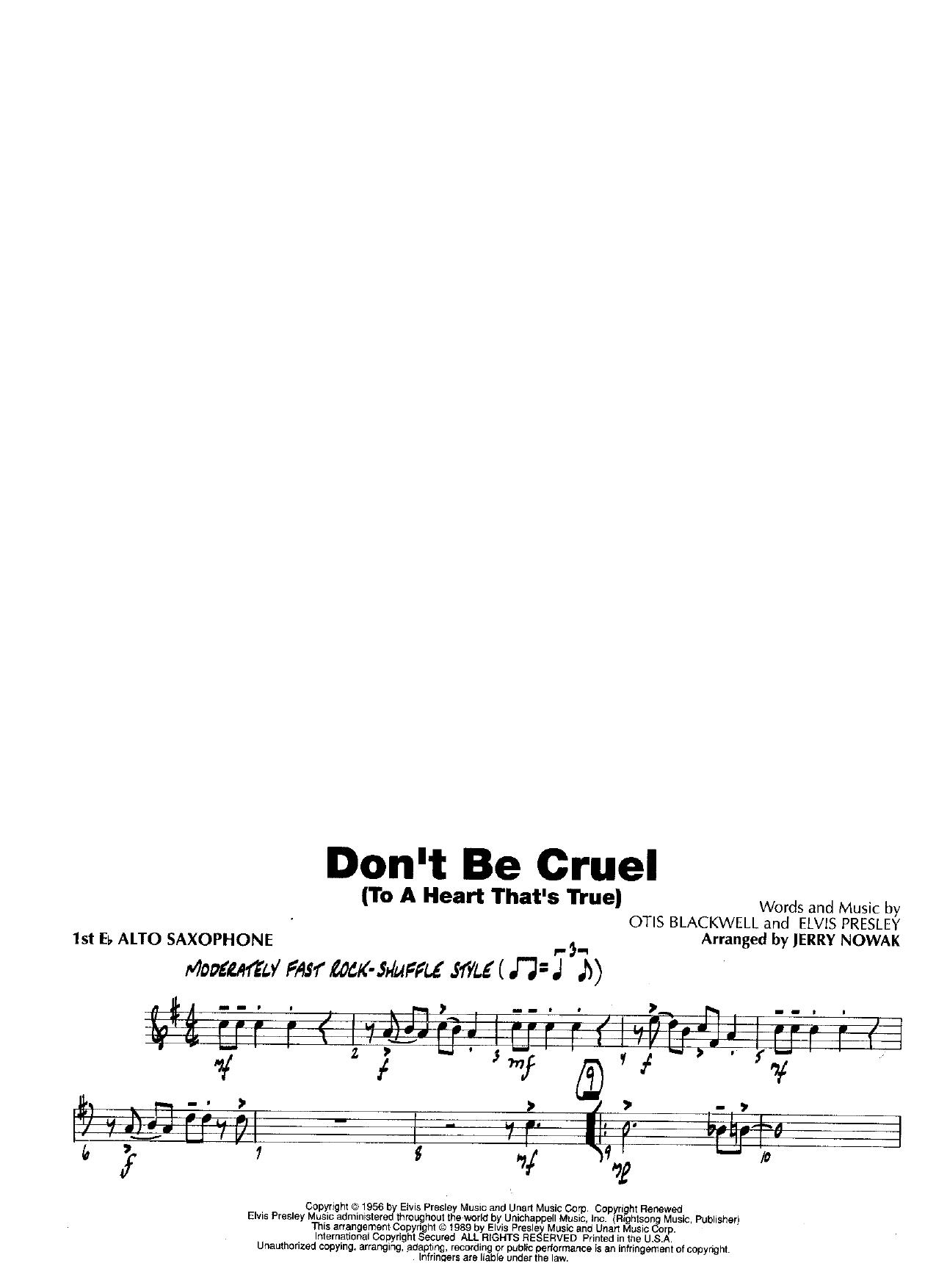
Don't Be Cruel (J.Nowak) sheet music preview

Don't Be Cruel (J.Nowak)

Composed by Otis Blackwell

Arranged by Jerry Nowak

  • Ensemble: Big Band
  • Pages: 38
  • Instruments (14): 1st Eb Alto Saxophone, 2nd Eb Alto Saxophone, 1st Bb Tenor Saxophone, 2nd Bb Tenor Saxophone, Eb Baritone Saxophone, 1st Bb Trumpet, 2nd Bb Trumpet, 3rd Bb Trumpet, 1st Trombone, 2nd Trombone, 3rd Trombone, Piano, Guitar, Drums
  • Difficulty: medium
  • Content: Individual Parts
  • Format: PDF Download (Instant)
  • Price: $24.99

Originally crafted by songwriter Otis Blackwell and catapulted into global pop and rhythm-and-blues history by Elvis Presley in 1956, "Don't Be Cruel" represents a cornerstone crossover moment where mid-century rhythm and blues heavily influenced mainstream American consciousness. While born from the energetic, driving bedrock of early rock and roll, the composition’s infectious syncopated groove, blues-infused chord progressions, and memorable melodic hooks made it an instant target for jazz interpretation. Over the decades, the tune transitioned seamlessly into the jazz and swing vernacular, celebrated for its structural adaptability and inherent rhythmic vitality. Jerry Nowak’s big band treatment recontextualizes this mid-century classic with a vibrant medium-swing feel, anchored by a steady, buoyant walking bassline and crisp backbeat dynamics. The chart captures an upbeat, approachable mood characterized by bright brass stabs, playful saxophone interplay, and an infectious, foot-tapping energy. Nowak expertly balances nostalgic rock-and-roll flavor with sophisticated big band voicings, creating a buoyant sonic landscape that evokes the celebratory atmosphere of a 1950s dance hall infused with modern jazz club sophistication. Known for his pedagogical mastery and intuitive understanding of ensemble capabilities, Nowak constructs an arrangement that is both educational and deeply satisfying to execute. The chart utilizes accessible yet rich harmonic extensions, clever section cross-cuing, and tight, interlocking ensemble solis that allow developing sections to sound remarkably mature. Rather than relying on sprawling, virtuosic improvisational spaces, Nowak distributes thematic material democratically across the ensemble, ensuring that the rhythm section, brass, and reeds all share active roles in driving the narrative forward. Performance-wise, the melody is introduced cleanly by the saxophones before opening up into full-ensemble shout sections that demand precise articulation and balanced dynamics. While flexible enough to accommodate open solo changes for featured horn players, the arrangement places its primary emphasis on ensemble cohesion, style, and rhythmic precision. High school, community, and collegiate big bands will find this chart exceptionally rewarding; it provides a fantastic vehicle for teaching young musicians how to swing hard within a familiar stylistic framework without getting bogged down by overly dense, modern harmonic complexities. Success with this arrangement hinges on maintaining an authentic, relaxed medium-swing feel without letting the tempo drag or rush. Aim for a steady quarter-note pulse around 120–124 BPM, ensuring that eighth notes are properly swung with natural triplet phrasing rather than played as straight eighths. The primary technical challenge lies in the crisp execution of syncopated accents between the brass and reed sections. Conductor focus should be placed on clean cut-offs and uniform articulation—especially on short, accented notes and dynamic swells. Ensure the rhythm section establishes a driving, unhurried groove: the bass player should focus on a quarter-note walking pattern with strong weight on beats two and four, while the drummer keeps a light, steady ride cymbal pattern complemented by a crisp hi-hat on the backbeats. Rehearsal should begin by section, isolating the call-and-response passages between the saxophones and brass to ensure stylistic unity. Pay close attention to dynamic markings; contrast the softer, conversational background figures with the punchy, full-ensemble shout choruses to maximize the chart's inherent theatrical impact. Q: What instruments and parts are included in this arrangement? A: This complete 38-page big band chart includes a full conductor score and 14 distinct instrumental parts: Alto Saxophone 1, Alto Saxophone 2, Tenor Saxophone 1, Tenor Saxophone 2, Baritone Saxophone, Trumpets 1 through 4, Trombones 1 through 3, Bass Trombone, Guitar, Piano, Bass, and Drums. Q: What is the difficulty level of this Jerry Nowak arrangement? A: This arrangement is graded as medium-easy (approximate difficulty level III), making it highly accessible for advanced middle school bands, high school jazz ensembles, and community big bands looking for rewarding repertoire. Q: What style and historical context does this piece represent? A: The piece adapts Otis Blackwell’s 1956 classic—famously recorded by Elvis Presley—into a buoyant, medium-swing big band jazz style that bridges early rock-and-roll idioms with traditional swing-era arranging techniques. Q: What makes this specific arrangement by Jerry Nowak unique? A: Nowak's treatment stands out for its clever educational design, utilizing tight section solis, accessible harmonic voicings, and shared melodic duties that allow developing bands to sound polished and professional without facing overwhelming technical hurdles. Q: What is the recommended performance tempo and duration? A: The arrangement is set at a comfortable medium-swing tempo (approximately 120–124 BPM) in 4/4 time, resulting in a performance duration of roughly 3 to 4 minutes depending on solo extensions.

Questions and answers

What is included in the Don't Be Cruel (J.Nowak) PDF?
The verified current file contains a conductor score and individual parts across 38 pages.
How many instruments or parts are listed for Don't Be Cruel (J.Nowak)?
The verified instrumentation list contains 14 entries for this Big Band arrangement.
Who is credited for Don't Be Cruel (J.Nowak)?
Composer: Otis Blackwell. Arranger: Jerry Nowak.
What difficulty is listed for Don't Be Cruel (J.Nowak)?
The verified difficulty level is medium.
Can I preview Don't Be Cruel (J.Nowak) before buying?
Yes. The product page provides a preview generated from the current PDF file.
How is Don't Be Cruel (J.Nowak) delivered?
After successful payment, the digital PDF is made available for download. The displayed price is $24.99.

Musicians Also Search For

Don't Be Cruel Jerry Nowak PDFDon't Be Cruel Jerry Nowak sheet musicDon't Be Cruel arranged by Jerry NowakJerry Nowak big band chartsJerry Nowak jazz arrangements PDFDon't Be Cruel Otis Blackwell sheet musicDon't Be Cruel Otis Blackwell big band arrangementsOtis Blackwell big band chartsDon't Be Cruel big band arrangementsDon't Be Cruel big band PDF downloadDon't Be Cruel jazz sheet musicbig band sheet music downloadDon't Be Cruel conductor score PDFDon't Be Cruel individual parts downloadDon't Be Cruel sheet music PDFbuy Don't Be Cruel sheet musicdownload Don't Be Cruel PDFDon't Be Cruel jazz chartsbest Jerry Nowak big band arrangementsOtis Blackwell arranged by Jerry NowakDon't Be Cruel printable sheet musicbig band repertoire PDF

All arrangements by Jerry Nowak All Otis Blackwell sheet music