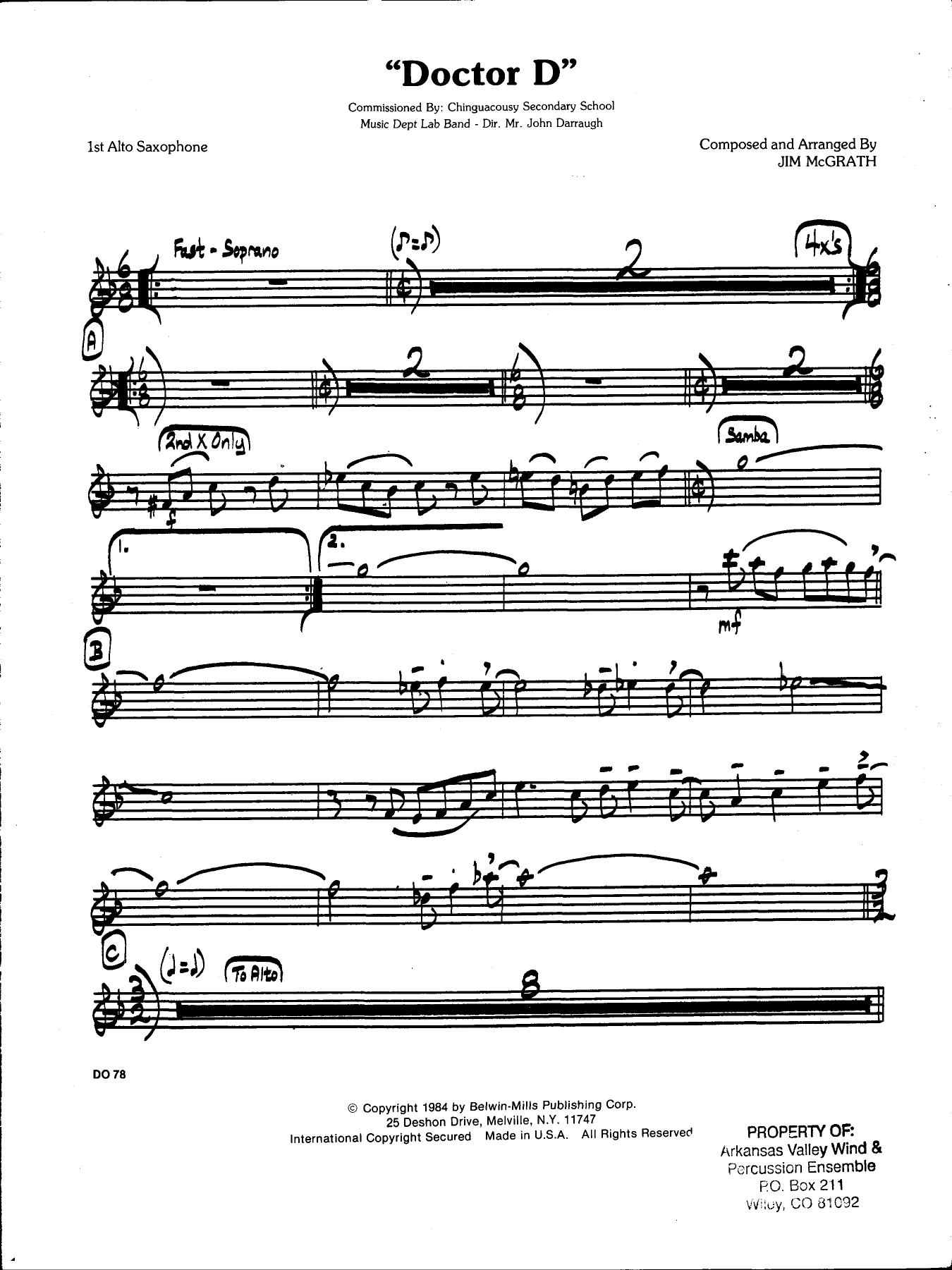
Doctor D (J.Mcgrath)
Composed by J.Mcgrath
Arranged by J.Mcgrath
- Ensemble: Big Band
- Style: Jazz Standard
- Pages: 74
- Instruments (18): 1st Alto Saxophone, 2nd Alto Saxophone, 1st Tenor Saxophone, 2nd Tenor Saxophone, Baritone Saxophone, 1st Trumpet, 2nd Trumpet, 3rd Trumpet, 4th Trumpet, 5th Trumpet, 1st Trombone, 2nd Trombone, 3rd Trombone, 4th Trombone, Bass, Drums, Piano, Guitar
- Difficulty: advanced
- Content: Individual Parts
- Format: PDF Download (Instant)
- Price: $24.99
"Doctor D (J.Mcgrath)" is a vibrant big band arrangement that reimagines the spirit of a foundational jazz standard, paying homage to the infectious energy of early 20th-century jazz while infusing it with contemporary big band sophistication. The original composition, "Doctor Jazz," was penned by the legendary Joe "King" Oliver in 1926, a pivotal year in the burgeoning jazz scene. This piece emerged from the heart of the New Orleans jazz era, a period characterized by collective improvisation, syncopated rhythms, and a joyous, unrestrained musical expression. "Doctor Jazz" quickly became a staple, celebrated for its uplifting lyrics that metaphorically call upon "Doctor Jazz" to cure the blues and inspire dancing. It was famously recorded by Jelly Roll Morton and his Red Hot Peppers, showcasing intricate counterpoint and innovative stop-time breaks, solidifying its place as a quintessential example of New Orleans jazz. Louis Armstrong's later recording in 1959 further cemented its status as an enduring jazz classic. J.Mcgrath's arrangement of "Doctor D" captures the essence of this historical context, translating the effervescent mood of the original into a dynamic big band setting. While the specific key is not provided, the arrangement is crafted to evoke a medium-up swing feel, maintaining the original's infectious rhythmic drive. The musical character is one of buoyant optimism and celebratory swing, designed to get audiences tapping their feet. Expect bright, articulate brass figures, harmonically rich saxophone soli sections, and a driving rhythm section that propels the piece forward with relentless energy. The arrangement likely features extended harmonies and sophisticated voicings typical of modern big band writing, expanding upon the traditional Dixieland roots of the original. J.Mcgrath, a distinguished Canadian composer and arranger known for his extensive work across film, television, and concert stages, brings a distinctive touch to this arrangement. His approach typically involves meticulous attention to detail, crafting intricate ensemble passages that showcase the full power and versatility of the big band. In "Doctor D," this translates to carefully constructed soli sections for the saxophones and brass, often building to powerful shout choruses that are both harmonically inventive and rhythmically compelling. The arrangement is designed to highlight individual sections while maintaining a cohesive and powerful ensemble sound. Technical challenges will include precise articulation in the fast-paced swing sections, dynamic control across the full range of the ensemble, and the ability to navigate complex harmonic progressions. Featured solo sections provide opportunities for improvisation, allowing individual musicians to express themselves within the established framework of the arrangement. This arrangement is suitable for advanced high school, college, community, and professional big bands. Its demanding ensemble passages and solo opportunities make it an excellent vehicle for developing technical proficiency and stylistic authenticity. The rewarding experience of performing "Doctor D" lies in its ability to transport both musicians and audience to the heart of jazz's vibrant history, while simultaneously engaging with a fresh, contemporary big band interpretation. The piece's inherent joy and the arranger's skillful craftsmanship combine to create a memorable and impactful performance. "Doctor D" thrives on a consistent, driving medium-up swing feel, typically around 160-180 BPM. Conductors should emphasize a light, buoyant eighth-note feel from the rhythm section to avoid a heavy or plodding execution. Key technical challenges include crisp articulation in the brass, particularly during the fast soli sections, and maintaining blend and balance within the saxophone section's intricate voicings. Rehearsal time should be dedicated to isolating these soli passages, ensuring rhythmic precision and harmonic clarity. Dynamic contrasts are crucial; encourage brass players to utilize plunger mutes where indicated for textural variety and expressive effect. The rhythm section should focus on a tight groove, with the bass and drums providing a solid foundation while the piano and guitar offer rhythmic and harmonic support without overpowering the ensemble. Soloists should be encouraged to study the harmonic structure thoroughly to deliver informed and engaging improvisations. **Q: What instruments are included in this arrangement?** A: This big band arrangement of "Doctor D" includes parts for 18 instruments: Alto Saxophone 1, Alto Saxophone 2, Tenor Saxophone 1, Tenor Saxophone 2, Baritone Saxophone, Trumpet 1, Trumpet 2, Trumpet 3, Trumpet 4, Trombone 1, Trombone 2, Trombone 3, Trombone 4, Piano, Bass, Drums, Guitar, and Auxiliary Percussion. **Q: What is the difficulty level of this arrangement?** A: This arrangement is considered advanced, suitable for experienced high school, college, community, and professional big bands due to its intricate voicings, demanding technical passages, and requirements for stylistic nuance. **Q: What is the musical style and historical context of "Doctor D"?** A: "Doctor D" is a big band arrangement in the jazz standard style, based on the classic "Doctor Jazz" composed by Joe "King" Oliver in 1926. It embodies the joyous, swinging spirit of early New Orleans jazz, reinterpreted for a modern big band. **Q: What makes J.Mcgrath's arrangement of "Doctor D" unique?** A: J.Mcgrath's arrangement is unique for its sophisticated big band voicings, dynamic soli sections for both brass and saxophones, and powerful shout choruses. It blends the historical essence of the original "Doctor Jazz" with contemporary arranging techniques, offering both challenge and reward for performers. **Q: What is the typical performance duration or tempo for this piece?** A: "Doctor D" is designed to be performed at a medium-up swing tempo, typically ranging from 160-180 beats per minute. The exact duration will depend on the number and length of improvised solos, but a typical performance would be approximately 4-6 minutes.
Questions and answers
- What is included in the Doctor D (J.Mcgrath) PDF?
- The verified current file contains individual parts across 74 pages.
- How many instruments or parts are listed for Doctor D (J.Mcgrath)?
- The verified instrumentation list contains 18 entries for this Big Band arrangement.
- Who is credited for Doctor D (J.Mcgrath)?
- Composer: J.Mcgrath. Arranger: J.Mcgrath.
- What difficulty is listed for Doctor D (J.Mcgrath)?
- The verified difficulty level is advanced.
- What style is listed for Doctor D (J.Mcgrath)?
- The catalog lists the style as Jazz Standard.
- Can I preview Doctor D (J.Mcgrath) before buying?
- Yes. The product page provides a preview generated from the current PDF file.
- How is Doctor D (J.Mcgrath) delivered?
- After successful payment, the digital PDF is made available for download. The displayed price is $24.99.
Musicians Also Search For
Doctor D J.Mcgrath PDF • Doctor D J.Mcgrath sheet music • Doctor D arranged by J.Mcgrath • J.Mcgrath big band charts • J.Mcgrath jazz arrangements PDF • Doctor D J.Mcgrath big band arrangements • Doctor D big band arrangements • Doctor D big band PDF download • Doctor D jazz sheet music • big band sheet music download • Doctor D individual parts download • Doctor D sheet music PDF • Doctor D Jazz Standard charts • Jazz Standard big band arrangements • buy Doctor D sheet music • download Doctor D PDF • Doctor D jazz charts • best J.Mcgrath big band arrangements • Doctor D printable sheet music • big band repertoire PDF