Do-Re-Mi (T.Hoshide)
Composed by Richard Rodgers
Arranged by T.Hoshide
- Ensemble: Concert Band
- Style: Jazz Standard
- Pages: 10
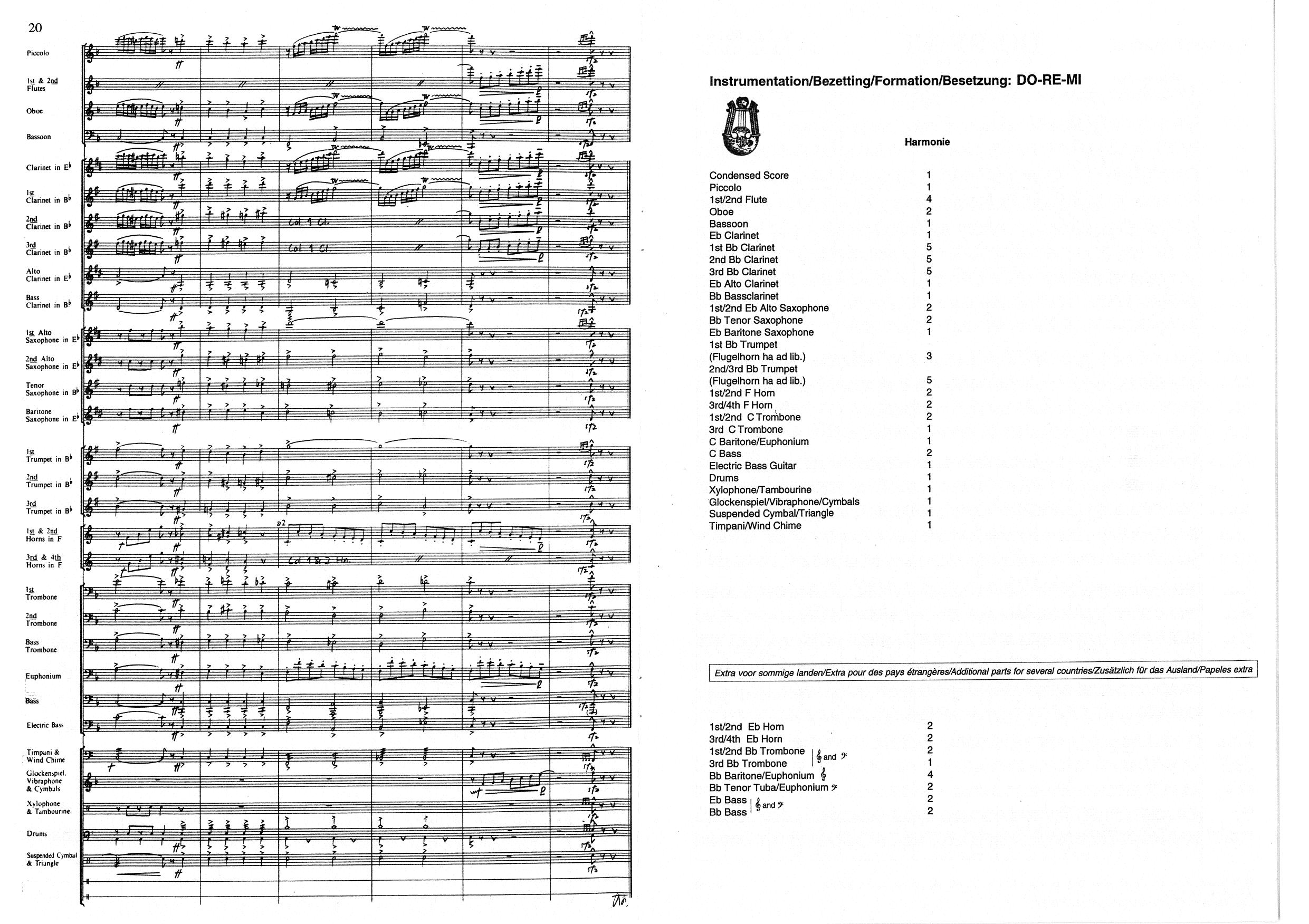
- Instruments (38): Piccolo, 1st Flute, 2nd Flute, Oboe, Bassoon, Eb Clarinet, 1st Bb Clarinet, 2nd Bb Clarinet, 3rd Bb Clarinet, Eb Alto Clarinet, Bb Bass Clarinet, 1st Eb Alto Saxophone, 2nd Eb Alto Saxophone, Bb Tenor Saxophone, Eb Baritone Saxophone, 1st Bb Trumpet, 2nd Bb Trumpet, 3rd Bb Trumpet, 1st Horn in F, 2nd Horn in F, 3rd Horn in F, 4th Horn in F, 1st Trombone, 2nd Trombone, Bass Trombone, Euphonium, Bass, Electric Bass, Timpani, Wind Chime, Glockenspiel, Vibraphone, Cymbals, Xylophone, Tambourine, Drums, Suspended Cymbal, Triangle
- Difficulty: easy
- Content: Individual Parts
- Format: PDF Download (Instant)
- Price: $22.99
Composed by Richard Rodgers with lyrics by Oscar Hammerstein II for the landmark 1959 Broadway musical *The Sound of Music*, "Do-Re-Mi" quickly transcended its theatrical origins to become a ubiquitous standard embraced by jazz artists, pop icons, and instrumental ensembles alike. The song's ingenious construction—featuring a syllabic scale association where every note pairs with a matching linguistic building block—presents an inherently catchy, modal framework that invites creative reharmonization. While immortalized on film through Julie Andrews’ buoyant Salzburg teaching montage, the tune's intrinsic melodic strength has made it a favorite canvas for jazz interpreters seeking a playful yet structurally robust vehicle for syncopated exploration. Takashi Hoshide’s inspired concert band adaptation reimagines this classic show tune through a sophisticated jazz-inflected lens, injecting vibrant swing grooves and contemporary wind-band textures into Rodgers’ timeless motifs. The arrangement moves briskly with an infectious, medium-swing pulse that balances buoyant syncopation with rich, expanded harmonies. Shifting gracefully between lush, cinematic scoring and crisp, driving big-band idioms, the mood transitions from cheerful nostalgia to sparkling, high-energy exuberance. Hoshide utilizes clever countermelodies and shifting instrumental colors to keep the thematic material fresh, ensuring that familiar phrases are heard through a revitalized, harmonically colorful harmonic vocabulary. Hoshide’s arranging style shines in the clever distribution of thematic material across the entire ensemble, avoiding monotony by constantly rotating textures between bright brass punches, warm saxophone solis, and fluttering woodwind embellishments. The arrangement incorporates snappy jazz articulations, articulate backbeats, and tastefully extended chords that evoke classic mid-century jazz orchestration adapted for modern wind instrumentation. Transition sections feature smooth modulation and rhythmic interjections that bridge playful melodic statements into robust ensemble climaxes, building toward a satisfyingly full-voiced shout chorus that highlights the percussive and harmonic capabilities of a well-balanced concert band. Intermediate-to-advanced ensembles (such as high school honor bands, university wind symphonies, and community concert bands) will find this chart wonderfully rewarding, as it offers a masterclass in style articulation without relying on overly prohibitive technical demands. The melody is shared democratically across sections, giving both woodwinds and brass a chance to lead, while targeted rhythmic figures challenge the ensemble to lock in tight, unified swing eighth notes. Providing an ideal balance of crowd-pleasing familiarity and artistic sophistication, this 20-page publication—complete with a comprehensive conductor score—serves as an exceptional change-of-pace concert opener, encore, or lighter programming centerpiece. Achieving an authentic jazz feel is paramount; conductors should ensure that all eighth notes are performed with a consistent, relaxed swing articulation rather than straight sixteenths or rigid classical subdivisions. Pay close attention to dynamic contrast, particularly during the transition from lush, lyrical rubato-style phrases into the strict tempo of the primary swing groove. Woodwinds must keep their rapid scalar passages light, clean, and detached to mirror the vocal agility of the original line, while the low brass and percussion maintain a steady, driving pulse on beats two and four. Articulation markings—such as accents, tenutos, and staccatos—must be rigorously enforced across all sections to capture the big-band stylistic vernacular embedded within Hoshide's scoring. Rehearsals should initially focus on sectional balance during the interlocking counterlines, ensuring that accompanying figures never obscure the primary melodic voice. Q: What instrumentation and parts are included in this publication? A: This arrangement is scored for a standard comprehensive concert band instrumentation, featuring complete woodwind, brass, and percussion parts alongside a 20-page full conductor score. Q: What is the difficulty level of this arrangement? A: It is designated as an intermediate-to-advanced work (approx. Grade 3.5 to 4), making it accessible to accomplished high school, university, and community concert bands. Q: What musical style and historical era does this piece represent? A: It bridges traditional American musical theater—originating from Rodgers and Hammerstein's 1959 production *The Sound of Music*—with a mid-century swing and jazz standard aesthetic. Q: What makes Takashi Hoshide’s treatment unique for concert band? A: Hoshide successfully marries traditional wind band scoring with authentic big-band jazz idioms, incorporating clever reharmonizations, vibrant countermelodies, and swinging rhythmic figures. Q: What is the approximate performance duration and tempo feel? A: The arrangement runs approximately 3 minutes and features a lively, upbeat medium-swing tempo feel designed to keep both performers and audiences thoroughly engaged.
Questions and answers
- What is included in the Do-Re-Mi (T.Hoshide) PDF?
- The verified current file contains a conductor score across 10 pages.
- How many instruments or parts are listed for Do-Re-Mi (T.Hoshide)?
- The verified instrumentation list contains 38 entries for this Concert Band arrangement.
- Who is credited for Do-Re-Mi (T.Hoshide)?
- Composer: Richard Rodgers. Arranger: T.Hoshide.
- What difficulty is listed for Do-Re-Mi (T.Hoshide)?
- The verified difficulty level is easy.
- What style is listed for Do-Re-Mi (T.Hoshide)?
- The catalog lists the style as Jazz Standard.
- Can I preview Do-Re-Mi (T.Hoshide) before buying?
- Yes. The product page provides a preview generated from the current PDF file.
- How is Do-Re-Mi (T.Hoshide) delivered?
- After successful payment, the digital PDF is made available for download. The displayed price is $22.99.
Musicians Also Search For
Do-Re-Mi T.Hoshide PDF • Do-Re-Mi T.Hoshide sheet music • Do-Re-Mi arranged by T.Hoshide • T.Hoshide concert band charts • T.Hoshide jazz arrangements PDF • Do-Re-Mi Richard Rodgers sheet music • Do-Re-Mi Richard Rodgers concert band arrangements • Richard Rodgers concert band charts • Do-Re-Mi concert band arrangements • Do-Re-Mi concert band PDF download • Do-Re-Mi jazz sheet music • concert band sheet music download • Do-Re-Mi conductor score PDF • Do-Re-Mi sheet music PDF • Do-Re-Mi Jazz Standard charts • Jazz Standard concert band arrangements • buy Do-Re-Mi sheet music • download Do-Re-Mi PDF • Do-Re-Mi jazz charts • best T.Hoshide concert band arrangements • Richard Rodgers arranged by T.Hoshide • Do-Re-Mi printable sheet music • concert band repertoire PDF