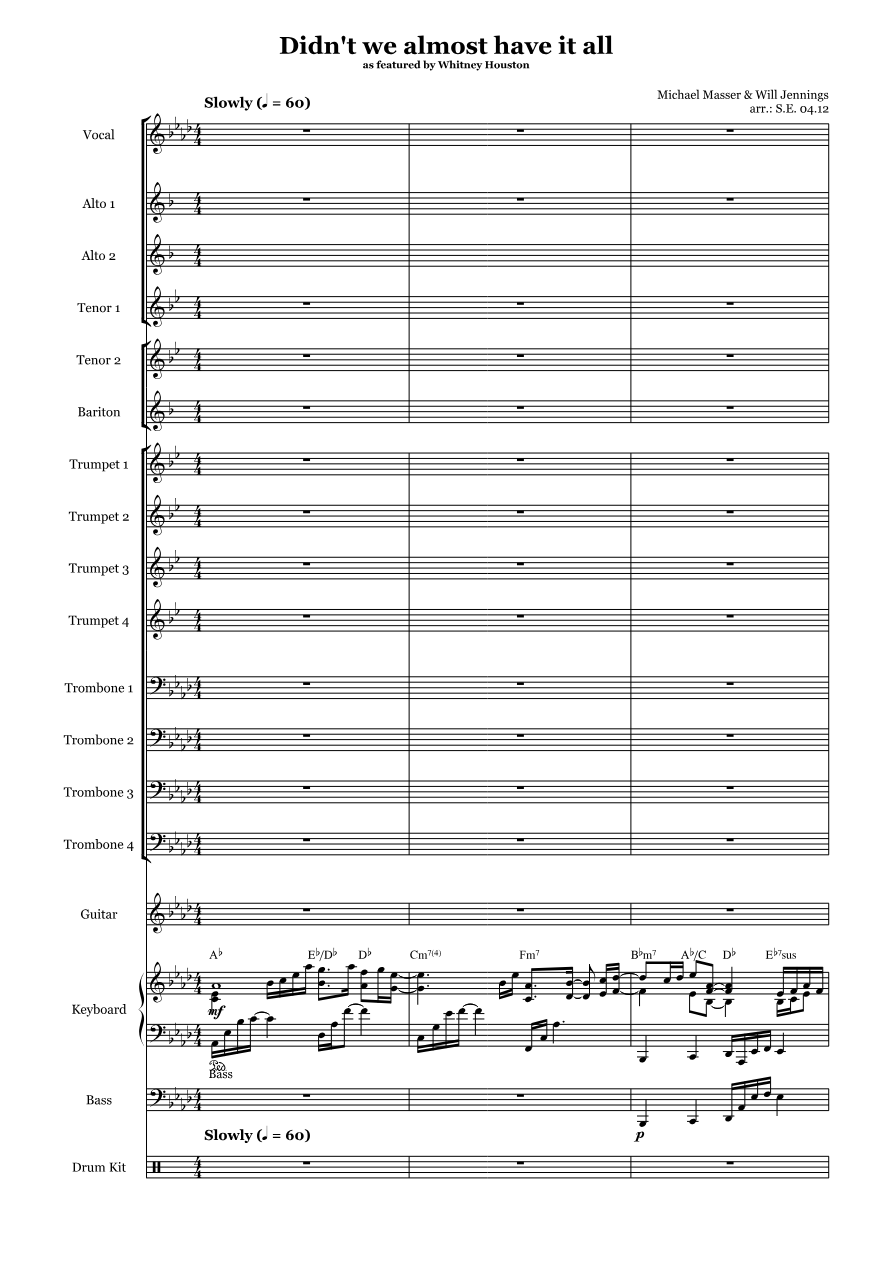
Didn't We Almost Have It All (W.Houston) sheet music preview

Didn't We Almost Have It All (W.Houston)

Composed by Michael Masser

Arranged by W.Houston

  • Ensemble: Big Band Vocal
  • Style: Jazz Standard
  • Pages: 65
  • Difficulty: advanced
  • Content: Sheet Music
  • Format: PDF Download (Instant)
  • Price: $24.99

"Didn't We Almost Have It All," originally composed by Michael Masser, soared to international fame through Whitney Houston's iconic 1987 rendition on her album *Whitney*. This power ballad, a quintessential representation of late 1980s pop and R&B, quickly became a global hit, showcasing Houston's unparalleled vocal prowess and solidifying its place as a contemporary classic. While rooted in pop, its sophisticated harmonic progressions and deeply emotional lyrical content have long made it ripe for jazz interpretation, allowing it to transcend its original genre and find a new life within the jazz standard repertoire. The song's enduring appeal lies in its poignant exploration of lost love and regret, themes universally resonant, and its soaring melodic lines provide a rich canvas for improvisational and ensemble exploration. W.Houston's big band vocal arrangement transforms this beloved pop anthem into a sophisticated jazz ballad, reimagining its emotional core within a lush, contemporary big band setting. The arrangement is set in a contemplative, slow ballad tempo, typically around 60-66 beats per minute, in the key of F major, which provides a comfortable vocal range while allowing for rich brass and saxophone voicings. W.Houston's signature approach often involves intricate countermelodies and warm, sustained harmonies, and this arrangement is no exception. Extended harmonies, including ninths, elevenths, and thirteenths, are woven throughout, creating a modern jazz texture that supports and enhances the original melody without overshadowing it. The mood is one of profound introspection and tender melancholy, building to moments of powerful, yet controlled, emotional release. The arranger's distinctive touch is evident in the artful distribution of melodic duties. The vocal soloist carries the primary melodic statement throughout, supported by a meticulously crafted ensemble. The first chorus features the vocalist with subtle, sustained brass pads, gradually introducing the saxophone section with delicate counter-lines. A notable feature is the brass soli section in the second chorus, where trombones and trumpets share a harmonized melodic fragment, providing a rich textural contrast before returning to the vocalist. An optional improvised tenor saxophone solo is cued over a harmonically rich background, offering a moment for individual expression. The arrangement culminates in a powerful, yet nuanced, shout chorus that builds dynamically, showcasing the full ensemble's capabilities with layered voicings and rhythmic precision, before a gentle, fading coda. This arrangement is ideally suited for college, community, and professional big bands seeking a challenging yet deeply rewarding vocal feature. The technical demands are moderate to advanced, particularly in the brass section for sustained control and intonation, and for the vocalist in maintaining emotional depth and vocal stamina over the ballad tempo. The intricate voicings and dynamic shifts require careful attention to balance and blend, making it an excellent vehicle for developing ensemble cohesion. Its emotional depth and sophisticated musicality make it a standout piece for any concert program, offering both performers and audiences a moving and memorable experience. Conductors should emphasize a unified, sustained approach to tone production, particularly in the brass section, to achieve the rich, warm harmonies W.Houston intended. The slow ballad tempo (quarter note = 60-66 bpm) demands exceptional breath control and rhythmic precision from all players, preventing the tempo from dragging. Pay close attention to dynamic contrasts; the piece moves from delicate piano passages to powerful forte sections, requiring careful shaping. The optional tenor saxophone solo should be encouraged to explore melodic improvisation over the sophisticated chord changes, while maintaining the overall emotional arc of the piece. Rehearsal time should be dedicated to balancing the vocal soloist with the ensemble, ensuring the intricate countermelodies in the saxophones and brass are present but never overwhelm the lead. No special techniques like plunger mutes or falls are explicitly required, but expressive vibrato and careful articulation will enhance the ballad's character. Q: What instruments are included in this arrangement? A: This big band vocal arrangement includes parts for a vocalist, 5 saxophones (2 altos, 2 tenors, 1 baritone), 4 trumpets, 4 trombones, piano, bass, and drums. Q: What is the difficulty level of "Didn't We Almost Have It All" (W.Houston) for big band? A: This arrangement is rated as moderate to advanced, suitable for college, community, and professional big bands. It requires strong ensemble playing, intonation, and dynamic control, particularly at the slow ballad tempo. Q: What is the musical style and historical context of this arrangement? A: This is a contemporary jazz big band arrangement of the pop ballad "Didn't We Almost Have It All," originally made famous by Whitney Houston in 1987. It reinterprets the song as a sophisticated jazz standard. Q: What makes W.Houston's arrangement of "Didn't We Almost Have It All" unique? A: W.Houston's arrangement is distinguished by its lush, extended harmonies, intricate countermelodies in the saxophones and brass, and a thoughtful dynamic arc that transforms the original pop hit into a deeply emotional and sophisticated jazz ballad. Q: What is the typical performance duration and tempo for this arrangement? A: The typical performance duration for this arrangement is approximately 4-5 minutes, performed at a slow ballad tempo, generally around 60-66 beats per minute.

Musicians Also Search For

Didn't We Almost Have It All W.Houston PDFDidn't We Almost Have It All W.Houston sheet musicDidn't We Almost Have It All arranged by W.HoustonW.Houston big band vocal chartsW.Houston jazz arrangements PDFDidn't We Almost Have It All Michael Masser sheet musicDidn't We Almost Have It All Michael Masser big band vocal arrangementMichael Masser big band vocal chartsDidn't We Almost Have It All big band vocal arrangementDidn't We Almost Have It All big band vocal PDF downloadDidn't We Almost Have It All jazz ensemble sheet musicbig band vocal sheet music instant downloadDidn't We Almost Have It All sheet music with partsDidn't We Almost Have It All Jazz Standard chartJazz Standard big band vocal arrangementsbuy Didn't We Almost Have It All sheet music onlinedownload Didn't We Almost Have It All PDFDidn't We Almost Have It All jazz chartbest W.Houston big band vocal arrangementsMichael Masser songs arranged by W.HoustonDidn't We Almost Have It All printable sheet musicbig band vocal repertoire PDF

All arrangements by W.Houston All Michael Masser sheet music