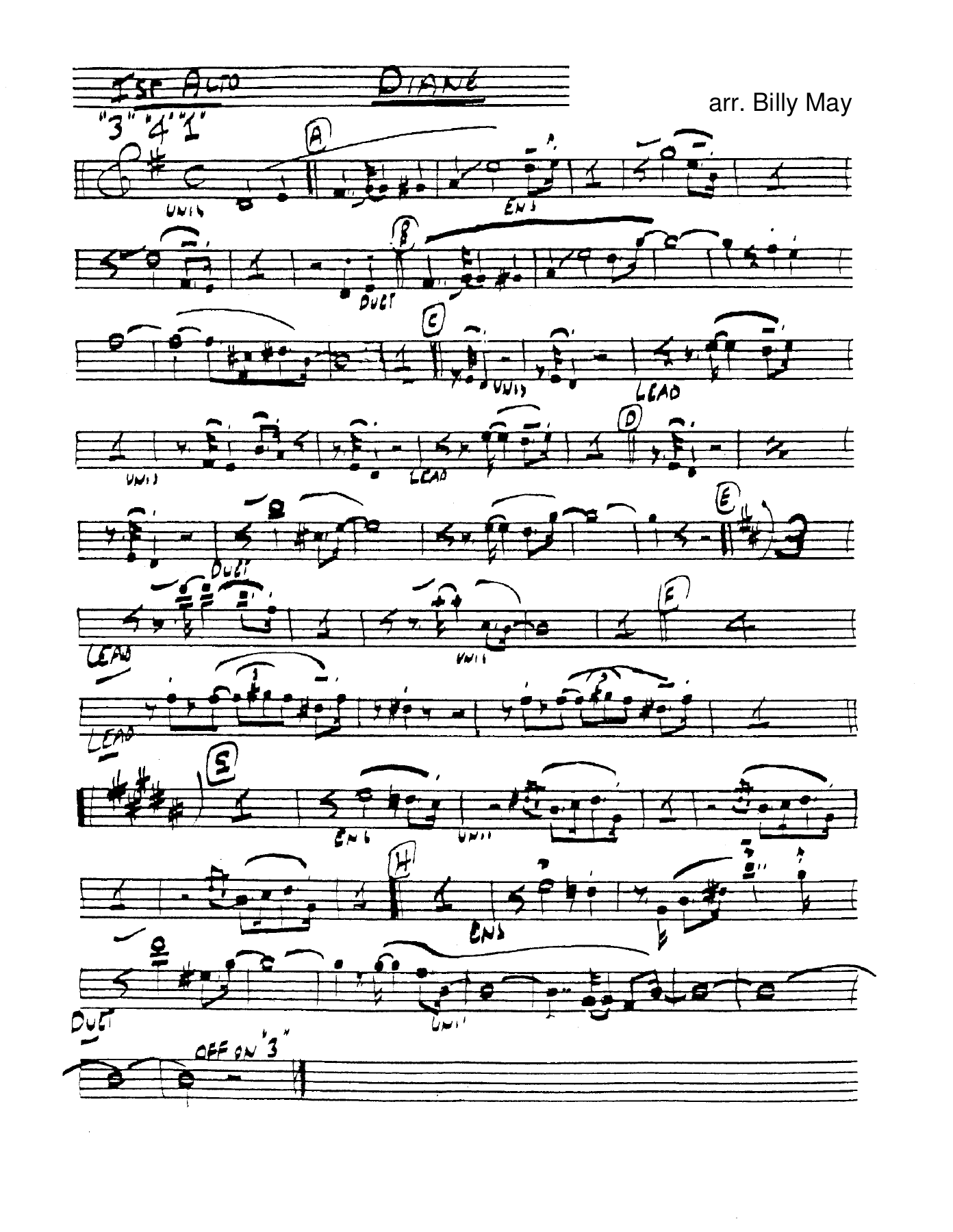
Diane (B.May)
Composed by Erno Rapee
Arranged by Billy May
- Ensemble: Big Band
- Style: Jazz Standard
- Pages: 17
- Instruments (16): 1st Alto Saxophone, 2nd Alto Saxophone, 1st Tenor Saxophone, 2nd Tenor Saxophone, Baritone Saxophone, 1st Trumpet, 2nd Trumpet, 3rd Trumpet, 4th Trumpet, 1st Trombone, 2nd Trombone, 3rd Trombone, 4th Trombone, Piano, Bass, Drums
- Difficulty: easy
- Content: Individual Parts
- Format: PDF Download (Instant)
- Price: $24.99
The timeless melody of "Diane," originally composed by Erno Rapee in 1927, emerges from the rich tapestry of the late 1920s, an era that saw the burgeoning popularity of romantic ballads and the rise of the American songbook. While perhaps not as universally recognized as some of its contemporaries, "Diane" gained significant traction through its inclusion in the 1927 film *Seventh Heaven*, where it served as a poignant theme. Its enduring quality lies in its lyrical, flowing melody and harmonic simplicity, making it a natural candidate for interpretation across various genres, eventually solidifying its place as a jazz standard through numerous instrumental and vocal renditions over the decades. This particular arrangement by the legendary Billy May elevates the piece, offering a sophisticated and swinging big band treatment that pays homage to the tune's romantic origins while infusing it with May's signature orchestral jazz flair. Billy May's arrangement of "Diane" is a masterclass in transforming a classic ballad into a vibrant, medium-swing big band chart. Set in a comfortable tempo, the piece maintains its inherent romanticism but is propelled by a gentle yet irresistible 4/4 swing feel. May's genius is immediately apparent in his lush, often close-voiced harmonies, which provide a warm, enveloping soundscape. The arrangement typically opens with the melody presented by the saxophone section, showcasing May's renowned saxophone soli writing—a hallmark of his style. Expect rich, full-bodied voicings that blend seamlessly, creating a sound that is both classic and distinctly May. The mood is one of sophisticated warmth and understated energy, evoking the golden age of big band jazz without resorting to overt bombast. A distinctive feature of May's approach is his ability to craft arrangements that sound complex and full yet remain accessible. In this "Diane" arrangement, the melody is predominantly carried by the saxophone section, often with subtle brass interjections that add color and emphasis. There are no extended improvised solos, maintaining the focus on the ensemble's collective sound and May's intricate scoring. The technical challenges lie primarily in achieving precise ensemble blend and balance, particularly within the saxophone soli passages, and in articulating the swing feel with a consistent, relaxed precision. The brass sections will need to navigate May's characteristic tight voicings and dynamic contrasts. The reward for performers is the opportunity to inhabit a truly classic big band sound, experiencing firsthand the elegance and swing that defined May's most iconic work. This arrangement is ideally suited for college-level jazz ensembles, advanced community big bands, and professional groups seeking a polished, swinging chart that showcases ensemble precision and musicality. While high school bands with strong lead players and a solid understanding of big band style could tackle it, the nuances of May's voicings and the demand for sophisticated ensemble blend make it particularly rewarding for more experienced musicians. It serves as an excellent vehicle for developing a cohesive ensemble sound, understanding classic big band arranging techniques, and appreciating the timeless appeal of a beautifully orchestrated jazz standard. Conductors should emphasize a relaxed, yet precise medium-swing feel throughout "Diane." The tempo should allow for the rich harmonies to bloom without dragging, typically around 120-130 BPM. A key technical challenge lies in the saxophone soli sections; encourage musicians to listen intently across the section for perfect blend and intonation, focusing on a unified attack and release. Brass players should aim for a warm, rounded tone, especially in sustained chords, and articulate any figures with clarity and a light touch to maintain the swing feel. There are no specific extended techniques like plungers or falls required, but attention to dynamic shaping and subtle phrase variations will bring out the romantic character of the piece. Rehearsal time should be dedicated to balancing the saxophone section against the brass support, ensuring that the melody always sings through while the accompanying lines provide harmonic depth without overpowering. Q: What instruments and parts are included in this arrangement? A: This big band arrangement of "Diane" is scored for 16 instruments, specifically: Alto Saxophone 1, Tenor Saxophone 1, Alto Saxophone 2, Tenor Saxophone 2, Baritone Saxophone, Trumpet 1, Trumpet 2, Trumpet 3, Trumpet 4, Trombone 1, Trombone 2, Trombone 3, Trombone 4, Piano, Bass, and Drums. Q: What is the difficulty level of Billy May's "Diane" arrangement? A: This arrangement is considered to be of a medium-advanced difficulty level. It requires proficient section players, particularly in the saxophone section for the intricate soli passages, and a strong understanding of big band ensemble playing and swing articulation. Q: What is the musical style and historical context of this arrangement? A: This is a big band jazz standard arrangement in a medium-swing style. The original song "Diane" was composed in 1927 by Erno Rapee, and Billy May's arrangement reimagines this romantic ballad with his signature lush harmonies and swinging orchestration, characteristic of the classic big band era. Q: What makes this specific arrangement by Billy May unique? A: Billy May's unique approach is evident in his sophisticated, often close-voiced saxophone soli writing, his ability to transform a ballad into a swinging chart without losing its melodic integrity, and his characteristic use of rich ensemble voicings that create a full, polished sound. Q: What is the typical performance duration and tempo for this piece? A: The typical performance duration for this arrangement is approximately 3 to 4 minutes, depending on the interpretation. It is designed to be played at a comfortable medium-swing tempo, generally in the range of 120-130 beats per minute.
Questions and answers
- What is included in the Diane (B.May) PDF?
- The verified current file contains individual parts across 17 pages.
- How many instruments or parts are listed for Diane (B.May)?
- The verified instrumentation list contains 16 entries for this Big Band arrangement.
- Who is credited for Diane (B.May)?
- Composer: Erno Rapee. Arranger: Billy May.
- What difficulty is listed for Diane (B.May)?
- The verified difficulty level is easy.
- What style is listed for Diane (B.May)?
- The catalog lists the style as Jazz Standard.
- Can I preview Diane (B.May) before buying?
- Yes. The product page provides a preview generated from the current PDF file.
- How is Diane (B.May) delivered?
- After successful payment, the digital PDF is made available for download. The displayed price is $24.99.
Musicians Also Search For
Diane Billy May PDF • Diane Billy May sheet music • Diane arranged by Billy May • Billy May big band charts • Billy May jazz arrangements PDF • Diane Erno Rapee sheet music • Diane Erno Rapee big band arrangements • Erno Rapee big band charts • Diane big band arrangements • Diane big band PDF download • Diane jazz sheet music • big band sheet music download • Diane individual parts download • Diane sheet music PDF • Diane Jazz Standard charts • Jazz Standard big band arrangements • buy Diane sheet music • download Diane PDF • Diane jazz charts • best Billy May big band arrangements • Erno Rapee arranged by Billy May • Diane printable sheet music • big band repertoire PDF