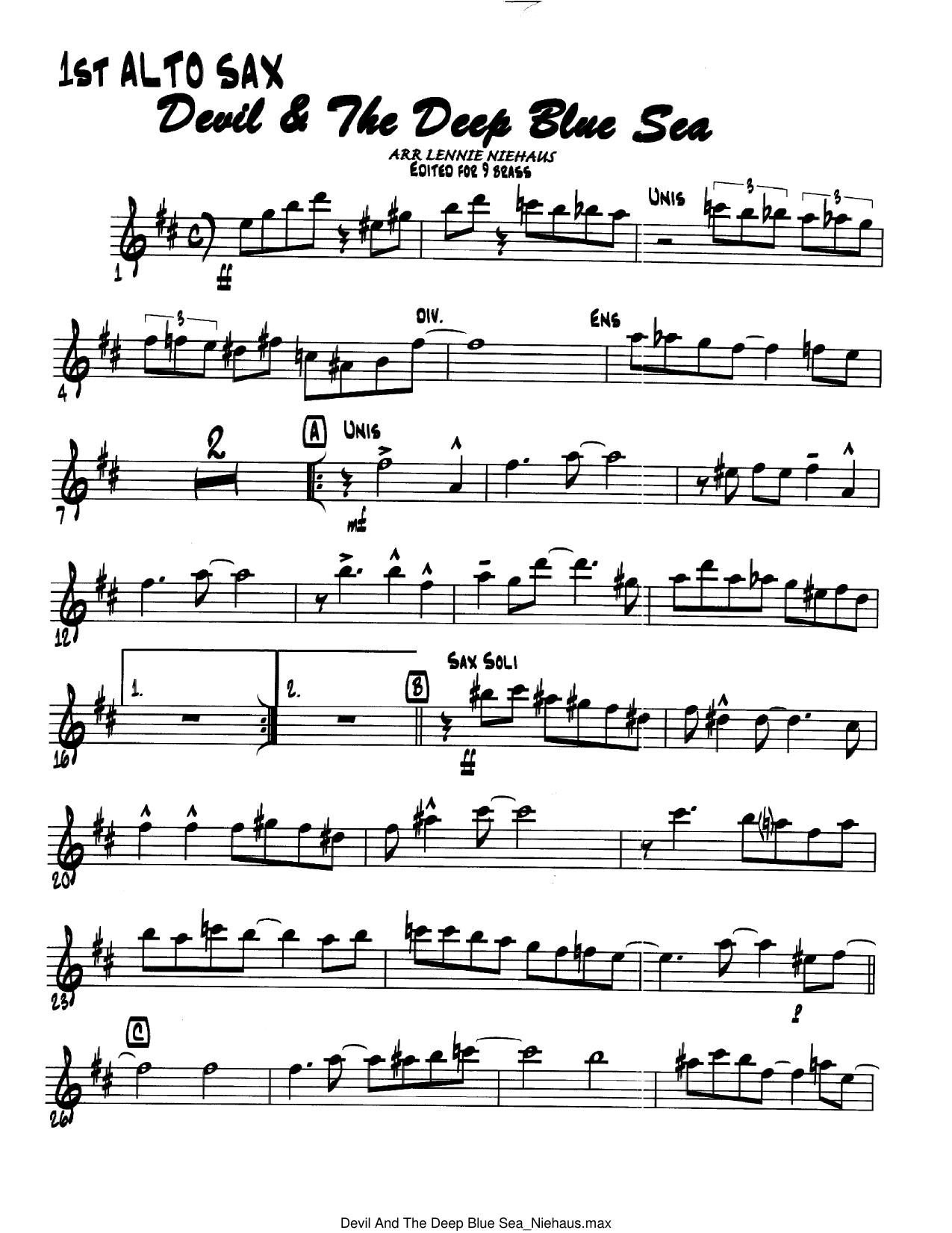
Devil And The Deep Blue Sea (L.Niehaus) sheet music preview

Devil And The Deep Blue Sea (L.Niehaus)

Composed by Harold Arlen

Arranged by Lennie Niehaus

  • Ensemble: Big Band
  • Pages: 51
  • Instruments (17): 1st Alto Sax, 2nd Alto Sax, 1st Tenor Sax, 2nd Tenor Sax, Bari Sax, 1st Trumpet, 2nd Trumpet, 3rd Trumpet, 4th Trumpet, 5th Trumpet, 1st Trombone, 2nd Trombone, 3rd Trombone, 4th Trombone, Bass, Drums, Piano/Guitar
  • Difficulty: advanced
  • Content: Individual Parts
  • Format: PDF Download (Instant)
  • Price: $24.99

Harold Arlen and Ted Koehler’s timeless 1932 Tin Pan Alley classic, "Between the Devil and the Deep Blue Sea," occupies a sacred space in the Great American Songbook, having been popularized by jazz royalty ranging from Cab Calloway and Thelonious Monk to George Harrison and Helen Merrill. Built upon a clever minor-to-major harmonic scheme and an infectious, blues-inflected melody, the tune naturally invites inventive reharmonization and driving rhythmic counterpoint. It represents the quintessential bridge between early 1930s vocal jazz and the sophisticated, horn-driven idioms that later fueled the swing era and West Coast modernism. Lennie Niehaus—the legendary alto saxophonist, arranger, and longtime collaborator of Clint Eastwood—applies his signature West Coast cool aesthetic to this definitive chart. Rather than relying on bombastic, high-register brass assaults, Niehaus crafts a medium-swing arrangement characterized by immaculate counterpoint, linear clarity, and rich, harmonically sophisticated sax solis. The chart opens with a tight, engaging intro that establishes a relaxed yet driving 4/4 medium-swing groove. The mood shifts effortlessly between playful, insouciant phrasing and moments of driving, foot-tapping intensity, evoking the sophisticated atmosphere of 1950s Los Angeles jazz clubs without losing the visceral, bluesy roots of the original Arlen composition. Throughout the 51-page manuscript, Niehaus distributes the melodic weight evenly across the 16-instrument big band, utilizing classic section writing where the saxes, trumpets, and trombones engage in crisp call-and-response figures. The arrangement features open solo space supported by clever, transparent background figures that encourage improvisers to stretch out without fighting a thick wall of sound. The ensemble writing demands precision in articulation, particularly in achieving the short, punchy bebop-inflected eighth-note phrasing that is the hallmark of Niehaus's pen. A tightly woven shout chorus builds the dynamic tension organically, utilizing subtle chromatic voice-leading and rich extended chords rather than sheer volume to achieve its climactic peak. Advanced high school ensembles, collegiate jazz orchestras, and professional community big bands will find this arrangement an ideal vehicle for developing stylistic polish, internal section listening, and swing feel. Because the technical demands prioritize clean execution, blend, and rhythmic exactitude over extreme altissimo ranges or blistering tempos, it rewards mature musicianship and stylistic awareness. Conducting this chart offers directors a masterclass in teaching students how to swing with a lighter, modern articulation while maintaining a robust, driving big band momentum. Executing this Lennie Niehaus chart successfully requires strict adherence to a steady, moderate swing tempo—ideally around quarter note = 120–126 BPM—avoiding the temptation to rush the groove. The primary technical challenge lies in the uniform execution of swung eighth notes; all players must articulate with a clean, light tongue, ensuring that the backbeats (beats 2 and 4) are emphasized naturally by the rhythm section. Drummers should maintain a classic, feathered bass drum style with a crisp ride cymbal pattern, keeping hi-hats sharp on 2 and 4 without overpowering the horns. Ensemble sections require meticulous attention to dynamic markings, particularly during the transparent sax soli passages where balance between the lead alto and the supporting voices is paramount. Brass players should avoid excessive use of heavy vibrato or aggressive edge; instead, aim for a warm, burnished tone that blends seamlessly across the section. Rehearsal should begin section by section, isolating the syncopated figures and ensuring that all slurs and accents match identically before combining the full ensemble. Q: What instruments and parts are included in this 16-instrument big band arrangement? A: The instrumentation comprises a standard 16-piece big band lineup featuring two alto saxophones, two tenor saxophones, one baritone saxophone, four trumpets, four trombones, and a complete rhythm section consisting of piano, bass, and drums. Q: What is the difficulty level of this Lennie Niehaus chart? A: This arrangement is rated as medium to advanced, making it exceptionally well-suited for advanced high school, collegiate, and professional community jazz orchestras seeking to refine their swing articulation and section blend. Q: What is the historical and stylistic background of this piece? A: Originally composed by Harold Arlen in 1932, this tune is a cornerstone jazz standard that has been interpreted across eras, while this specific treatment filters the material through Lennie Niehaus’s sophisticated West Coast cool jazz arranging style. Q: What makes this specific arrangement unique compared to other big band versions? A: Niehaus's arrangement stands out for its linear harmonic clarity, clever contrapuntal voice-leading, and transparent background figures that support soloists without cluttering the sonic texture. Q: What is the recommended performance tempo and approximate duration? A: The chart is designed to be performed at a comfortable medium-swing tempo around quarter note = 120–126 BPM, yielding a performance duration of approximately 3 to 4 minutes depending on solo extensions.

Questions and answers

What is included in the Devil And The Deep Blue Sea (L.Niehaus) PDF?
The verified current file contains a conductor score and individual parts across 51 pages.
How many instruments or parts are listed for Devil And The Deep Blue Sea (L.Niehaus)?
The verified instrumentation list contains 17 entries for this Big Band arrangement.
Who is credited for Devil And The Deep Blue Sea (L.Niehaus)?
Composer: Harold Arlen. Arranger: Lennie Niehaus.
What difficulty is listed for Devil And The Deep Blue Sea (L.Niehaus)?
The verified difficulty level is advanced.
Can I preview Devil And The Deep Blue Sea (L.Niehaus) before buying?
Yes. The product page provides a preview generated from the current PDF file.
How is Devil And The Deep Blue Sea (L.Niehaus) delivered?
After successful payment, the digital PDF is made available for download. The displayed price is $24.99.

Musicians Also Search For

Devil And The Deep Blue Sea Lennie Niehaus PDFDevil And The Deep Blue Sea Lennie Niehaus sheet musicDevil And The Deep Blue Sea arranged by Lennie NiehausLennie Niehaus big band chartsLennie Niehaus jazz arrangements PDFDevil And The Deep Blue Sea Harold Arlen sheet musicDevil And The Deep Blue Sea Harold Arlen big band arrangementsHarold Arlen big band chartsDevil And The Deep Blue Sea big band arrangementsDevil And The Deep Blue Sea big band PDF downloadDevil And The Deep Blue Sea jazz sheet musicbig band sheet music downloadDevil And The Deep Blue Sea conductor score PDFDevil And The Deep Blue Sea individual parts downloadDevil And The Deep Blue Sea sheet music PDFbuy Devil And The Deep Blue Sea sheet musicdownload Devil And The Deep Blue Sea PDFDevil And The Deep Blue Sea jazz chartsbest Lennie Niehaus big band arrangementsHarold Arlen arranged by Lennie NiehausDevil And The Deep Blue Sea printable sheet musicbig band repertoire PDF

All arrangements by Lennie Niehaus All Harold Arlen sheet music