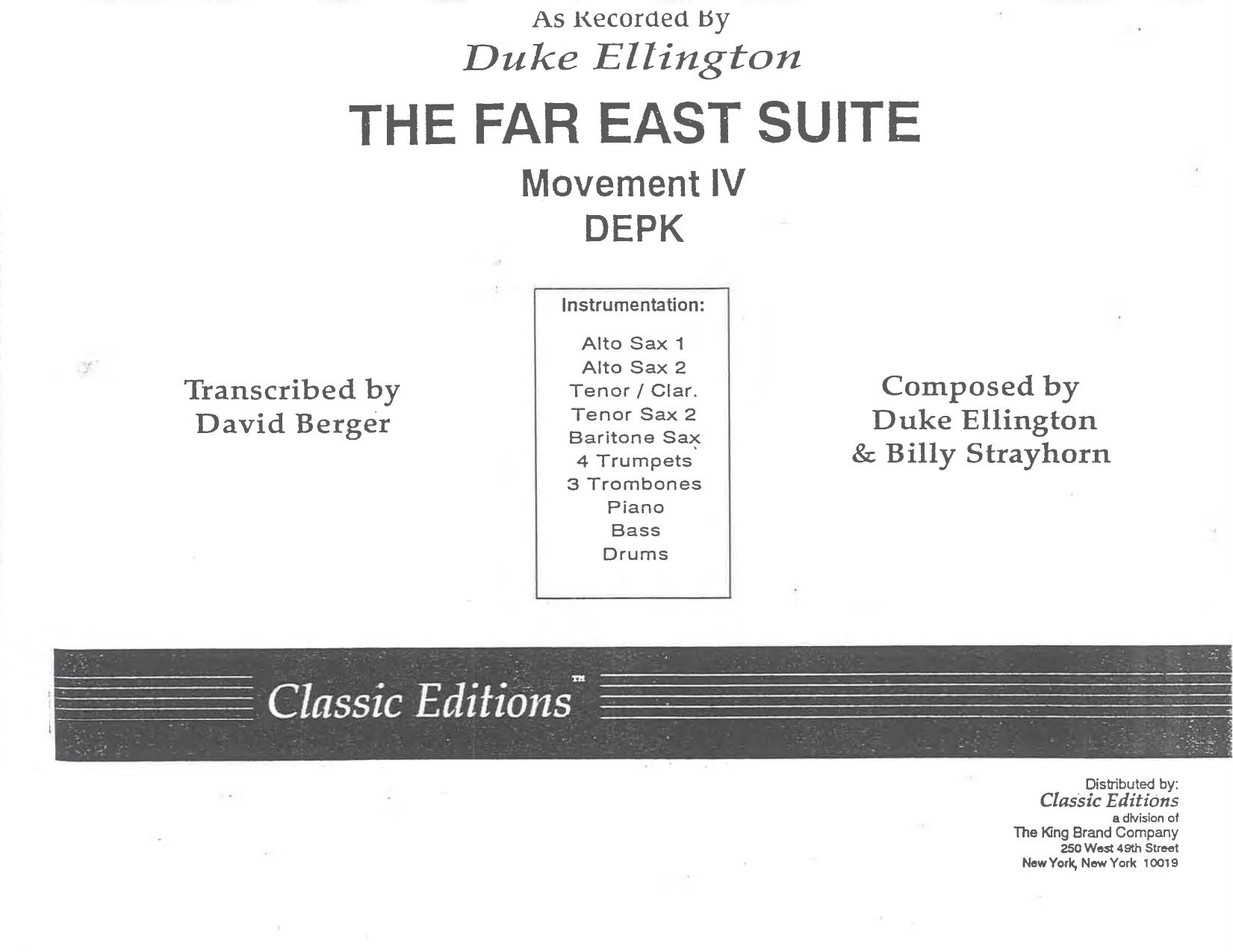
Depk (D.Ellington & B.Strayhorn) sheet music preview

Depk (D.Ellington & B.Strayhorn)

Composed by Duke Ellington

Arranged by Duke Ellington & B.Strayhorn.D.Berger

  • Ensemble: Big Band
  • Pages: 71
  • Instruments (15): Reed 1 (Alto Sax), Reed 2 (Alto Sax), Reed 3 (Clarinet / Tenor Sax), Reed 4 (Tenor Sax), Reed 5 (Baritone Sax), Trumpet 1, Trumpet 2, Trumpet 3, Trumpet 4, Trombone 1, Trombone 2, Trombone 3 (Bass), Piano, Bass, Drums
  • Difficulty: advanced
  • Content: Individual Parts
  • Format: PDF Download (Instant)
  • Price: $24.99

Conceived during the Duke Ellington Orchestra’s landmark 1963–1964 international tour and later immortalized on the Grammy Award-winning *Far East Suite*, "Depk" stands as a brilliant testament to Ellington and Billy Strayhorn’s fascination with global musical landscapes. Inspired by traditional Middle Eastern line dances encountered during their travels, this movement captures an exotic, hypnotic energy that pushes the boundaries of traditional big band idioms. Rather than relying on standard 32-bar forms, Ellington crafted a modal, atmospheric soundscape that evokes bustling bazaars, ancient rhythms, and vibrant cultural tapestries, cementing the suite's status as a pinnacle of mid-1960s modern jazz composition. Musically, the piece thrives on an insistent, driving rhythmic pulse paired with pungent, evocative harmonies. Operating at a medium swing-to-groove tempo, the piece utilizes modal phrasing and undulating motifs that alternate between playful bombast and sultry sophistication. The emotional trajectory is remarkably cinematic, evoking images of desert caravans through swirling woodwind textures and punchy brass interjections. The harmonic language avoids predictable resolutions, favoring suspended chords and chromatic friction that maintain an intoxicating tension from the opening measure down to the final chord. This definitive publication features meticulous curation and transcription oversight by jazz authority David Berger, working directly from Ellington's handwritten sketch scores and original performance parts. The arranger's treatment honors the unique sonic architecture of the legendary Ellington band, specifically highlighting the iconic blend of clarinets, muted brass, and low-register saxophones. The writing avoids generic section block-chords, instead deploying transparent, counterpoint-driven voicings where individual instrumental voices weave independently. Signature Ellingtonian touches—such as growling plunger-mute brass and sultry reed solis—are mapped out precisely to recreate the orchestra's distinct vocalized instrumental timbre. Structurally, the composition serves as a dual showcase, placing heavy emphasis on dynamic interplay between the piano and the clarinet chair. The melody is frequently carried by dense reed combinations and soaring trumpet lines, while strategic solo spaces invite pianists and woodwind specialists to stretch out within modal frameworks. Technical demands center on rhythmic precision, stylistic flexibility, and intonation rather than sheer velocity; performers must master syncopated figures that sit squarely across the bar line. Navigating the subtle shifts in dynamic shading and maintaining a relaxed yet intense swing feel provide an immensely rewarding challenge for any cohesive ensemble. Advanced high school, collegiate, and professional big bands will find this arrangement an exceptional vehicle for developing stylistic maturity, section blending, and historical awareness. Because the charts rely heavily on the distinct personalities of the classic Ellington roster, modern ensembles gain invaluable experience in stepping outside standard swing-era paradigms to interpret programmatic, globally inspired jazz masterworks. Achieving an authentic rendition of "Depk" requires strict attention to stylistic nuance, particularly regarding articulation and tonal color. The rhythm section must establish a deep, pulsing groove that feels grounded yet fluid, avoiding any heavy-handedness on the downbeats. The drummer should utilize crisp cymbal work and subtle tom accents to emulate the hand-percussion textures implied in the original Middle Eastern inspiration, keeping the underlying momentum relentless. Brass players should make ample use of varied mutes—specifically cup and straight mutes—to achieve the dry, nasal, and haunting textures characteristic of the recording. Emphasize wide, expressive vibrato on feature lines, while ensemble passages demand clean, articulated staccatos that lock tightly with the bass line. Pay close attention to dynamic contrasts; the sudden shifts from muted whispers to robust, brass-led shout sections provide the primary structural contrast of the piece. Conductor focus should center on balancing the intricate reed counterpoint so that inner voices remain audible beneath the primary thematic statements. Q: What instruments and parts are included in this arrangement? A: This 71-page publication includes a full conductor's score and a standard 16-instrument big band instrumentation consisting of 2 alto saxophones, 2 tenor saxophones (with Tenor 1 doubling clarinet), baritone saxophone, 4 trumpets, 3 trombones, piano, bass, and drums. Q: What is the difficulty level of this chart? A: This arrangement is graded as medium-advanced, making it ideal for skilled college ensembles, advanced high school bands, and professional repertory orchestras looking for sophisticated stylistic challenges. Q: What is the historical background of this piece? A: Composed by Duke Ellington in late 1963 and later recorded in 1966, "Depk" is an integral movement from the critically acclaimed *Far East Suite*, inspired by the ensemble's State Department-sponsored tour of the Middle East and Asia. Q: What makes this specific David Berger edition unique? A: This version is meticulously reconstructed from Duke Ellington’s original handwritten sketch scores, copyright deposit scores, and historical studio recordings, providing authentic voicings and a fully transcribed piano solo tailored for modern performance. Q: What is the performance duration and tempo feel of the piece? A: The arrangement features an engaging medium swing-to-groove tempo with an elastic, modal pulse that typically yields a performance duration of around 4 to 5 minutes.

Questions and answers

What is included in the Depk (D.Ellington & B.Strayhorn) PDF?
The verified current file contains a conductor score and individual parts across 71 pages.
How many instruments or parts are listed for Depk (D.Ellington & B.Strayhorn)?
The verified instrumentation list contains 15 entries for this Big Band arrangement.
Who is credited for Depk (D.Ellington & B.Strayhorn)?
Composer: Duke Ellington. Arranger: Duke Ellington & B.Strayhorn.D.Berger.
What difficulty is listed for Depk (D.Ellington & B.Strayhorn)?
The verified difficulty level is advanced.
Can I preview Depk (D.Ellington & B.Strayhorn) before buying?
Yes. The product page provides a preview generated from the current PDF file.
How is Depk (D.Ellington & B.Strayhorn) delivered?
After successful payment, the digital PDF is made available for download. The displayed price is $24.99.

Musicians Also Search For

Depk Duke Ellington & B.Strayhorn.D.Berger PDFDepk Duke Ellington & B.Strayhorn.D.Berger sheet musicDepk arranged by Duke Ellington & B.Strayhorn.D.BergerDuke Ellington & B.Strayhorn.D.Berger big band chartsDuke Ellington & B.Strayhorn.D.Berger jazz arrangements PDFDepk Duke Ellington sheet musicDepk Duke Ellington big band arrangementsDuke Ellington big band chartsDepk big band arrangementsDepk big band PDF downloadDepk jazz sheet musicbig band sheet music downloadDepk conductor score PDFDepk individual parts downloadDepk sheet music PDFbuy Depk sheet musicdownload Depk PDFDepk jazz chartsbest Duke Ellington & B.Strayhorn.D.Berger big band arrangementsDuke Ellington arranged by Duke Ellington & B.Strayhorn.D.BergerDepk printable sheet musicbig band repertoire PDF

All arrangements by Duke Ellington & B.Strayhorn.D.Berger All Duke Ellington sheet music