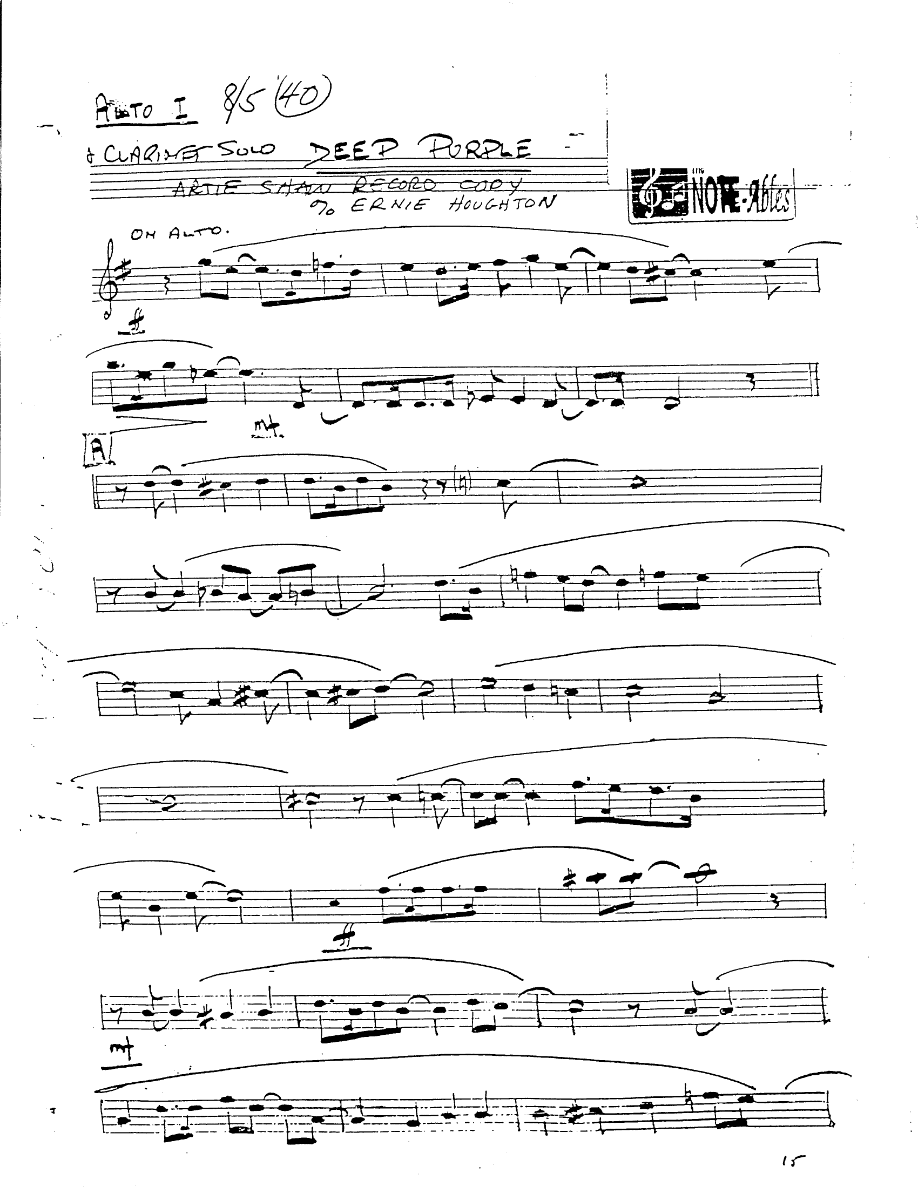
Deep Purple (E.Houghton) sheet music preview

Deep Purple (E.Houghton)

Composed by Peter DeRose

Arranged by Artie Shaw

  • Ensemble: Big Band
  • Style: Jazz Standard
  • Pages: 45
  • Instruments (18): Alto Saxophone 1, Alto Saxophone 2, Tenor Saxophone 1, Tenor Saxophone 2, Baritone Saxophone, Trumpet 1, Trumpet 2, Trumpet 3, Trumpet 4, Trombone 1, Trombone 2, Trombone 3, Trombone 4, Piano, Guitar, Bass, Drum Set, Clarinet
  • Difficulty: medium
  • Content: Individual Parts
  • Format: PDF Download (Instant)
  • Price: $24.99

Peter DeRose's "Deep Purple," originally a popular song from 1934, blossomed into an enduring jazz standard, largely due to its lush melody and evocative harmonic progression. While Larry Clinton's 1939 big band recording with Bea Wain on vocals propelled it to mainstream success, it was the song's inherent beauty and adaptability that cemented its place in the jazz repertoire. This arrangement, attributed to the legendary Artie Shaw and specifically noted as "E.Houghton" (likely a transcription or adaptation of a Shaw performance by a skilled hand), captures the sophisticated essence of the swing era. It represents a period where popular melodies were transformed into intricate orchestral works, showcasing the virtuosity and harmonic richness characteristic of the finest big bands. The piece's melancholic yet romantic character, coupled with its memorable theme, makes it a timeless vehicle for expressive jazz interpretation. This particular rendition of "Deep Purple" unfolds as a medium-slow swing ballad, typically set in the key of C major, though Shaw's arrangements often featured subtle modulations or reharmonizations that add depth. The mood is one of wistful elegance and understated passion, evoking the golden age of big band romance. Expect rich, often dense voicings that highlight the full spectrum of the 17-piece ensemble. Artie Shaw's arrangements are renowned for their meticulous attention to detail, lyrical counterpoint, and a sophisticated harmonic palette that goes beyond simple block chords. Soli sections, particularly in the saxophone and brass choirs, are crafted with a keen ear for blend and balance, creating a seamless, flowing sound that is both intricate and accessible. The arrangement likely features Shaw's characteristic use of clarinet (or a clarinet-like lead in the sax section) to deliver the melody with a smooth, singing quality, a hallmark of his "Gramercy Five" and larger orchestra sound. Performance of this arrangement demands a band with strong ensemble control and a mature understanding of swing ballad phrasing. The melody is predominantly carried by the saxophone section, often with the lead alto or tenor taking the initial statement, then expanding into full section soli. While specific solo features are not explicitly detailed in the provided information, Shaw's arrangements frequently include improvised solos, often for clarinet, alto saxophone, or trumpet, which would be indicated with chord changes. Technical challenges include maintaining a consistent, relaxed swing feel at a slower tempo, achieving precise intonation within complex voicings, and executing dynamic contrasts that build and release tension effectively. The reward lies in performing a piece of genuine musical artistry, allowing musicians to explore expressive phrasing and deep harmonic colors. This arrangement is ideally suited for college-level jazz ensembles, advanced community bands, or professional groups looking to delve into the authentic sound of a classic swing-era big band arrangement. Its demands on musicianship and ensemble cohesion make it a challenging yet profoundly satisfying addition to any repertoire. Approaching "Deep Purple (E.Houghton)" requires a focus on lyrical phrasing and a relaxed, medium-slow swing feel. The tempo should be around quarter note = 80-90 BPM, allowing for ample space within the melodic lines and harmonic suspensions. Key technical challenges include achieving precise intonation within the dense saxophone and brass voicings, particularly in sustained chords. Encourage musicians to listen across sections for blend and balance, ensuring that inner voices are present but not overpowering the lead. Dynamic shaping is crucial; practice swells and diminuendos to bring out the inherent romance and wistfulness of the piece. While no specific special techniques like plungers or doits are explicitly noted, a smooth, vocal-like articulation is paramount. Rehearsal should emphasize sectionals to perfect blend and articulation, followed by full ensemble work to integrate the intricate counterlines and ensure the swing pulse remains steady and unforced throughout. Q: What instruments and parts are included in this arrangement? A: This arrangement is scored for a standard 17-piece big band, including Alto Saxophone 1, Alto Saxophone 2, Tenor Saxophone 1, Tenor Saxophone 2, Baritone Saxophone, Trumpet 1, Trumpet 2, Trumpet 3, Trumpet 4, Trombone 1, Trombone 2, Trombone 3, Bass Trombone, Piano, Bass, Drums, and Guitar. Q: What is the difficulty level of this arrangement? A: This arrangement is considered advanced intermediate to advanced. It requires strong ensemble control, mature phrasing, and good intonation, making it suitable for college-level jazz ensembles, advanced community bands, or professional groups. Q: What is the musical style and historical context of this arrangement? A: This is a classic big band jazz standard from the swing era, originally a popular song from 1934. Arranged by Artie Shaw, it embodies the sophisticated, lyrical, and harmonically rich sound characteristic of the late 1930s big band tradition. Q: What makes this Artie Shaw arrangement of "Deep Purple" unique? A: Artie Shaw's signature approach includes lush, often complex voicings, lyrical counterpoint, and a sophisticated harmonic palette. This arrangement likely features his distinctive treatment of the melody, often with a singing lead in the saxophones or a clarinet-like quality, reflecting his band's elegant style. Q: What is the typical performance duration and tempo for this piece? A: The typical performance duration for a medium-slow swing ballad like this is usually around 3 to 4 minutes. The recommended tempo is a relaxed medium-slow swing, approximately quarter note = 80-90 BPM.

Musicians Also Search For

Deep Purple Artie Shaw PDFDeep Purple Artie Shaw sheet musicDeep Purple arranged by Artie ShawArtie Shaw big band chartsArtie Shaw jazz arrangements PDFDeep Purple Peter DeRose sheet musicDeep Purple Peter DeRose big band arrangementPeter DeRose big band chartsDeep Purple big band arrangementDeep Purple big band PDF downloadDeep Purple jazz ensemble sheet musicbig band sheet music instant downloadDeep Purple individual parts downloadDeep Purple sheet music with partsDeep Purple Jazz Standard chartJazz Standard big band arrangementsbuy Deep Purple sheet music onlinedownload Deep Purple PDFDeep Purple jazz chartbest Artie Shaw big band arrangementsPeter DeRose songs arranged by Artie ShawDeep Purple printable sheet musicbig band repertoire PDF

All arrangements by Artie Shaw All Peter DeRose sheet music