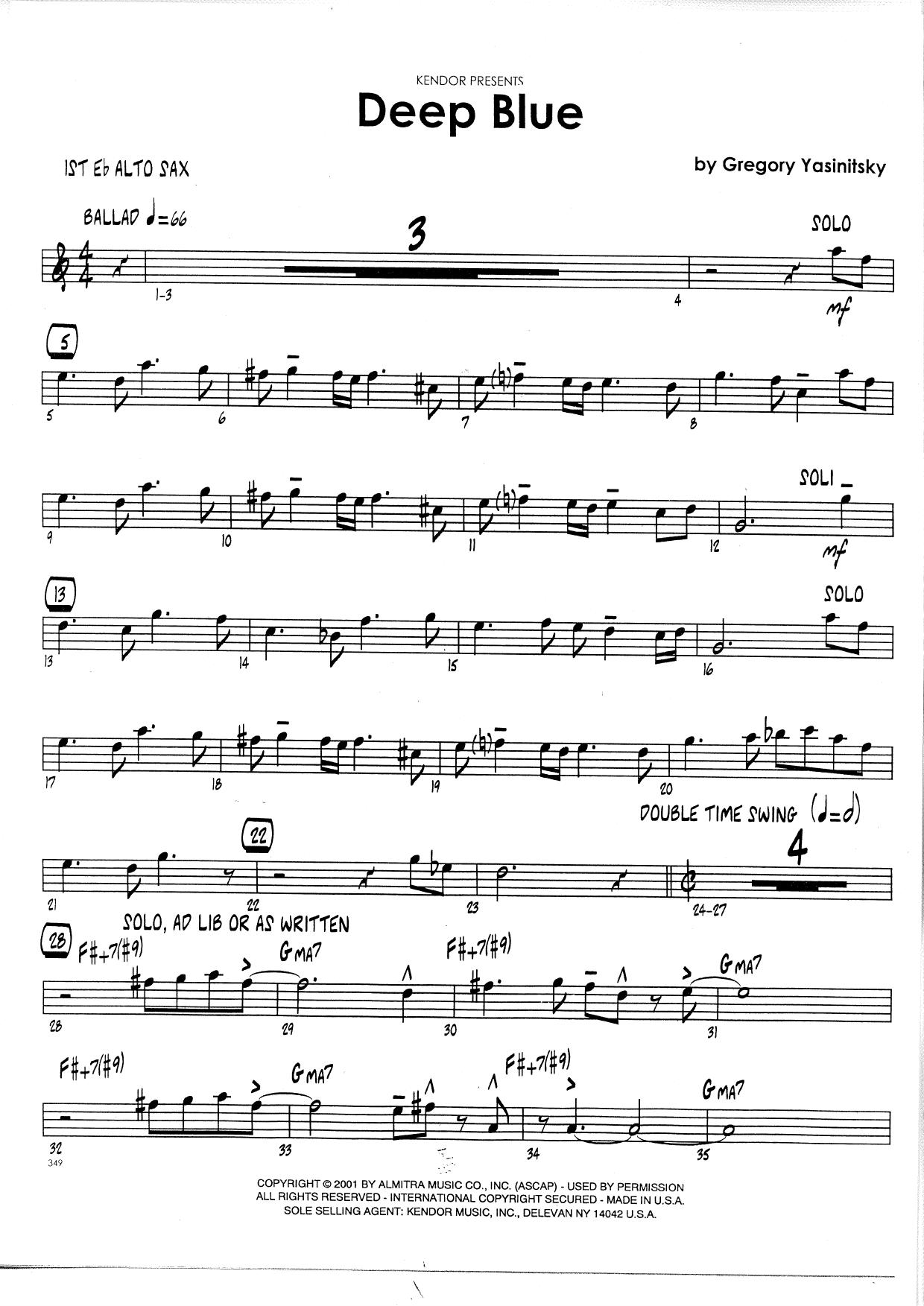
Deep Blue (G.Yasinitsky) sheet music preview

Deep Blue (G.Yasinitsky)

Composed by Gregory Yasinitsky

Arranged by Gregory Yasinitsky

  • Ensemble: Big Band
  • Pages: 43
  • Instruments (17): 1st Eb Alto Sax, 2nd Eb Alto Sax, 1st Bb Tenor Sax, 2nd Bb Tenor Sax, Eb Baritone Sax, 1st Bb Trumpet, 2nd Bb Trumpet, 3rd Bb Trumpet, 4th Bb Trumpet, 1st Trombone, 2nd Trombone, 3rd Trombone, 4th Trombone, Guitar, Piano, Bass, Drums
  • Difficulty: medium
  • Content: Individual Parts
  • Format: PDF Download (Instant)
  • Price: $24.99

Composed and arranged by renowned saxophonist, composer, and educator Gregory Yasinitsky, "Deep Blue" stands as a sophisticated contribution to contemporary big band literature. Dr. Yasinitsky, Regents Professor Emeritus at Washington State University, has crafted a work that bridges the gap between classic post-bop harmonic language and accessible, modern jazz ensemble writing. While not an archaic artifact of the 1930s swing era, this piece captures the timeless spirit of mid-century modal jazz and modern mainstream writing, drawing stylistic lineage from the rich traditions established by giants like Thad Jones, Bob Mintzer, and the contemporary studio jazz idiom. "Deep Blue" unfolds at a relaxed, driving medium-straight or light swing groove (approximately quarter note = 116 BPM), anchored by a rich, spacious harmonic palette. The mood is contemplative yet energetic, evoking the moody atmosphere of late-night coastal waters through lush, extended chord voicings—frequently utilizing major sevenths, minor ninths, and suspended quartal structures. The piece opens with an inviting, atmospheric introduction before settling into a infectious groove where the rhythm section establishes a sophisticated foundation. The overarching emotional arc shifts fluidly from introspective, smoky lyricism in the head statements to a high-energy, brass-driven crescendo during the climactic developmental sections. Yasinitsky’s compositional fingerprint is unmistakable throughout the score, characterized by seamless counterpoint, rich sax-soli writing, and clever orchestration that ensures clarity even through dense harmonic shifts. The arrangement opens with the melody introduced by the saxophones, later expanding to involve the full brass ensemble in rich, harmonized statements. A standout feature of the arrangement is its cleverly constructed shout chorus, which builds tension through syncopated cross-rhythms and dynamic contrast before resolving into a satisfying, soaring ensemble tutti. Solos are thoughtfully designated over accessible chord changes, providing ideal features for developing improvisers while offering enough harmonic depth to inspire advanced players. Advanced high school, collegiate, and premier community big bands will find "Deep Blue" to be an ideal vehicle for developing ensemble cohesion, dynamic control, and stylistic versatility. While the technical demands are approachable—avoiding extreme range requirements for the brass or impossibly fast tempos—the primary challenge lies in achieving a unified articulation style and balancing the intricate inner voicings. The rhythm section is given ample room to groove, with structured piano and bass prompts that guide the ensemble's time feel. Comprehensive and deeply rewarding to rehearse, this 43-page chart offers a masterclass in modern big band arranging that will command the attention of any audience. Achieving success with "Deep Blue" requires meticulous attention to articulation, blend, and time-feel. The tempo should remain steady and relaxed; avoid rushing the medium groove, as the momentum relies heavily on the rhythm section's deep pocket and the bassist's precise quarter-note pulse. The drummer should utilize a crisp ride cymbal pattern with a gentle hi-hat on beats two and four, keeping fills tasteful and supportive of the horns. Technically, the brass sections must focus on smooth, connected slurs in the transitional lines and controlled dynamic shading during the modal vamp sections. Ensure that the background figures behind the soloists remain under-mixed so the featured improvisers can project effortlessly without overblowing. Pay special attention to the dynamic markings in the shout chorus; the sudden shifts from forte to piano are vital for achieving the dramatic contrast Yasinitsky intended. Rehearsal should begin section by section, isolating the inner voice movements in the saxophones and trombones before combining them with the full ensemble. Q: What instruments and parts are included in this big band arrangement? A: The 43-page publication includes a full conductor score and 17 individual instrumental parts: Alto Saxophone 1, Alto Saxophone 2, Tenor Saxophone 1, Tenor Saxophone 2, Baritone Saxophone, Trumpets 1-4, Trombones 1-4, Piano, Guitar, Bass, and Drums. Q: What is the difficulty level of "Deep Blue"? A: This arrangement is graded as medium-advanced, making it exceptionally well-suited for advanced high school, collegiate, and professional or community jazz ensembles looking to hone their contemporary swing and modal reading skills. Q: What is the musical style and historical context of the piece? A: Written by contemporary jazz composer Gregory Yasinitsky, the piece is a modern mainstream jazz composition that blends post-bop harmonic sensibilities with the classic, driving groove of the big band tradition. Q: What makes this specific arrangement by Gregory Yasinitsky unique? A: It is distinguished by Yasinitsky’s signature lush voicings, clever inner-voice counterpoint, an expressive saxophone soli, and a dynamic shout chorus that builds intense rhythmic and harmonic momentum. Q: What is the performance duration and tempo of the arrangement? A: The piece is set at a comfortable medium groove tempo (around quarter note = 116 BPM) and typically runs between 4 to 5 minutes, depending on the number and length of the improvised solos.

Questions and answers

What is included in the Deep Blue (G.Yasinitsky) PDF?
The verified current file contains a conductor score and individual parts across 43 pages.
How many instruments or parts are listed for Deep Blue (G.Yasinitsky)?
The verified instrumentation list contains 17 entries for this Big Band arrangement.
Who is credited for Deep Blue (G.Yasinitsky)?
Composer: Gregory Yasinitsky. Arranger: Gregory Yasinitsky.
What difficulty is listed for Deep Blue (G.Yasinitsky)?
The verified difficulty level is medium.
Can I preview Deep Blue (G.Yasinitsky) before buying?
Yes. The product page provides a preview generated from the current PDF file.
How is Deep Blue (G.Yasinitsky) delivered?
After successful payment, the digital PDF is made available for download. The displayed price is $24.99.

Musicians Also Search For

Deep Blue Gregory Yasinitsky PDFDeep Blue Gregory Yasinitsky sheet musicDeep Blue arranged by Gregory YasinitskyGregory Yasinitsky big band chartsGregory Yasinitsky jazz arrangements PDFDeep Blue Gregory Yasinitsky big band arrangementsDeep Blue big band arrangementsDeep Blue big band PDF downloadDeep Blue jazz sheet musicbig band sheet music downloadDeep Blue conductor score PDFDeep Blue individual parts downloadDeep Blue sheet music PDFbuy Deep Blue sheet musicdownload Deep Blue PDFDeep Blue jazz chartsbest Gregory Yasinitsky big band arrangementsDeep Blue printable sheet musicbig band repertoire PDF

All arrangements by Gregory Yasinitsky All Gregory Yasinitsky sheet music