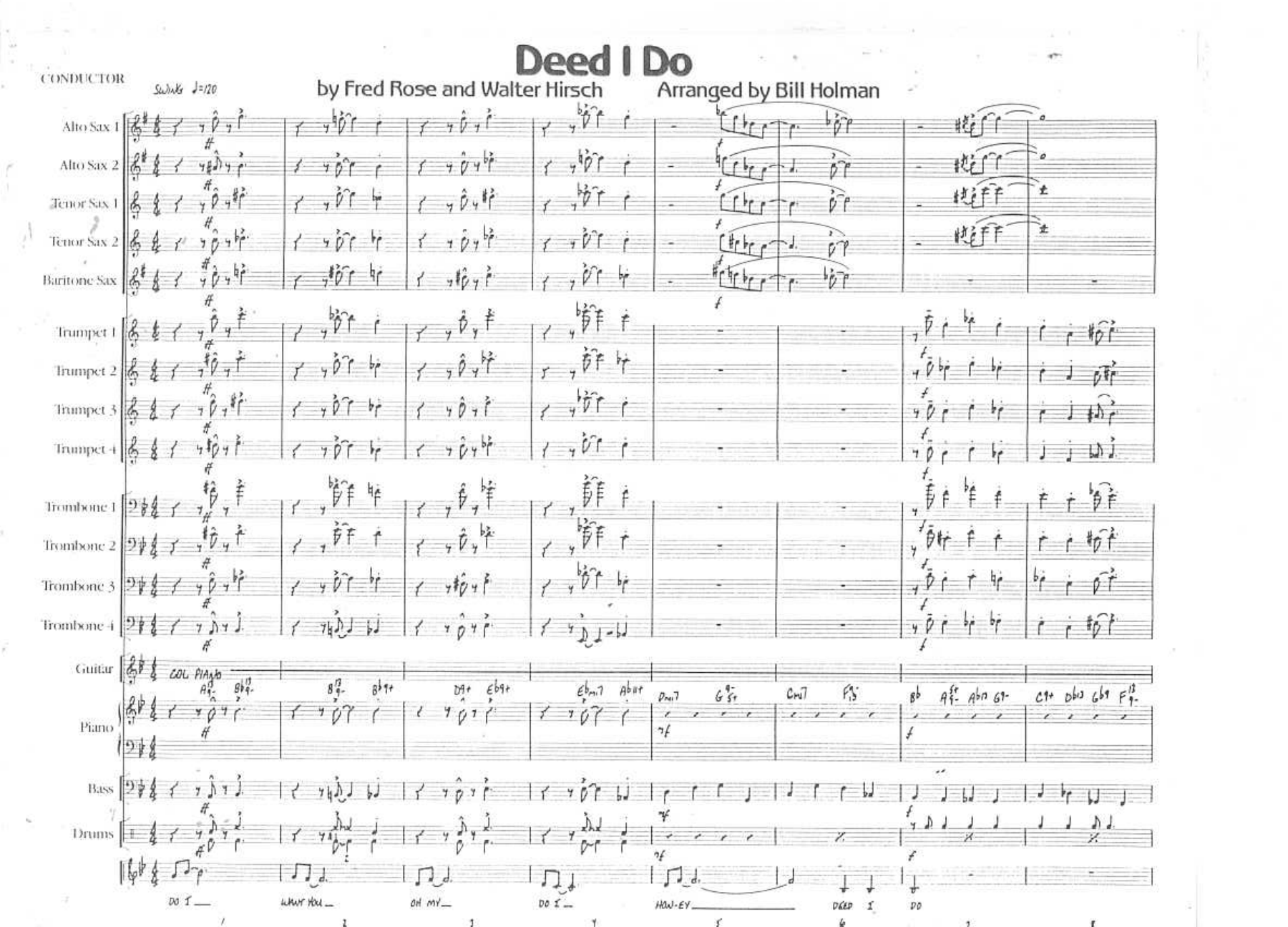
Deed I Do (B.Holman) sheet music preview

Deed I Do (B.Holman)

Composed by Fred Rose, Walter Hirsch

Arranged by Bill Holman

  • Ensemble: Big Band
  • Style: Jazz Standard
  • Pages: 45
  • Instruments (18): Vocal, Alto Sax 1, Alto Sax 2, Tenor Sax 1, Tenor Sax 2, Baritone Sax, Trumpet 1, Trumpet 2, Trumpet 3, Trumpet 4, Trombone 1, Trombone 2, Trombone 3, Trombone 4, Piano, Bass, Drums, Guitar
  • Difficulty: advanced
  • Content: Individual Parts
  • Format: PDF Download (Instant)
  • Price: $24.99

"Deed I Do," a timeless jazz standard, traces its origins back to 1926, penned by Fred Rose and Walter Hirsch. Emerging from the vibrant Tin Pan Alley era, this jaunty tune quickly became a favorite, famously recorded by artists like Ruth Etting and later embraced by countless jazz luminaries, including Mildred Bailey, Benny Goodman, and Peggy Lee. Its enduring appeal lies in its deceptively simple, yet infinitely adaptable, AABA form and its optimistic, swinging melodic contour, making it a cornerstone of the jazz repertoire. The song embodies the effervescent spirit of the pre-swing and early swing eras, a period of burgeoning popular song and dance music that laid the groundwork for the big band explosion. Bill Holman's masterful arrangement of "Deed I Do" transforms this classic into a sophisticated showcase for big band. Holman, renowned for his intricate yet effortlessly swinging charts, approaches this piece with his characteristic blend of harmonic ingenuity and rhythmic drive. The musical character is a medium-up swing, maintaining the original's bright disposition while infusing it with a contemporary big band energy. The arrangement typically features a bright, accessible key, allowing for full, resonant voicings across the ensemble. Holman's signature can be heard in the tightly woven saxophone soli sections, where complex lines are delivered with remarkable clarity and precision, creating a thrilling textural contrast. The overall mood is one of sophisticated joy and rhythmic propulsion, evoking the golden age of big band jazz with a modern edge. Holman's distinctive arranging techniques are on full display, from his often unexpected yet logical harmonic substitutions to his brilliantly orchestrated shout choruses that build dynamic intensity. The melody is skillfully distributed, often beginning with the saxophones before being passed to the brass or presented in a full ensemble statement. While there are ample opportunities for featured soloists, typically a tenor saxophone or trumpet, these moments are seamlessly integrated into the larger architectural flow of the arrangement, supported by lush background figures. Technical challenges include navigating the precise articulations and dynamic contrasts inherent in Holman's writing, particularly within the fast-moving soli passages and the powerful, brass-heavy shout sections. Performing this arrangement is immensely rewarding, offering a deep dive into the art of big band swing and the unique genius of Bill Holman, culminating in a powerful and satisfying musical experience. This arrangement is ideally suited for college, community, and professional big bands seeking a challenging yet deeply swinging chart that will elevate their performance. This arrangement of "Deed I Do" by Bill Holman thrives on precision and rhythmic vitality. Conductors should aim for a medium-up swing tempo, around ♩ = 180-200, ensuring a light, buoyant feel rather than a heavy, driving one. Key technical challenges include the intricate saxophone soli passages, which require meticulous attention to articulation, balance, and intonation for maximum clarity. Brass sections must execute dynamic swells and sharp attacks in the shout choruses with unified precision. Rehearsal time should focus on layering the background figures during solo sections to ensure they support without overpowering the soloist. Pay close attention to Holman's dynamic markings, as they are crucial to shaping the piece's energy arc. While no special techniques like plunger mutes are explicitly required, brass players should be prepared for typical jazz inflections such as falls and scoops, executed with stylistic awareness. The overall goal is to achieve a cohesive, swinging ensemble sound that highlights Holman's sophisticated harmonic and rhythmic interplay. **Q: What instruments and parts are included in this arrangement?** A: This arrangement is scored for a standard 18-instrument big band, including Alto Saxophone 1, Alto Saxophone 2, Tenor Saxophone 1, Tenor Saxophone 2, Baritone Saxophone, Trumpet 1, Trumpet 2, Trumpet 3, Trumpet 4, Trombone 1, Trombone 2, Trombone 3, Bass Trombone, Piano, Guitar, Bass, and Drums. It also includes a full conductor score, totaling 81 pages. **Q: What is the difficulty level of this arrangement?** A: This arrangement is considered advanced, suitable for college, community, and professional big bands. It presents challenges in intricate soli passages, precise articulation, dynamic control, and sophisticated harmonic navigation typical of Bill Holman's writing. **Q: What is the musical style and historical context of "Deed I Do"?** A: "Deed I Do" is a classic jazz standard from 1926, embodying the medium-up swing style. It reflects the vibrant Tin Pan Alley and early swing eras, known for its catchy melodies and adaptable harmonic structure, making it a staple in the jazz repertoire. **Q: What makes Bill Holman's arrangement of "Deed I Do" unique?** A: Bill Holman's arrangement is distinguished by his signature harmonic sophistication, intricate saxophone soli sections, brilliantly orchestrated shout choruses, and a seamless blend of traditional swing with modern big band voicings. It transforms the classic tune into a sophisticated and powerfully swinging showcase. **Q: What is the typical performance duration and tempo for this piece?** A: The typical performance duration for this arrangement is approximately 3-4 minutes, depending on the number and length of improvised solos. The recommended tempo is a medium-up swing, generally around ♩ = 180-200 beats per minute, maintaining a light and buoyant feel.

Questions and answers

What is included in the Deed I Do (B.Holman) PDF?
The verified current file contains a conductor score and individual parts across 45 pages.
How many instruments or parts are listed for Deed I Do (B.Holman)?
The verified instrumentation list contains 18 entries for this Big Band arrangement.
Who is credited for Deed I Do (B.Holman)?
Composer: Fred Rose, Walter Hirsch. Arranger: Bill Holman.
What difficulty is listed for Deed I Do (B.Holman)?
The verified difficulty level is advanced.
What style is listed for Deed I Do (B.Holman)?
The catalog lists the style as Jazz Standard.
Can I preview Deed I Do (B.Holman) before buying?
Yes. The product page provides a preview generated from the current PDF file.
How is Deed I Do (B.Holman) delivered?
After successful payment, the digital PDF is made available for download. The displayed price is $24.99.

Musicians Also Search For

Deed I Do Bill Holman PDFDeed I Do Bill Holman sheet musicDeed I Do arranged by Bill HolmanBill Holman big band chartsBill Holman jazz arrangements PDFDeed I Do Fred Rose, Walter Hirsch sheet musicDeed I Do Fred Rose, Walter Hirsch big band arrangementsFred Rose, Walter Hirsch big band chartsDeed I Do big band arrangementsDeed I Do big band PDF downloadDeed I Do jazz sheet musicbig band sheet music downloadDeed I Do conductor score PDFDeed I Do individual parts downloadDeed I Do sheet music PDFDeed I Do Jazz Standard chartsJazz Standard big band arrangementsbuy Deed I Do sheet musicdownload Deed I Do PDFDeed I Do jazz chartsbest Bill Holman big band arrangementsFred Rose, Walter Hirsch arranged by Bill HolmanDeed I Do printable sheet musicbig band repertoire PDF

All arrangements by Bill Holman All Fred Rose, Walter Hirsch sheet music