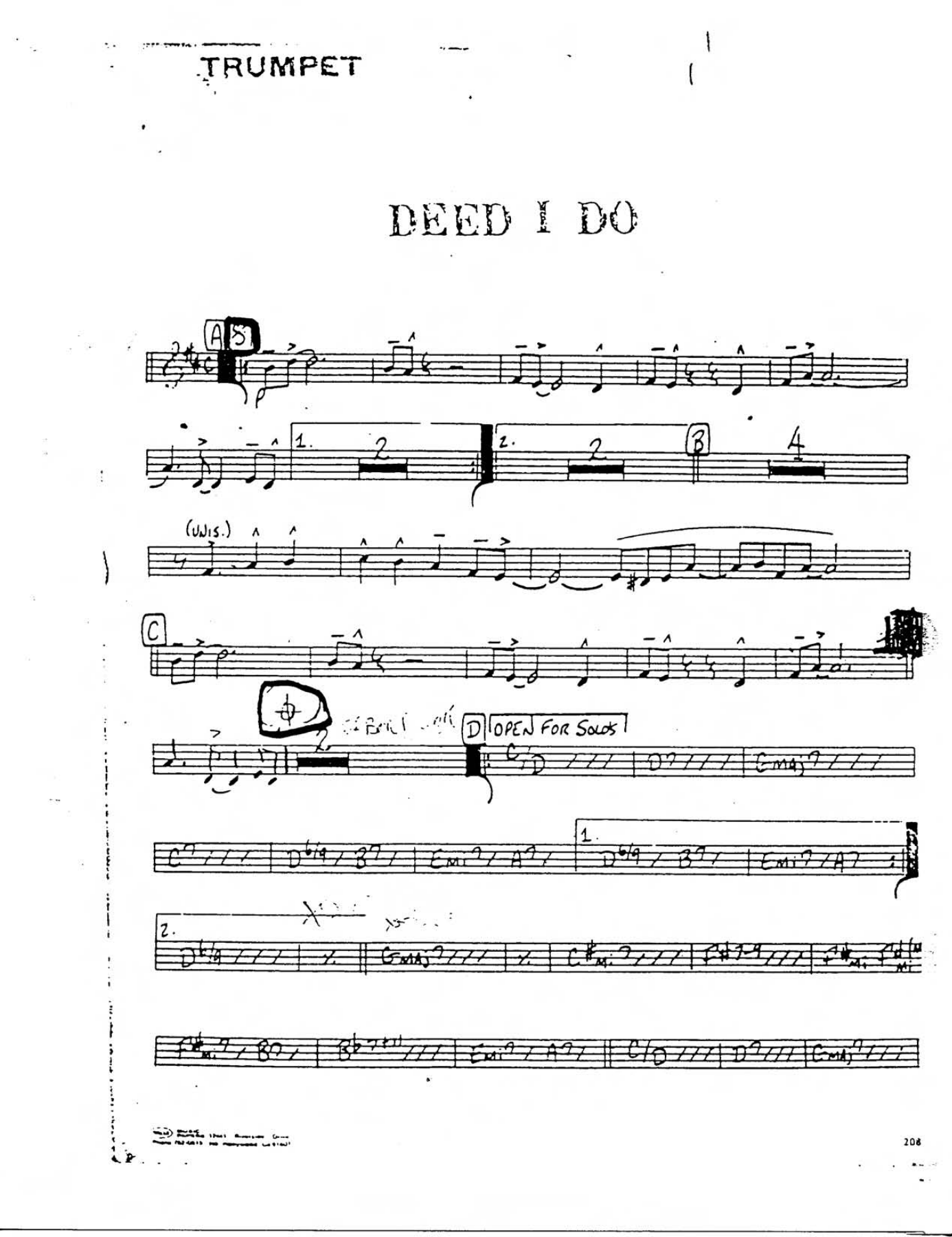
Deed I Do (comp. Fred Rose)
Composed by Fred Rose
Arranged by Rick Stitzel
- Ensemble: Small Ensemble
- Style: Jazz Standard
- Pages: 45
- Instruments (18): Vocal, Alto Sax 1, Alto Sax 2, Tenor Sax 1, Tenor Sax 2, Baritone Sax, Trumpet 1, Trumpet 2, Trumpet 3, Trumpet 4, Trombone 1, Trombone 2, Trombone 3, Trombone 4, Guitar, Piano, Bass, Drums
- Difficulty: easy
- Content: Individual Parts
- Format: PDF Download (Instant)
- Price: $12.99
Written by Fred Rose and Walter Hirsch in 1926, "Deed I Do" rapidly ascended from Tin Pan Alley novelty to an enduring cornerstone of the American songbook. While originally introduced during the roaring twenties, the tune found its true jazz identity through landmark recordings by icons like Anita O'Day, Django Reinhardt, and later modal and mainstream practitioners who relished its cyclical, infectious chord progression. Its deceptively simple AABA form provides a perfect vehicle for jazz interpretation, balancing a playful, syncopated melody with rich harmonic underpinnings that invite both vocalists and instrumentalists to stretch out. This timeless composition captures the quintessential optimism of early jazz while offering enough structural flexibility to remain fresh across generations of stylistic evolution. Bouncing along with an infectious medium-swing feel in 4/4 time, this small ensemble chart radiates a warm, vintage-to-modern energy that immediately engages both the band and the audience. The mood is celebratory, breezy, and unapologetically swinging, driven by a crisp rhythmic pulse and buoyant harmonic voicings. Listeners will instantly recognize the tongue-in-cheek romantic earnestness of the melody, translated here into a sophisticated instrumental dialogue. The arrangement evokes the intimate, high-energy atmosphere of mid-century jazz clubs, where interactive small-group interplay and effortless swing took center stage over dense, wall-of-sound orchestration. Though the specific arranger's identity remains anonymous, the hand behind the manuscript displays a masterclass in classic small-ensemble economy and counterpoint. Eschewing over-wrought, modernistic reharmonizations, this treatment honors the tune's vintage pedigree by prioritizing transparent chord voicings, clever horn conversational fragments, and a smart distribution of thematic material. The 13-page score utilizes tight horn interjections, driving walking basslines, and crisp rhythmic kicks to maintain forward momentum without ever overcrowding the texture. Rather than relying on massive shout choruses, the arrangement builds intensity through dynamic layering, subtle register shifts, and tightly knit ensemble solis that showcase the distinct tonal colors of a compact horn section. Carried initially by the primary lead horn, the melody soon branches out into conversational counter-melodies shared across the ensemble before opening up into dedicated solo changes for key instrumentalists. Technical challenges lie primarily in maintaining a relaxed, micro-timed swing eighth-note feel at a moderate tempo—avoiding both the trap of rushing and the heaviness of playing too straight. Articulation is paramount; performers must execute crisp tongue accents, ghost notes, and subtle slurs that mimic natural vocal phrasing. Advanced high school, collegiate, and professional small groups will find this chart deeply rewarding, as its transparent scoring leaves nowhere to hide, demanding strong individual time, immaculate intonation, and a mature sense of swing vernacular. Success with this arrangement hinges on achieving a relaxed, conversational medium-swing tempo around 120-132 BPM. Conductors should emphasize that the eighth notes must swing naturally, avoiding any tendency toward a stiff, dotted-eighth-and-sixteenth feel. The primary technical challenge involves balancing the ensemble textures so that background figures complement rather than obscure the lead voice. Horn players should practice their counter-melodies at a dynamic level one notch below the primary melody holder. Pay close attention to short-long articulations on upbeat accents to lock in the groove with the rhythm section. Drumners should anchor the track with a feather-light bass drum and a crisp ride cymbal pattern, accentuating beats two and four on the hi-hat. Rehearsals should begin slowly with a metronome clicking exclusively on beats two and four to internalize the pocket before integrating the swinging horn lines. Q: What instruments and parts are included in this 13-page arrangement? A: The score and parts are tailored for a classic jazz small ensemble format, typically featuring configurations for a frontline of horns (such as trumpet and alto/tenor saxophone) alongside a full rhythm section consisting of piano, bass, and drums. Q: What is the overall difficulty level of this chart? A: This arrangement is rated intermediate to advanced, making it ideal for proficient high school groups, collegiate jazz combos, and professional small ensembles looking for a polished, traditional swing chart. Q: What is the historical style and background of "Deed I Do"? A: Composed by Fred Rose in 1926, the tune is a classic Tin Pan Alley standard that transitioned into an essential jazz standard recorded by legendary instrumentalists and vocalists throughout the swing and bebop eras. Q: What makes this particular anonymous arrangement unique? A: It stands out for its clever, transparent small-group voicing and conversational horn writing that honors the 1920s pedigree while utilizing mid-century swing sensibilities to maintain high engagement throughout its 13 pages. Q: What is the suggested performance duration and tempo feel? A: The piece is designed for a breezy, infectious medium-swing feel (around 120–132 BPM) and typically runs between 3 and 4 minutes depending on the number of improvised solo choruses taken.
Questions and answers
- What is included in the Deed I Do (comp. Fred Rose) PDF?
- The verified current file contains a conductor score and individual parts across 45 pages.
- How many instruments or parts are listed for Deed I Do (comp. Fred Rose)?
- The verified instrumentation list contains 18 entries for this Small Ensemble arrangement.
- Who is credited for Deed I Do (comp. Fred Rose)?
- Composer: Fred Rose. Arranger: Rick Stitzel.
- What difficulty is listed for Deed I Do (comp. Fred Rose)?
- The verified difficulty level is easy.
- What style is listed for Deed I Do (comp. Fred Rose)?
- The catalog lists the style as Jazz Standard.
- Can I preview Deed I Do (comp. Fred Rose) before buying?
- Yes. The product page provides a preview generated from the current PDF file.
- How is Deed I Do (comp. Fred Rose) delivered?
- After successful payment, the digital PDF is made available for download. The displayed price is $12.99.
Musicians Also Search For
Deed I Do Rick Stitzel PDF • Deed I Do Rick Stitzel sheet music • Deed I Do arranged by Rick Stitzel • Rick Stitzel small ensemble charts • Rick Stitzel jazz arrangements PDF • Deed I Do Fred Rose sheet music • Deed I Do Fred Rose small ensemble arrangements • Fred Rose small ensemble charts • Deed I Do small ensemble arrangements • Deed I Do small ensemble PDF download • Deed I Do jazz sheet music • small ensemble sheet music download • Deed I Do conductor score PDF • Deed I Do individual parts download • Deed I Do sheet music PDF • Deed I Do Jazz Standard charts • Jazz Standard small ensemble arrangements • buy Deed I Do sheet music • download Deed I Do PDF • Deed I Do jazz charts • best Rick Stitzel small ensemble arrangements • Fred Rose arranged by Rick Stitzel • Deed I Do printable sheet music • small ensemble repertoire PDF