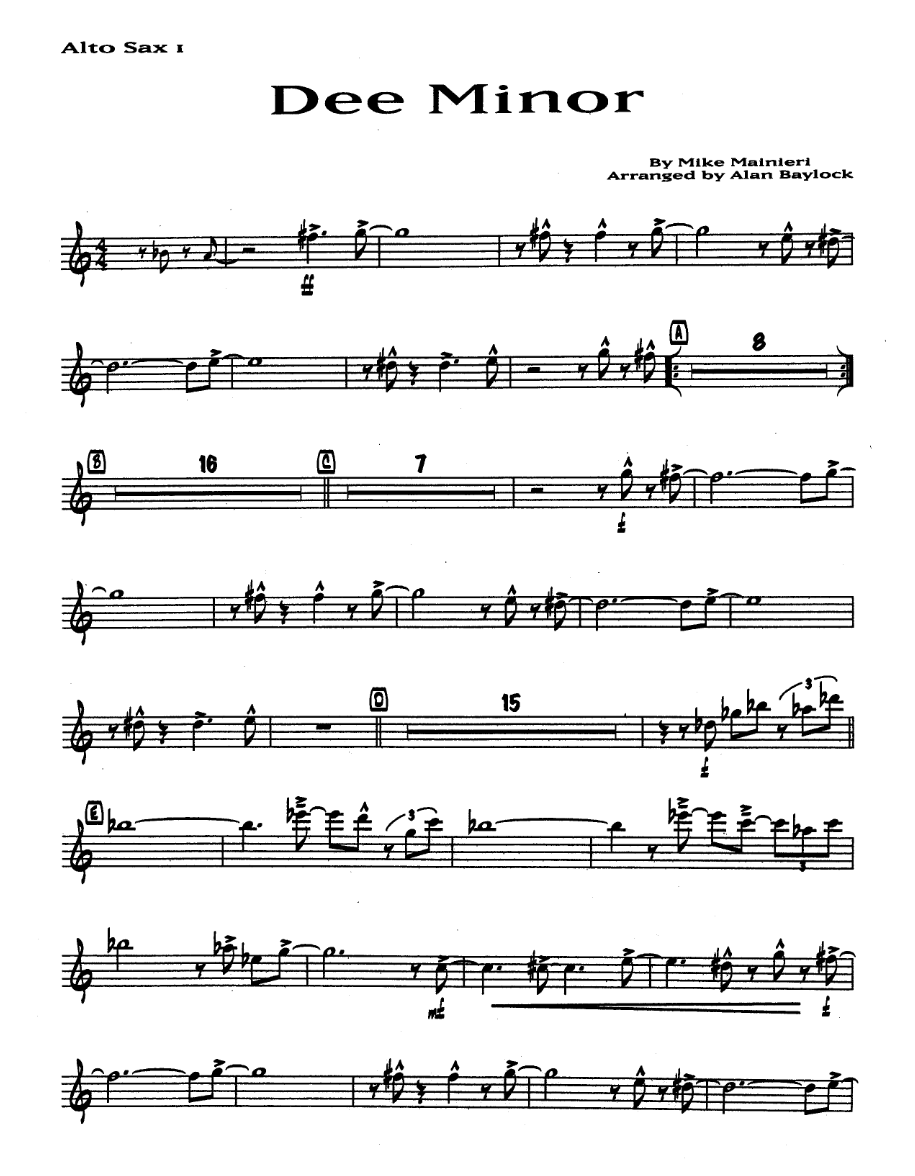
Dee Minor (A.Baylock) sheet music preview

Dee Minor (A.Baylock)

Composed by Alan Baylock

Arranged by A.Baylock

  • Ensemble: Big Band
  • Style: Jazz Standard
  • Pages: 53
  • Instruments (16): Alto Saxophone 1, Alto Saxophone 2, Tenor Saxophone 1, Tenor Saxophone 2, Baritone Saxophone, Trumpet 1, Trumpet 2, Trumpet 3, Trumpet 4, Trombone 1, Trombone 2, Trombone 3, Bass, Piano, Guitar, Drum Set
  • Difficulty: advanced
  • Content: Individual Parts
  • Format: PDF Download (Instant)
  • Price: $24.99

Alan Baylock's "Dee Minor" emerges as a quintessential contemporary big band chart, showcasing the arranger's mastery of modern jazz orchestration. While not a traditional "jazz standard" in the historical sense, Baylock's original compositions, like this one, have become staples in the modern big band repertoire, known for their sophisticated harmonic language, driving rhythms, and engaging solo opportunities. "Dee Minor" embodies the vibrant, post-bop energy characteristic of big band writing from the late 20th and early 21st centuries, reflecting the evolution of the genre beyond its swing era roots into a more complex, yet still highly accessible, sound. It represents the kind of challenging and rewarding material frequently performed by top college and professional ensembles. Musically, "Dee Minor" is an up-tempo, driving swing chart that immediately establishes an energetic yet laid-back groove. The piece is typically set in a minor key, as its title suggests, likely D minor, which lends a slightly darker, more introspective color to its otherwise exuberant feel. The mood is one of sophisticated excitement, propelled by a relentless swing pulse at a brisk tempo, often in the range of 200-220 BPM. Baylock's signature approach is evident in the tightly voiced horn sections, which often feature intricate counterpoint and unexpected harmonic turns. The piece balances powerful full-ensemble passages with moments of delicate interplay, creating a dynamic journey for both performers and listeners. A.Baylock's arrangement of his own composition is a masterclass in modern big band writing. The melody is initially presented by the saxophone section, often in a unison or tightly voiced soli, before being picked up by the brass. Expect Baylock's characteristic use of stacked voicings, extended harmonies, and rhythmic precision. The chart features prominent solo sections, typically for tenor saxophone and trumpet, providing ample space for improvisation over challenging yet rewarding chord changes. The shout choruses are particularly impactful, building tension and release with powerful brass figures and screaming lead trumpet lines, all underpinned by a driving rhythm section. The piece demands a high level of ensemble blend, intonation, and rhythmic accuracy, especially in the fast-paced soli sections and unison figures. "Dee Minor" is ideally suited for advanced high school, collegiate, community, and professional jazz ensembles. Its technical demands, sophisticated harmonic content, and requirement for strong improvisational skills make it an excellent vehicle for showcasing a band's capabilities. Performing this piece is incredibly rewarding, offering musicians the chance to engage with a challenging, well-crafted composition that pushes their technical and musical boundaries, culminating in a thrilling and memorable performance. "Dee Minor" requires a precise and energetic approach to achieve its full impact. The primary technical challenge lies in maintaining rhythmic accuracy and tight ensemble synchronization at a brisk tempo (around quarter note = 200-220 BPM). Emphasize a strong, driving swing feel from the rhythm section, with the bass providing a solid walking line and the drums articulating a crisp ride cymbal pattern. Horn players must focus on clean articulation, especially in the fast soli passages and unison lines, ensuring all notes speak clearly. Intonation in the tightly voiced brass and saxophone sections is crucial. For soloists, encourage exploration of the D minor tonality and its related modes. Rehearsal should prioritize rhythmic subdivision, sectional blend, and dynamic contrast, particularly in the powerful shout choruses and sudden dynamic shifts. No special mutes or extended techniques are typically required beyond standard brass mutes (straight, cup, plunger) where indicated. Q: What instruments and parts are included in this arrangement? A: This arrangement is scored for a standard 17-piece big band: Alto Saxophone 1 & 2, Tenor Saxophone 1 & 2, Baritone Saxophone, Trumpet 1-4, Trombone 1-4 (including bass trombone), Piano, Bass, and Drums. Q: What is the difficulty level of "Dee Minor"? A: "Dee Minor" is considered an advanced-level arrangement, suitable for college, advanced high school, or professional jazz ensembles due to its fast tempo, complex harmonies, and demanding technical passages. Q: What is the musical style and historical context of "Dee Minor"? A: "Dee Minor" is an original contemporary big band composition by Alan Baylock, written in an up-tempo, post-bop swing style. It reflects modern big band writing from the late 20th/early 21st century, characterized by sophisticated harmonies and driving rhythms. Q: What makes this arrangement unique compared to other big band charts? A: This arrangement is unique as an original composition by Alan Baylock, showcasing his signature writing style with intricate voicings, powerful shout choruses, and challenging solo sections, making it a staple in modern big band repertoire. Q: What is the typical performance duration and tempo for "Dee Minor"? A: "Dee Minor" is an up-tempo swing chart, typically performed at a brisk tempo of approximately 200-220 beats per minute. Its performance duration usually ranges from 4 to 6 minutes, depending on the length of the improvised solos.

Musicians Also Search For

Dee Minor A.Baylock PDFDee Minor A.Baylock sheet musicDee Minor arranged by A.BaylockA.Baylock big band chartsA.Baylock jazz arrangements PDFDee Minor Alan Baylock sheet musicDee Minor Alan Baylock big band arrangementAlan Baylock big band chartsDee Minor big band arrangementDee Minor big band PDF downloadDee Minor jazz ensemble sheet musicbig band sheet music instant downloadDee Minor individual parts downloadDee Minor sheet music with partsDee Minor Jazz Standard chartJazz Standard big band arrangementsbuy Dee Minor sheet music onlinedownload Dee Minor PDFDee Minor jazz chartbest A.Baylock big band arrangementsAlan Baylock songs arranged by A.BaylockDee Minor printable sheet musicbig band repertoire PDF

All arrangements by A.Baylock All Alan Baylock sheet music