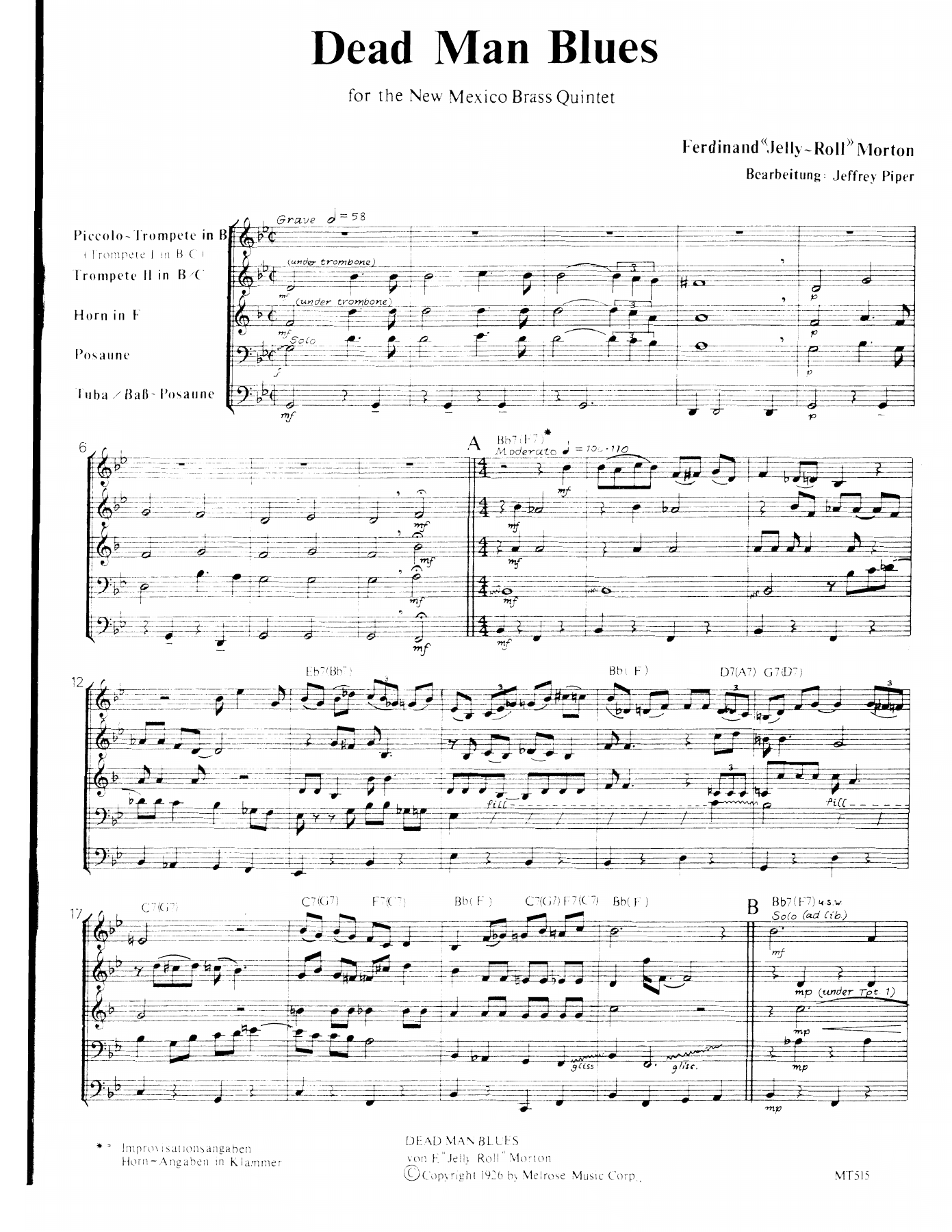
Dead Man Blues (J.R.Morton)
Composed by Jelly Roll Morton
Arranged by Jeffrey Piper
- Ensemble: Small Ensemble
- Style: Jazz Standard
- Pages: 9
- Instruments (5): Bass-Posaune / Tuba, Horn in F, Posaune, Bb Piccolo Tpt. (Tpt. I in Bb), Trompete II in C
- Difficulty: easy
- Content: Individual Parts
- Format: PDF Download (Instant)
- Price: $12.99
Jelly Roll Morton's "Dead Man Blues" stands as a quintessential piece from the nascent era of jazz, first recorded in 1926 by Morton's Red Hot Peppers. This composition is a vibrant sonic snapshot of early New Orleans jazz, embodying the transition from ragtime to a more improvisational and ensemble-driven style. Morton, widely recognized as jazz's first true arranger, proved that the genre's spirit could be retained and enhanced through thoughtful notation. The original recording famously opens with a somber, New Orleans-style funeral dirge, specifically quoting "Flee as a bird to the mountain," before shifting into a celebratory, medium-swing collective improvisation, reflecting the city's unique cultural blend of solemnity and exuberance. This duality, moving from a mournful processional to a lively dance, is central to its character and makes it a jazz standard that captures the very essence of early jazz storytelling. Jeffrey Piper's arrangement of "Dead Man Blues" meticulously honors Morton's groundbreaking vision while presenting it in a format accessible to contemporary small ensembles. Piper, known for his thoughtful and historically informed interpretations, typically approaches classic jazz repertoire with a keen eye for authentic stylistic elements, often incorporating period-specific voicings and rhythmic nuances. This arrangement is no exception, maintaining the original's medium-swing feel and the distinctive key changes that add to its dynamic narrative. The mood oscillates between the initial solemnity and the subsequent spirited celebration, evoking a range of emotions from reflective melancholy to joyous abandon. The arrangement features the iconic opening dirge prominently, setting a powerful, evocative tone before launching into the infectious, driving rhythm that defined Morton's Red Hot Peppers. Performance of this arrangement offers both challenge and immense reward. The melody is shared dynamically, often featuring the clarinet and cornet in intertwined lines, characteristic of New Orleans polyphony. While specific solo sections are indicated, the arrangement also encourages collective improvisation within the established stylistic framework, allowing musicians to engage with the piece's historical roots. Technical challenges include navigating the intricate ensemble interplay, maintaining a cohesive yet flexible medium-swing feel, and executing the stylistic inflections crucial to early jazz, such as subtle glissandi and articulate phrasing. The rewarding aspect lies in recreating the vibrant, communal sound of a classic Red Hot Peppers recording, fostering a deep understanding of jazz history, and delivering a performance that is both historically authentic and musically engaging. This arrangement is ideally suited for college and advanced high school jazz ensembles, as well as community bands with proficient musicians. Its detailed scoring provides a robust framework for learning and performing early jazz, while still offering ample room for individual and collective expression. Professional small ensembles will also find it a refreshing and authentic addition to their repertoire, providing a solid foundation for exploring the nuances of Jelly Roll Morton's genius. The nine-page score and parts are meticulously crafted to guide musicians through the complexities of this seminal work, making it an invaluable educational and performance tool. Conductors should emphasize the stark contrast between the opening funeral dirge and the subsequent medium-swing section. The initial dirge, marked *Largo*, requires a solemn, processional feel, with careful attention to blend and intonation, particularly in the lower brass and reeds. The transition to the main *Medium Swing* tempo should be deliberate, signaling a shift in energy and mood. Encourage musicians to listen intently to each other, especially during the polyphonic sections, to ensure clarity without sacrificing the characteristic New Orleans "controlled chaos." Articulation is key; emphasize short, crisp notes for the rhythmic figures and smooth legato for melodic lines. Trumpet players should be prepared for plunger mute work, and clarinets should focus on a warm, woody tone. Rehearsal should prioritize rhythmic precision in the swing sections and expressive phrasing throughout, paying close attention to the dynamic swells and falls that bring Morton's original recordings to life. **Q: What instruments/parts are included in this arrangement?** A: This small ensemble arrangement typically includes parts for Cornet (or Trumpet), Clarinet, Trombone, Piano, Banjo (or Guitar), Bass, and Drums, reflecting the instrumentation of Jelly Roll Morton's Red Hot Peppers. **Q: What is the difficulty level of this arrangement?** A: This arrangement is rated as intermediate to advanced, suitable for college, proficient high school, and community jazz ensembles, requiring solid technical facility and an understanding of early jazz stylistic nuances. **Q: What is the musical style and historical context of "Dead Man Blues"?** A: "Dead Man Blues" is a classic example of early New Orleans jazz, composed by Jelly Roll Morton in 1926, showcasing the transition from ragtime with its blend of structured arrangement and collective improvisation, famously starting with a funeral dirge. **Q: What makes Jeffrey Piper's arrangement of "Dead Man Blues" unique?** A: Jeffrey Piper's arrangement stands out for its faithful adherence to Morton's original stylistic elements and voicings, meticulously preserving the historical integrity while providing clear, playable parts for modern small jazz ensembles. **Q: What is the approximate performance duration and tempo of this piece?** A: The approximate performance duration for this arrangement is around 3-4 minutes, with a distinct tempo shift from a *Largo* funeral dirge to a driving *Medium Swing* for the main body of the piece.
Questions and answers
- What is included in the Dead Man Blues (J.R.Morton) PDF?
- The verified current file contains a conductor score and individual parts across 9 pages.
- How many instruments or parts are listed for Dead Man Blues (J.R.Morton)?
- The verified instrumentation list contains 5 entries for this Small Ensemble arrangement.
- Who is credited for Dead Man Blues (J.R.Morton)?
- Composer: Jelly Roll Morton. Arranger: Jeffrey Piper.
- What difficulty is listed for Dead Man Blues (J.R.Morton)?
- The verified difficulty level is easy.
- What style is listed for Dead Man Blues (J.R.Morton)?
- The catalog lists the style as Jazz Standard.
- Can I preview Dead Man Blues (J.R.Morton) before buying?
- Yes. The product page provides a preview generated from the current PDF file.
- How is Dead Man Blues (J.R.Morton) delivered?
- After successful payment, the digital PDF is made available for download. The displayed price is $12.99.
Musicians Also Search For
Dead Man Blues Jeffrey Piper PDF • Dead Man Blues Jeffrey Piper sheet music • Dead Man Blues arranged by Jeffrey Piper • Jeffrey Piper small ensemble charts • Jeffrey Piper jazz arrangements PDF • Dead Man Blues Jelly Roll Morton sheet music • Dead Man Blues Jelly Roll Morton small ensemble arrangements • Jelly Roll Morton small ensemble charts • Dead Man Blues small ensemble arrangements • Dead Man Blues small ensemble PDF download • Dead Man Blues jazz sheet music • small ensemble sheet music download • Dead Man Blues conductor score PDF • Dead Man Blues individual parts download • Dead Man Blues sheet music PDF • Dead Man Blues Jazz Standard charts • Jazz Standard small ensemble arrangements • buy Dead Man Blues sheet music • download Dead Man Blues PDF • Dead Man Blues jazz charts • best Jeffrey Piper small ensemble arrangements • Jelly Roll Morton arranged by Jeffrey Piper • Dead Man Blues printable sheet music • small ensemble repertoire PDF