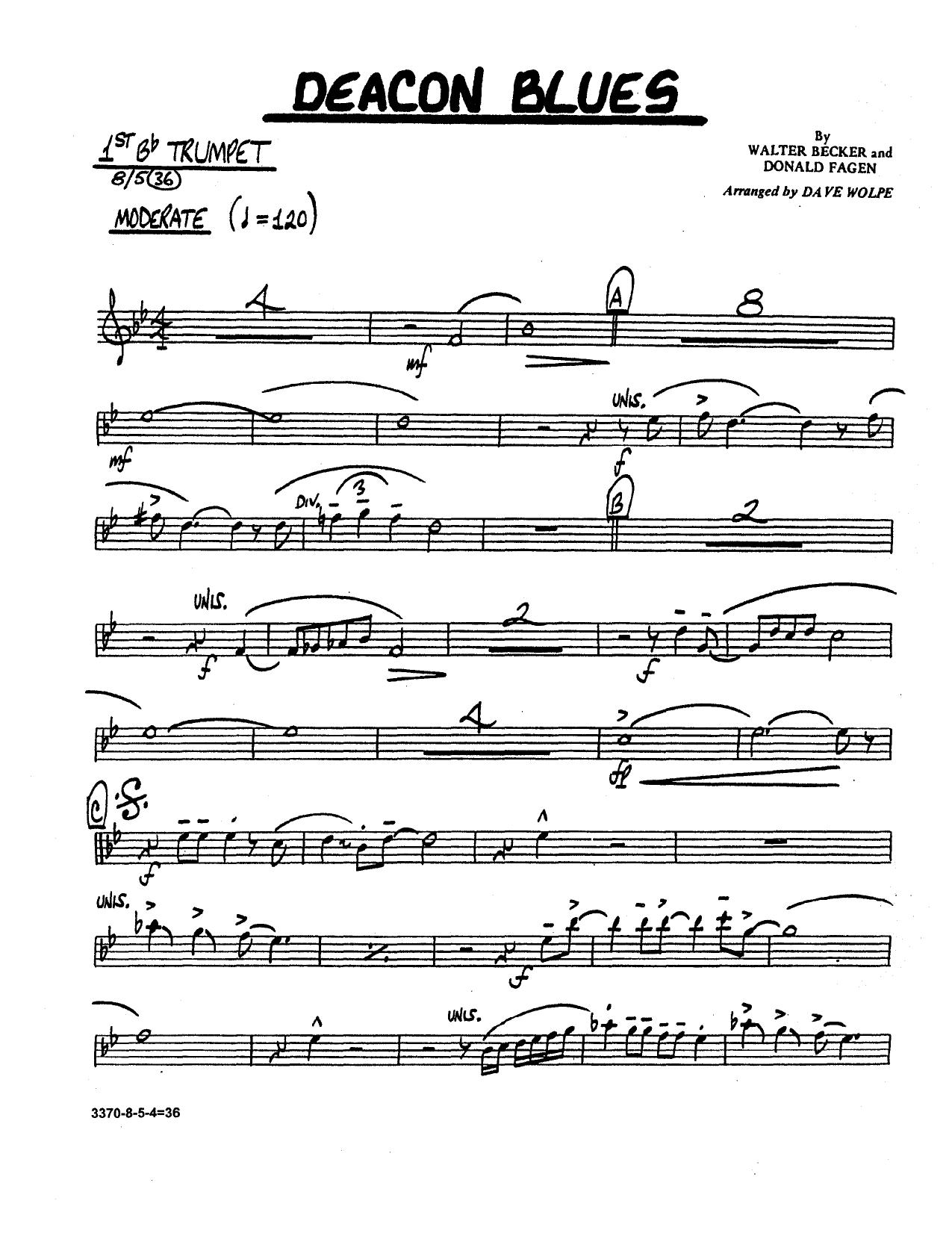
Deacon Blues (D.Wolpe)
Composed by Walter Becker
Arranged by Dave Wolpe
- Ensemble: Big Band
- Pages: 36
- Instruments (17): 1st Bb Trumpet, 2nd Bb Trumpet, 3rd Bb Trumpet, 4th Bb Trumpet, 1st Trombone, 2nd Trombone, 3rd Trombone, Bass Trombone, 1st Eb Alto Sax, 2nd Eb Alto Sax, 1st Bb Tenor Sax, 2nd Bb Tenor Sax, Eb Baritone Sax, Bass, Drums, Guitar, Piano
- Difficulty: medium
- Content: Individual Parts
- Format: PDF Download (Instant)
- Price: $24.99
Steely Dan’s iconic track "Deacon Blues," originally released on their landmark 1977 platinum album *Aja*, stands as a masterpiece of sophisticated pop-jazz fusion. Written by the legendary songwriting partnership of Walter Becker and Donald Fagen, the composition captures the cynical yet romantic disillusionment of a suburban dreamer yearning for a life in jazz. Driven by a sophisticated harmonic vocabulary that bridges post-bop modal jazz and west coast studio pop, the tune immediately resonated with jazz musicians worldwide. Over the decades, it has transitioned from a sophisticated FM radio staple into a revered contemporary standard, interpreted by instrumentalists and large ensembles alike who are drawn to its melancholic beauty and deceptive structural depth. Master arranger Dave Wolpe translates this intricate studio creation into a powerhouse big band chart that retains the lush harmonic complexity of the original while infusing it with vibrant horn textures. Set in a relaxed, flowing medium-tempo groove, the chart captures that signature West Coast laid-back pocket while maintaining an undercurrent of driving momentum. Wolpe utilizes rich, extended chord voicings—frequently employing major sevenths, ninths, and suspended alterations—to recreate the sophisticated Fender Rhodes and guitar textures of the Becker-Fagen composition. The mood shifts fluidly from introspective, smoky verses to soaring, cinematic ensemble passages that evoke late-night metropolitan isolation and quiet aspiration. Wolpe’s arrangement cleverly distributes melodic duties across the ensemble, ensuring that every section shares in the storytelling. The woodwinds open with the instantly recognizable vamp, quickly giving way to rich saxophone solis that highlight tight sectional blend and subtle dynamic shading. The brass section is deployed judiciously, providing warm, cushioned pads underneath the vocal-like phrasing of the horns, and later erupting into powerful, harmonically rich shout choruses that elevate the emotional intensity without ever forcing the volume. Featured solo opportunities allow standout improvisers in the band to stretch out over a contemporary jazz-rock progression, echoing the spirit of the legendary sax solos from the original recording. Advanced high school, collegiate, and professional community big bands will find this 17-instrument chart an immensely rewarding addition to their repertoire. While the individual technical demands across the five saxophones, four trumpets, four trombones, and four-piece rhythm section are manageable for proficient players, the primary challenge—and reward—lies in achieving the sophisticated ensemble cohesion and stylistic unity required to sell the groove. Achieving the right balance between the laid-back rhythm section feel and the precise, polished horn articulations will test a band's maturity, making it a stellar showcase piece for festival programs or sophisticated concert sets. Getting the most out of Dave Wolpe’s arrangement of "Deacon Blues" requires a careful approach to the rhythm section groove and the overall micro-timing of the ensemble. The tempo should sit comfortably in a relaxed medium pocket; dragging will kill the momentum, while pushing will ruin the relaxed, nocturnal mood. The rhythm section is the engine here—the drummer must lock in a steady, understated backbeat with clean hi-hat work that mimics Bernard Purdie’s legendary pocket without overplaying. Brass players should focus on warm, rounded tones rather than aggressive edge, particularly in the muted passages and background figures. Pay close attention to dynamic markings during the transition from the subdued verses into the broader, open ensemble sections. Directors should rehearse the sax soli slowly, ensuring absolute uniformity in articulation, phrasing, and vibrato before bringing it up to performance tempo. Encourage soloists to lean into the modal shifts and reference the blues-inflected, lyrical style of the original recording rather than relying strictly on rapid-fire bebop lines. Q: What specific instruments and parts are included in this 17-instrument arrangement? A: The instrumentation features a standard big band lineup comprising 5 saxophones (Alto 1, Alto 2, Tenor 1, Tenor 2, Baritone), 4 trumpets, 4 trombones, and a 4-piece rhythm section consisting of piano, guitar, bass, and drums, spread across a 36-page score and parts set. Q: What is the difficulty level of this Dave Wolpe arrangement? A: This arrangement is graded as advanced, making it ideal for upper-level high school, collegiate, and professional community big bands that have strong section balance and a mature rhythm section capable of handling sophisticated contemporary jazz-rock feels. Q: What is the musical style and historical background of this piece? A: Originally composed by Walter Becker for Steely Dan's 1977 album *Aja*, this chart translates a classic sophisti-pop jazz-fusion masterpiece into an expansive big band setting rich with extended harmonies and a relaxed groove. Q: What makes this specific arrangement by Dave Wolpe unique? A: Wolpe expertly adapts complex studio-produced chord voicings into lush horn solis and dynamic shout choruses, capturing the melancholic, cinematic essence of the original recording while tailored specifically for big band textures. Q: What is the performance duration and recommended tempo for this chart? A: While performance duration typically spans around 4 to 5 minutes depending on the length of improvised solos, the chart is anchored by a steady, relaxed medium tempo that requires strict internal timekeeping from the rhythm section.
Questions and answers
- What is included in the Deacon Blues (D.Wolpe) PDF?
- The verified current file contains individual parts across 36 pages.
- How many instruments or parts are listed for Deacon Blues (D.Wolpe)?
- The verified instrumentation list contains 17 entries for this Big Band arrangement.
- Who is credited for Deacon Blues (D.Wolpe)?
- Composer: Walter Becker. Arranger: Dave Wolpe.
- What difficulty is listed for Deacon Blues (D.Wolpe)?
- The verified difficulty level is medium.
- Can I preview Deacon Blues (D.Wolpe) before buying?
- Yes. The product page provides a preview generated from the current PDF file.
- How is Deacon Blues (D.Wolpe) delivered?
- After successful payment, the digital PDF is made available for download. The displayed price is $24.99.
Musicians Also Search For
Deacon Blues Dave Wolpe PDF • Deacon Blues Dave Wolpe sheet music • Deacon Blues arranged by Dave Wolpe • Dave Wolpe big band charts • Dave Wolpe jazz arrangements PDF • Deacon Blues Walter Becker sheet music • Deacon Blues Walter Becker big band arrangements • Walter Becker big band charts • Deacon Blues big band arrangements • Deacon Blues big band PDF download • Deacon Blues jazz sheet music • big band sheet music download • Deacon Blues individual parts download • Deacon Blues sheet music PDF • buy Deacon Blues sheet music • download Deacon Blues PDF • Deacon Blues jazz charts • best Dave Wolpe big band arrangements • Walter Becker arranged by Dave Wolpe • Deacon Blues printable sheet music • big band repertoire PDF